Abstract
This repository contains the data used in statistical analysis and the analaysis scripts for the publication described below. Abstract of the manuscript: Background European apple canker, caused by Neonectria ditissima, remains a major constraint to sustainable apple production, with limited chemical control options and no microbiome-based solutions currently available. Recent correlative studies link high relative abundance of Sphingomonas taxa in leaf scar tissues with reduced canker severity, suggesting a potential role for targeted microbiome manipulation. However, whether Sphingomonas can establish in planta, affect plant growth and influence resident microbial communities across plant compartments remains unresolved. Results Apple ‘M9’ rootstocks were inoculated at planting with consortia of apple-derived Sphingomonas strains, and effects on plant growth and microbial communities in roots, rhizosphere, and leaf scars were assessed. Inoculation did not enhance plant growth (height, girth, biomass) nor increase the relative abundance of Sphingomonas in any compartment. Nevertheless, significant shifts in microbial alpha diversity were observed, particularly in root and rhizosphere communities, indicating a measurable impact on community structure despite the lack of detectable inoculant establishment. These changes occurred without significant effects on beta diversity or on the relative abundance of taxa belowground. In contrast, root inoculation significantly altered fungal community composition in leaf scar tissues, reducing the relative abundance of several genera containing known plant pathogens, including Gnomoniopsis, Phomopsis, Ilyonectria robusta, Neofabraea actinidiae, and Perenniporia fraxinea. Marked differences between younger and older leaf scar tissues further indicated a strong influence of external inoculum sources on aboveground microbiota. Conclusions This study demonstrates that root-applied microbiome amendments can exert cross-compartment effects on aboveground fungal communities in a perennial crop, even in the absence of sustained colonisation by the inoculated taxa. The observed reduction in potential pathogens in leaf scars provides a plausible mechanistic link to previously reported associations between Sphingomonas abundance and reduced apple canker severity. More broadly, the results reveal a decoupling between inoculant persistence and microbiome restructuring, highlighting a new possibility for microbiome engineering in woody hosts. Optimising delivery strategies and understanding temporal colonisation dynamics will be critical for translating microbiome-based interventions into effective disease management tools.
Abstract from the paper’s OpenAlex record; open copy licensed cc-by. Read at the source ↗
The text the model read, with the source record’s inline markup (italics, sub- and superscripts) rendered and its character entities decoded; quote offsets refer to the raw text.
Claims 14
Claim · model-written summary
Inoculation with apple-derived Sphingomonas strains did not enhance growth (height, girth, biomass) of M9 rootstocks.
- Taxon
- Malus domestica
 Malus domesticat0
- Material
- M9e0
- Treatment
- consortia of apple-derived Sphingomonas strainse0
- Interactor
- Sphingomonas
 Sphingomonase0symbiont
- Outcome
- plant growth (height, girth, biomass)e1
- Direction
- did not enhancee1
Not reportedComparator
Organisms pictured · Representative pictures of the matched species, not figures from the paper.


Verbatim
t0“apple (Malus domestica) rootstock”
e0“Apple ‘M9’ rootstocks were inoculated at planting with consortia of apple-derived Sphingomonas strains”
e1“Inoculation did not enhance plant growth (height, girth, biomass) nor increase the relative abundance of Sphingomonas in any compartment”
Claim · model-written summary
Inoculation did not increase the relative abundance of Sphingomonas in any compartment.
- Taxon
- Malus domesticaMalus domesticat0
- Treatment
- Inoculatione1
- Interactor
- SphingomonasSphingomonase1symbiont
- Outcome
- relative abundance of Sphingomonase1
- Direction
- nor increasee1
- Qualifier
- in any compartmente1
Not reportedComparator
Organisms pictured · Representative pictures of the matched species, not figures from the paper.
Verbatim
t0“apple (Malus domestica) rootstock”
e1“Inoculation did not enhance plant growth (height, girth, biomass) nor increase the relative abundance of Sphingomonas in any compartment”
Claim · model-written summary
Inoculation significantly shifted microbial alpha diversity, particularly in root and rhizosphere communities.
- Taxon
- Malus domesticaMalus domesticat0
- Organ / stage
- root and rhizosphere communitiese2
- Treatment
- consortia of apple-derived Sphingomonas strainse0
- Outcome
- microbial alpha diversitye2
Not reportedComparatorDirection
Organisms pictured · Representative pictures of the matched species, not figures from the paper.
Verbatim
t0“apple (Malus domestica) rootstock”
e0“Apple ‘M9’ rootstocks were inoculated at planting with consortia of apple-derived Sphingomonas strains”
e2“Nevertheless, significant shifts in microbial alpha diversity were observed, particularly in root and rhizosphere communities”
Claim · model-written summary
Inoculation had no significant effect on beta diversity.
- Taxon
- Malus domesticaMalus domesticat0
- Treatment
- consortia of apple-derived Sphingomonas strainse0
- Outcome
- beta diversitye3
- Direction
- without significant effectse3
Not reportedComparator
Organisms pictured · Representative pictures of the matched species, not figures from the paper.
Verbatim
t0“apple (Malus domestica) rootstock”
e0“Apple ‘M9’ rootstocks were inoculated at planting with consortia of apple-derived Sphingomonas strains”
e3“These changes occurred without significant effects on beta diversity or on the relative abundance of taxa belowground”
Claim · model-written summary
Inoculation had no significant effect on the relative abundance of taxa belowground.
- Taxon
- Malus domesticaMalus domesticat0
- Treatment
- consortia of apple-derived Sphingomonas strainse0
- Outcome
- relative abundance of taxa belowgrounde3
- Direction
- without significant effectse3
Not reportedComparator
Organisms pictured · Representative pictures of the matched species, not figures from the paper.
Verbatim
t0“apple (Malus domestica) rootstock”
e0“Apple ‘M9’ rootstocks were inoculated at planting with consortia of apple-derived Sphingomonas strains”
e3“These changes occurred without significant effects on beta diversity or on the relative abundance of taxa belowground”
Claim · model-written summary
Root inoculation significantly altered fungal community composition in leaf scar tissues.
- Taxon
- Malus domesticaMalus domesticat0
- Organ / stage
- leaf scar tissuese4
- Treatment
- root inoculatione4
- Outcome
- fungal community compositione4
- Direction
- significantly alterede4
Not reportedComparator
Organisms pictured · Representative pictures of the matched species, not figures from the paper.
Verbatim
t0“apple (Malus domestica) rootstock”
e4“root inoculation significantly altered fungal community composition in leaf scar tissues, reducing the relative abundance of several genera containing known plant pathogens, including Gnomoniopsis, Phomopsis, Ilyonectria robusta, Neofabraea actinidiae, and Perenniporia fraxinea”
Claim · model-written summary
Root inoculation reduced the relative abundance of Gnomoniopsis.
- Taxon
- Malus domesticaMalus domesticat0
- Treatment
- root inoculatione4
- Interactor
- Gnomoniopsis
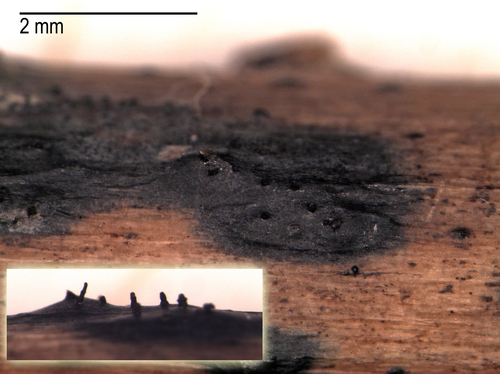
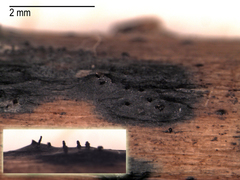 Gnomoniopsise4pathogen
- Outcome
- relative abundance of several genera containing known plant pathogense4
- Direction
- reducinge4
Not reportedComparator
Organisms pictured · Representative pictures of the matched species, not figures from the paper.
Verbatim
t0“apple (Malus domestica) rootstock”
e4“root inoculation significantly altered fungal community composition in leaf scar tissues, reducing the relative abundance of several genera containing known plant pathogens, including Gnomoniopsis, Phomopsis, Ilyonectria robusta, Neofabraea actinidiae, and Perenniporia fraxinea”
Claim · model-written summary
Root inoculation reduced the relative abundance of Phomopsis.
- Taxon
- Malus domesticaMalus domesticat0
- Treatment
- root inoculatione4
- Outcome
- relative abundance of several genera containing known plant pathogense4
- Direction
- reducinge4
 Phomopsis
Not reportedComparator
Organisms pictured · Representative pictures of the matched species, not figures from the paper.

Verbatim
t0“apple (Malus domestica) rootstock”
e4“root inoculation significantly altered fungal community composition in leaf scar tissues, reducing the relative abundance of several genera containing known plant pathogens, including Gnomoniopsis, Phomopsis, Ilyonectria robusta, Neofabraea actinidiae, and Perenniporia fraxinea”
Claim · model-written summary
Root inoculation reduced the relative abundance of Ilyonectria robusta.
- Taxon
- Malus domesticaMalus domesticat0
- Treatment
- root inoculatione4
- Interactor
- Ilyonectria robustaIlyonectria robustae4pathogen
- Outcome
- relative abundance of several genera containing known plant pathogense4
- Direction
- reducinge4
Not reportedComparator
Organisms pictured · Representative pictures of the matched species, not figures from the paper.
Verbatim
t0“apple (Malus domestica) rootstock”
e4“root inoculation significantly altered fungal community composition in leaf scar tissues, reducing the relative abundance of several genera containing known plant pathogens, including Gnomoniopsis, Phomopsis, Ilyonectria robusta, Neofabraea actinidiae, and Perenniporia fraxinea”
Claim · model-written summary
Root inoculation reduced the relative abundance of Neofabraea actinidiae.
- Taxon
- Malus domesticaMalus domesticat0
- Treatment
- root inoculatione4
- Interactor
- Neofabraea actinidiaeNeofabraea actinidiaee4pathogen
- Outcome
- relative abundance of several genera containing known plant pathogense4
- Direction
- reducinge4
Not reportedComparator
Organisms pictured · Representative pictures of the matched species, not figures from the paper.
Verbatim
t0“apple (Malus domestica) rootstock”
e4“root inoculation significantly altered fungal community composition in leaf scar tissues, reducing the relative abundance of several genera containing known plant pathogens, including Gnomoniopsis, Phomopsis, Ilyonectria robusta, Neofabraea actinidiae, and Perenniporia fraxinea”
Claim · model-written summary
Root inoculation reduced the relative abundance of Perenniporia fraxinea.
- Taxon
- Malus domesticaMalus domesticat0
- Treatment
- root inoculatione4
- Interactor
- Perenniporia fraxinea
 Perenniporia fraxineae4pathogen
- Outcome
- relative abundance of several genera containing known plant pathogense4
- Direction
- reducinge4
Not reportedComparator
Organisms pictured · Representative pictures of the matched species, not figures from the paper.

Verbatim
t0“apple (Malus domestica) rootstock”
e4“root inoculation significantly altered fungal community composition in leaf scar tissues, reducing the relative abundance of several genera containing known plant pathogens, including Gnomoniopsis, Phomopsis, Ilyonectria robusta, Neofabraea actinidiae, and Perenniporia fraxinea”
Claim · model-written summary
Leaf scar tissues showed marked differences between younger and older tissues in aboveground microbiota.
- Taxon
- Malus domesticaMalus domesticat0
- Organ / stage
- leaf scar tissuese5
- Outcome
- differences between younger and older leaf scar tissuese5
Organisms pictured · Representative pictures of the matched species, not figures from the paper.
Verbatim
t0“apple (Malus domestica) rootstock”
e5“Marked differences between younger and older leaf scar tissues further indicated a strong influence of external inoculum sources on aboveground microbiota”
Claim · model-written summary
The reduction in potential pathogens in leaf scars is a plausible mechanistic link to reduced apple canker severity.
- Taxon
- Malus domesticaMalus domesticat0
- Organ / stage
- leaf scarse6
- Outcome
- reduction in potential pathogens in leaf scarse6
- Qualifier
- plausible mechanistic linke6
Organisms pictured · Representative pictures of the matched species, not figures from the paper.
Verbatim
t0“apple (Malus domestica) rootstock”
e6“The observed reduction in potential pathogens in leaf scars provides a plausible mechanistic link to previously reported associations between Sphingomonas abundance and reduced apple canker severity”
Claim · model-written summary
Inoculant persistence was decoupled from microbiome restructuring.
- Taxon
- Malus domesticaMalus domesticat0
- Outcome
- a decoupling between inoculant persistence and microbiome restructuringe7
Organisms pictured · Representative pictures of the matched species, not figures from the paper.
Verbatim
t0“apple (Malus domestica) rootstock”
e7“the results reveal a decoupling between inoculant persistence and microbiome restructuring”
The same questions in other papers
inoculation · Sphingomonas · Malus domestica (apple)Results agree
1 paper in the same direction as this paper
- no effect
inoculation · Gnomoniopsis · Malus domestica (apple)Results agree
1 paper in the same direction as this paper
- positive
Claims are grouped by organism, treatment and what was measured or targeted. A paper counts as positive when any of its claims in the group is positive.