View: List Claim type Research area Organism Taxon as written Decade Paper Method / resource observed original result basis n/a Claim · model-written summary
The Nepenthes maxima cultivar Lake Poso is described.
Nepenthes maxima 'Lake Poso'e0 Nepenthes maxima 'Lake Poso'e0 Not reported Comparator Value
Verbatim
e0 “Nepenthes maxima 'Lake Poso' ”
✓ located verbatim in the source · abstract, characters 54–82 Other claims from this paper (5) Observation observed original result measured Claim · model-written summary
Five C. maxima varieties were suitable for spring cultivation.
fit for cultivating in spring e0 Verbatim
e0 “five varieties of C. maxima were fit for cultivating in spring ”
✓ located verbatim in the source · abstract, characters 126–187 t0 “Cucurbita maxima
✓ located verbatim in the source · title, characters 34–50 Other claims from this paper (5) Recommendation author interpretation original result basis n/a Claim · model-written summary
C. maxima varieties should be stem-regulated.
should be stem-regulated e0 Verbatim
e0 “five varieties of C. maxima were fit for cultivating in spring and should be stem-regulated ”
✓ located verbatim in the source · abstract, characters 126–216 t0 “Cucurbita maxima
✓ located verbatim in the source · title, characters 34–50 Other claims from this paper (5) Association observed original result measured Claim · model-written summary
The CH4 emission maxima often matched the maxima of daily mean air temperature.
CH 4 emission maxima e2 maxima of daily mean air temperature e2 Verbatim
e0 “Seasonal variations in CH 4 emission rates from rice paddies ”
✓ located verbatim in the source · abstract, characters 0–60 e2 “the CH 4 emission maxima often matched the maxima of daily mean air temperature ”
✓ located verbatim in the source · abstract, characters 703–782 Other claims from this paper (6) Observation observed original result measured Claim · model-written summary
Aneura maxima is newly reported from Thailand.
Verbatim
e0 “one hepatic (Aneura maxima ) ”
✓ located verbatim in the source · abstract, characters 76–103 Other claims from this paper (1) Observation observed original result basis n/a Claim · model-written summary
Porella maxima is a new combination.
Verbatim
e7 “P. maxima (Steph.) M. L. So, comb. nov. ”
✓ located verbatim in the source · abstract, characters 312–351 Other claims from this paper (10) Observation observed original result measured Claim · model-written summary
Aneura maxima is newly reported in the Slovak Republic.
Verbatim
e0 “Aneura maxima is reported as new to the Slovak Republic. ”
✓ located verbatim in the source · abstract, characters 0–56 Other claims from this paper (1) Observation observed original result positive measured Claim · model-written summary
The bush trait was transferred from Cucurbita moschata to C. maxima .
Cucurbita moschata e0 Verbatim
e0 “The bush trait in Cucurbita moschata was successfully transferred to C. maxima
✓ located verbatim in the source · abstract, characters 0–77 Other claims from this paper (3) Association author interpretation original result measured Claim · model-written summary
At low nitrate, G. maxima strongly influenced the nitrate-reducing community.
presence of G. maxima e0 nitrate-reducing community e0 when the nitrate concentration was low e0 Not reported Direction
Verbatim
e0 “when the nitrate concentration was low, the presence of G. maxima greatly influenced the nitrate-reducing community. ”
✓ located verbatim in the source · abstract, characters 1057–1173 t0 “Glyceria maxima
✓ located verbatim in the source · title, characters 17–32 Other claims from this paper (5) Method / resource observed original result measured Claim · model-written summary
The markers applied to Cucurbita maxima at 18 markers.
Verbatim
e0 “Cucurbita maxima (18 markers) ”
✓ located verbatim in the source · abstract, characters 888–917 Other claims from this paper (5) Lexical search (BM25). All words must match; if nothing does, any word. Organism names also match every spelling of the same organism. No semantic search yet.
 Nepenthes maximae0
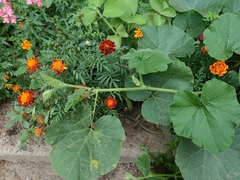 Cucurbita maxima
 Oryza sativa
 Aneura maxima
 Glyceria maxima