View: List Claim type Research area Organism Taxon as written Decade Paper Method / resource observed original result basis n/a Claim · model-written summary
The Nepenthes maxima cultivar Lake Poso is described.
Nepenthes maxima 'Lake Poso'e0 Nepenthes maxima 'Lake Poso'e0 Not reported Comparator Value
Verbatim
e0 “Nepenthes maxima 'Lake Poso' ”
✓ located verbatim in the source · abstract, characters 54–82 Other claims from this paper (5) Method / resource observed original result negative simulated Claim · model-written summary
That adjustment gave predicted maxima about 25% below observations.
predicted maxima e0 observed maxima e0 Not reported Taxon
Verbatim
e0 “predicted maxima approximately 25% less than the observed maxima ”
✓ located verbatim in the source · abstract, characters 1308–1372 Other claims from this paper (5) Method / resource observed original result measured Claim · model-written summary
The linkage analysis revealed 20 genetic linkage groups of Cucurbita maxima .
genetic linkage groups e0 Verbatim
t0 “Cucurbita maxima
✓ located verbatim in the source · title, characters 23–39 e0 “revealed 20 genetic linkage groups of C. maxima
✓ located verbatim in the source · abstract, characters 309–356 Other claims from this paper (3) Method / resource observed original result measured Claim · model-written summary
The Cucurbita maxima linkage map covers a genetic distance of 991.5 cM.
genetic distance e0 Verbatim
t0 “Cucurbita maxima
✓ located verbatim in the source · title, characters 23–39 e0 “covering a genetic distance of 991.5 cM ”
✓ located verbatim in the source · abstract, characters 357–396 Other claims from this paper (3) Method / resource observed original result measured Claim · model-written summary
The markers applied to Cucurbita maxima at 18 markers.
Verbatim
e0 “Cucurbita maxima (18 markers) ”
✓ located verbatim in the source · abstract, characters 888–917 Other claims from this paper (5) Method / resource observed original result measured Claim · model-written summary
The average distance between adjacent markers on the Cucurbita maxima linkage map is 12.1 cM.
between adjacent markers e0 Verbatim
t0 “Cucurbita maxima
✓ located verbatim in the source · title, characters 23–39 e0 “an average of 12.1 cM between adjacent markers ”
✓ located verbatim in the source · abstract, characters 402–448 Other claims from this paper (3) Method / resource observed original result positive simulated Claim · model-written summary
Regression modeling placed growth maxima at or before three applications.
Verbatim
e0 “Regression modeling quantitatively defined the optimal spray frequency, with growth maxima occurring at or before 3 applications ”
✓ located verbatim in the source · abstract, characters 1197–1325 t0 “soybean ”
✓ located verbatim in the source · title, characters 57–64 Other claims from this paper (9) Method / resource author interpretation original result basis n/a Claim · model-written summary
The growth-regulatory process of maize primary roots can be modelled in terms of auxin and other regulators, with cell-associated maxima and maxima propagating through the tissue.
plant growth-regulatory process e2 cell-associated maxima of regulator concentration e2 Verbatim
t0 “zea mays Primary Roots ”
✓ located verbatim in the source · title, characters 38–60 e2 “model the plant growth-regulatory process in terms of auxin and other regulators, considering both cell-associated maxima of regulator concentration and maxima which propagate through the tissue ”
✓ located verbatim in the source · abstract, characters 559–753 Other claims from this paper (1) Method / resource author interpretation original result positive measured Claim · model-written summary
The authors identify Glyceria maxima sprouts as potentially useful for Mn biomonitoring.
biomonitoring environmental contamination with Mn e0 Not reported Comparator Value
Verbatim
e0 “the sprouts of Glyceria maxima are potentially useful in biomonitoring environmental contamination with Mn. ”
✓ located verbatim in the source · abstract, characters 1617–1724 Other claims from this paper (8) Method / resource observed original result basis n/a Claim · model-written summary
A complete genome assembly of pumpkin (Cucurbita maxima ) provides insights into its centromere architecture.
Complete genome assembly t0 Not reported Value
Verbatim
t0 “Complete genome assembly provides insights into the centromere architecture of pumpkin (Cucurbita maxima ) ”
✓ located verbatim in the source · title, characters 0–105 Lexical search (BM25). All words must match; if nothing does, any word. Organism names also match every spelling of the same organism. No semantic search yet.
 Nepenthes maximae0
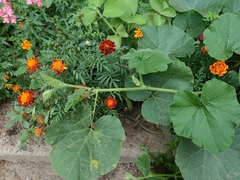 Cucurbita maxima
 Glycine max
 Zea mays
 Glyceria maxima