Claim · model-written summary
E. nigromaculatus and S. pygmaeus are reported for the first time on P. passerinii.
- Taxon
- P. passeriniiPhloeomyzus passeriniie1
- Interactor
- P. passeriniiPhloeomyzus passeriniie1pest
- Second interactor
- E. nigromaculatus and S. pygmaeus
 Sympherobius pygmaeus
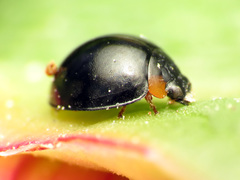 Parexochomus nigromaculatuse0biocontrol_agent
- Outcome
- reported for the first timee1
Verbatim
e0“The species, E. nigromaculatus and S. pygmaeus”
e1“are reported for the first time on P. passerinii”
Title
Saeid Moharramipour; N. A. Rajabi-Mazhar; S. E. Sadeghi DOAJ (DOAJ: Directory of Open Access Journals) 2007
Other claims from this paper (10)
- Observation Seven poplar clones (Populus alba 58/57, P. deltoides 72/51, P. deltoides missoriensis, P. x. euramericana 214, P. nigra 62/72, 62/140 and 62/149) were immune to the woolly poplar aphid.
- Observation The remaining P. nigra clones were infested to varying degrees.
- Observation Analysis of variance showed a significant difference in aphid infestation between the poplar clones.
- Association Mean infestation of P. nigra 56/72 was significantly higher than that of the other studied clones at all sampling dates.
- Association Mean infestation of branches at the four main geographical directions of the tree differed significantly at the first sampling date.
- Association Mean infestation of branches at the four main geographical directions of the tree did not differ significantly at the two other sampling dates.
- Observation Natural enemies of the aphid collected in the region were Exochomus nigromaculatus, Chilocorus bipustulatus, Sympherobius pygmaeus, Anthocoris sp., Orius sp. and Chiracanthium sp.
- Observation The parasitoid species Thaumatomyia elongatula and Pachyneuron sp. are reported for the first time on this pest from Iran.
- Observation Mean density of T. elongatula and S. pygmaeus was higher than other natural enemy species, and they fell in the same LSD test class.
- Observation Mean density of the parasitoid wasp Pachyneuron sp. was lower than that of other natural enemies.