Claim · model-written summary
In Pulchellodromus glaucinus fed on T. urticae and A. gossypii, incubation periods differed significantly between constant temperatures; the shortest was at 30°C and the longest at 25°C.
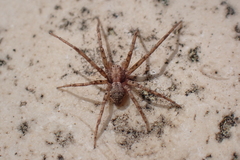 Pulchellodromus glaucinus
Verbatim
e0“Biological studied to the common spider species, Pulchellodromus glaucinus (Simon) (Araneae: Philodromidae) was studied when feeding on Tetranychus urticae and Aphis gossypii at 25 and 30°C under laboratory conditions”
e1“It was significantly different between the constant temperatures, the shortest incubation period of male and female was recorded at 30°C and the longest period was recorded at 25°C”
Title
Advanced studies on spiders associated with pests on cotton plants in Egypt
Ahmed Mohamed Mansour Mohamed; M. E. M Sweelam; H. M Heikal; et al. Menoufia Journal of Plant Protection 2022. doi:10.21608/mjapam.2022.273829
Other claims from this paper (18)
- Observation At Qaha station, Qalyubia governorate, the spiders on cotton belonged to 17 families, 35 genera and 41 species.
- Observation At Beni-Suef governorate the spiders on cotton belonged to nine families, 27 genera and 34 species.
- Observation The most abundant spider families were Philodromidae, Theridiidae, Salticidae, Thomisidae and Cheiracanthiidae.
- Observation The spider species with the highest percentage frequency of occurrence were Thanatus albini, Cheiracanthium inclusum, Dictyna innocens and Pulchellodromus glaucinus at Beni-Suef and Qalyubia governorates.
- Observation The two-spotted spider mite Tetranychus urticae increased from mid-May and peaked in mid-August on cotton.
- Observation The cotton aphid Aphis gossypii was at moderate numbers in mid-May and gradually increased to June.
- Observation Spiders associated with cotton peaked in mid-July.
- Association The combined effect of weather factors on the population dynamics of T. urticae and A. gossypii was insignificant over the two seasons and locations in most cases.
- Association Plant age, fitted as a third-degree polynomial, had a much more significant effect on pest population dynamics than weather factors.
- Observation Female P. glaucinus fed on A. gossypii at 30 °C had the shortest total spiderling period, 61.0 days.
- Observation Male P. glaucinus fed on A. gossypii at 30 °C had the shortest total spiderling period, 49.3 days.
- Observation Female P. glaucinus fed on mixed T. urticae + A. gossypii at 25°C had the longest total spiderling period, 72.8 days.
- Observation Male P. glaucinus fed on the same mixed food at 30°C had a total spiderling period of 56.8 days.
- Observation The longest longevity of P. glaucinus, 8.0 days (male) and 28.3 days (female), occurred at 25°C on mixed T. urticae + A. gossypii food.
- Observation The shortest longevity of P. glaucinus, 6.8 days (male) and 24.0 days (female), occurred at 30°C when fed on A. gossypii.
- Observation Female P. glaucinus consumed about 57.3 and 54.5 prey during the longevity stage on T. urticae + A. gossypii and on A. gossypii at 25°C, and 54.5 and 55.5 individuals at 30°C.
- Observation ISSR analysis gave the highest similarity, estimated at 80%, between the spider families Philodromidae, Theridiidae and Cheiracanthiidae in pairs.
- Observation ISSR analysis gave 90% similarity between the spider families Salticidae and Cheiracanthiidae.