Claim · model-written summary
Alsophila setosa extract had 82.21% activity against MAO-A at 100 μg/mL.
- Taxon
- Alsophila setosa
 Alsophila setosae0
- Treatment
- 100 μg/mLe0
- Outcome
- MAO-Ae0
- Direction
- most activee0
- Value
- 82.21%e0
Not reportedMaterialGeneCompoundOrgan / stageInteractorInteractor roleSecond interactorSecond interactor roleComparatorSettingQualifier
Organisms pictured · Representative pictures of the matched species, not figures from the paper.
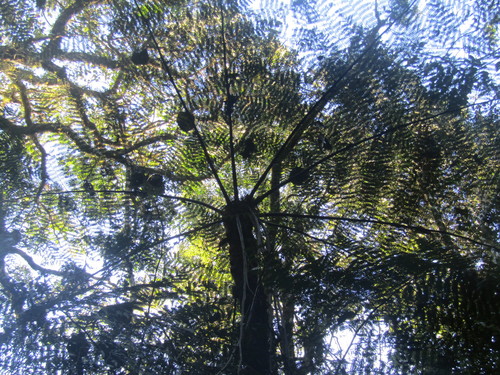
Verbatim
e0“Against MAO-A, D. truncatula (82.61%), Alsophila setosa (82.21%), Cyathea phalerata (74.07%) and C. delgadii (70.32%) were the most active extracts (100 μg/mL)”
Title
JulianaMM Andrade; RogerR Dresch; Carolina dosS Passos; et al. Pharmacognosy Magazine 2014. doi:10.4103/0973-1296.127354
Other claims from this paper (11)
- Observation Hesperidin was identified in Asplenium gastonis extract.
- Observation Xanthone mangiferin was present in A. serra.
- Observation Asplenium serra extract was among those with highest antioxidant activity at 10 μg/mL.
- Observation Lastreopsis amplissima extract was among those with highest antioxidant activity at 10 μg/mL.
- Observation Cyathea dichromatolepis extract was among those with highest antioxidant activity at 10 μg/mL.
- Observation A. serra extract showed 94.06% antichemotactic activity at 10 μg/mL.
- Observation Didymochlaena truncatula extract showed 93.41% antichemotactic activity at 10 μg/mL.
- Observation The fern extracts showed no cytotoxicity at the highest concentration.
- Observation D. truncatula extract had 82.61% activity against MAO-A at 100 μg/mL.
- Observation Cyathea phalerata extract had 74.07% activity against MAO-A at 100 μg/mL.
- Observation C. delgadii extract had 70.32% activity against MAO-A at 100 μg/mL.