Claim · model-written summary
Cochliobolus sativus frequency declined slightly but significantly over time in barley B1 at 50 or 70°C.
- Taxon
- barley (Hordeum vulgare)
 Hordeum vulgaree1
- Material
- B1e0
- Treatment
- heating at 50 or 70°Ce0
- Interactor
- Cochliobolus sativus
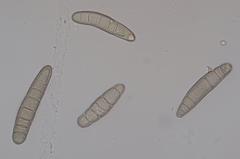 Bipolaris sorokinianae0pathogen
- Outcome
- frequency of Cochliobolus sativuse0
- Direction
- declinede0
Not reportedGeneCompoundOrgan / stageSecond interactorSecond interactor roleComparatorSettingValueQualifier
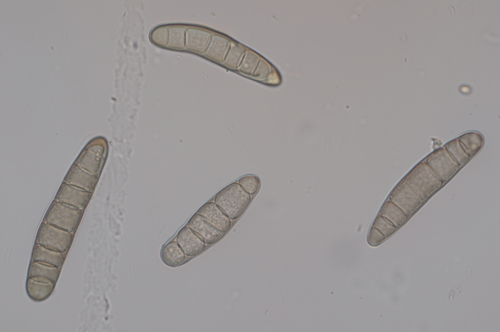
Organisms pictured · Representative pictures of the matched species, not figures from the paper.

Verbatim
e0“After heating at 50 or 70°C, the observed frequency of Cochliobolus sativus in B1 declined slightly but significantly over time”
e1“barley (Hordeum vulgare) (B1, B2)”
Title
Effect of dry heat treatment on seed-borneFusarium graminearumand other cereal pathogens
R. M. Clear; S. K. Patrick; R. Wallis; et al. Canadian Journal of Plant Pathology 2002. doi:10.1080/07060660209507038
Other claims from this paper (18)
- Intervention effect Fusarium graminearum was eliminated from wheat RS2 at 60°C after 15 days, 70°C after 5 days, or 80°C after 2 days.
- Intervention effect F. graminearum was eliminated from barley B2 at 60°C after 21 days, 70°C after 9 days, or 80°C after 5 days.
- Intervention effect Cochliobolus sativus frequency substantially increased in barley B2 at 50 or 70°C.
- Intervention effect C. sativus incidence significantly declined in barley B2 at 80°C.
- Intervention effect P. teres was observed significantly more often in barley B1 after heating at 50 or 70°C.
- Intervention effect P. tritici-repentis detection in durum wheat AD1 and AD2 was unaffected at 50°C.
- Intervention effect P. tritici-repentis detection significantly increased over time in wheat AD2 at 70°C.
- Intervention effect P. tritici-repentis incidence in wheat AD1 initially increased and then decreased at 70°C.
- Intervention effect C. sativus, P. teres and P. tritici-repentis remained viable after 14 days at 70°C.
- Intervention effect C. sativus was undetected after 10 days at 80°C.
- Intervention effect Wheat germination at 12, 14 and 16% moisture was unaffected after 7 days at 70°C.
- Intervention effect Barley germination at the same moisture contents declined slightly after heating.
- Intervention effect Most samples retained germination rates after heat regimens sufficient to eradicate F. graminearum.
- Intervention effect Viability significantly declined for durum wheat AD2 at 70°C.
- Intervention effect Viability significantly declined for barley B1 at 70°C.
- Intervention effect Barley B2 germination increased at 70°C.
- Intervention effect Barley B2 germination declined at 80°C.
- Recommendation The authors recommend thermotherapy to control movement of F. graminearum and other heat sensitive pathogens in breeding germplasm.