Abstract
To find seed treatments that are acceptable for organic cereal production, we tested the efficacy of three treatments, i.e. dry heat, a low dose of acetic acid vapours (AAV-L), and a high dose of AAV (AAV-H), to control Fusarium graminearum ( Fg ) and Bipolaris sorokiniana ( Bs ), two seed-borne pathogens affecting emergence and yield in barley and wheat. These treatments were compared with a control (no treatment) and Vitaflo®-280. Treatments were applied on six barley and six wheat seed lots contaminated with Fg at a rate of > 20% (i.e. > 20% of seeds contaminated) and/or Bs at a rate of > 50%. For all Fg -contaminated lots, the three non-chemical treatments reduced the contamination rate under the rejection threshold of 15%, which is the Danish recommendation for Fusarium spp. For Bs -contaminated lots, AAV-H reduced contamination the most, followed by AAV-L, and then by dry heat, which had no effect on barley. However, these treatments did not reduce Bs contamination under the rejection threshold of 30%, except for AAV-H in one barley lot and dry heat in one wheat lot. Also, AAV-H reduced the germination in three wheat lots and in the hulless barley AC Hawkeye, and this had negative effects on grain yield for two of the wheat lots. AAV-H had no effect on grain yield in the other lots, and neither did the other treatments in any of the lots. Dry heat was effective for controlling Fg in both cereals, whereas AAV-H showed some potential to control both pathogens, but only in covered grains. None of the treatments evaluated appears to be appropriate for reducing contamination by either pathogens in wheat and barley.
Abstract from the paper’s OpenAlex record, shown for indexing and research. Copyright remains with the authors or the publisher. Read at the source ↗
The text the model read, with the source record’s inline markup (italics, sub- and superscripts) rendered and its character entities decoded; quote offsets refer to the raw text.
Claims 13
Claim · model-written summary
The three non-chemical treatments reduced Fusarium graminearum contamination rate under the 15% rejection threshold in all Fg-contaminated lots.
- Taxon
- barley and wheat
 Hordeum vulgare
 Triticum aestivume0
- Treatment
- three non-chemical treatmentse2
- Interactor
- Fusarium graminearum
 Fusarium graminearume0pathogen
- Outcome
- contamination ratee2
- Direction
- reducede2
- Qualifier
- under the rejection threshold of 15%e2
- Comparator
- control (no treatment)e1
Organisms pictured · Representative pictures of the matched species, not figures from the paper.


Verbatim
e0“to control Fusarium graminearum ( Fg ) and Bipolaris sorokiniana ( Bs ), two seed-borne pathogens affecting emergence and yield in barley and wheat”
e1“These treatments were compared with a control (no treatment)”
e2“For all Fg -contaminated lots, the three non-chemical treatments reduced the contamination rate under the rejection threshold of 15%”
Claim · model-written summary
AAV-H reduced Bipolaris sorokiniana contamination the most of the treatments in barley and wheat lots.
- Taxon
- barley and wheatHordeum vulgareTriticum aestivume0
- Treatment
- AAV-He3
- Interactor
- Bipolaris sorokiniana
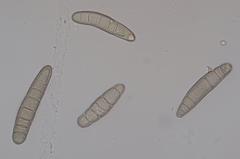 Bipolaris sorokinianae0pathogen
- Outcome
- contaminatione3
- Direction
- reducede3
- Qualifier
- the moste3
- Comparator
- control (no treatment)e1
Organisms pictured · Representative pictures of the matched species, not figures from the paper.
Verbatim
e0“to control Fusarium graminearum ( Fg ) and Bipolaris sorokiniana ( Bs ), two seed-borne pathogens affecting emergence and yield in barley and wheat”
e1“These treatments were compared with a control (no treatment)”
e3“For Bs -contaminated lots, AAV-H reduced contamination the most, followed by AAV-L, and then by dry heat, which had no effect on barley”
Claim · model-written summary
Dry heat had no effect on Bipolaris sorokiniana contamination in barley.
- Taxon
- barleyHordeum vulgaree3
- Treatment
- dry heate3
- Interactor
- Bipolaris sorokinianaBipolaris sorokinianae0pathogen
- Outcome
- contaminatione3
- Direction
- no effecte3
- Comparator
- control (no treatment)e1
Organisms pictured · Representative pictures of the matched species, not figures from the paper.
Verbatim
e0“to control Fusarium graminearum ( Fg ) and Bipolaris sorokiniana ( Bs ), two seed-borne pathogens affecting emergence and yield in barley and wheat”
e1“These treatments were compared with a control (no treatment)”
e3“For Bs -contaminated lots, AAV-H reduced contamination the most, followed by AAV-L, and then by dry heat, which had no effect on barley”
Claim · model-written summary
AAV-L reduced Bipolaris sorokiniana contamination, less than AAV-H.
- Taxon
- barley and wheatHordeum vulgareTriticum aestivume0
- Treatment
- AAV-Le3
- Interactor
- Bipolaris sorokinianaBipolaris sorokinianae0pathogen
- Outcome
- contaminatione3
- Direction
- decreaseinferrede3
- Qualifier
- followed by AAV-Le3
- Comparator
- control (no treatment)e1
Organisms pictured · Representative pictures of the matched species, not figures from the paper.
Verbatim
e0“to control Fusarium graminearum ( Fg ) and Bipolaris sorokiniana ( Bs ), two seed-borne pathogens affecting emergence and yield in barley and wheat”
e1“These treatments were compared with a control (no treatment)”
e3“For Bs -contaminated lots, AAV-H reduced contamination the most, followed by AAV-L, and then by dry heat, which had no effect on barley”
Claim · model-written summary
The treatments did not reduce Bipolaris sorokiniana contamination under the 30% threshold, except AAV-H in one barley lot and dry heat in one wheat lot.
- Taxon
- barley and wheatHordeum vulgareTriticum aestivume0
- Treatment
- these treatmentse4
- Interactor
- Bipolaris sorokinianaBipolaris sorokinianae0pathogen
- Outcome
- Bs contaminatione4
- Direction
- did not reducee4
- Qualifier
- under the rejection threshold of 30%, except for AAV-H in one barley lot and dry heat in one wheat lote4
- Comparator
- control (no treatment)e1
Organisms pictured · Representative pictures of the matched species, not figures from the paper.
Verbatim
e0“to control Fusarium graminearum ( Fg ) and Bipolaris sorokiniana ( Bs ), two seed-borne pathogens affecting emergence and yield in barley and wheat”
e1“These treatments were compared with a control (no treatment)”
e4“However, these treatments did not reduce Bs contamination under the rejection threshold of 30%, except for AAV-H in one barley lot and dry heat in one wheat lot”
Claim · model-written summary
AAV-H reduced germination in three wheat lots.
- Taxon
- wheatTriticum aestivume5
- Material
- three wheat lotse5
- Treatment
- AAV-He5
- Outcome
- germinatione5
- Direction
- reducede5
- Comparator
- control (no treatment)e1
Organisms pictured · Representative pictures of the matched species, not figures from the paper.
Verbatim
e1“These treatments were compared with a control (no treatment)”
e5“AAV-H reduced the germination in three wheat lots and in the hulless barley AC Hawkeye, and this had negative effects on grain yield for two of the wheat lots”
Claim · model-written summary
AAV-H reduced germination in the hulless barley AC Hawkeye.
Verbatim
e1“These treatments were compared with a control (no treatment)”
e5“AAV-H reduced the germination in three wheat lots and in the hulless barley AC Hawkeye, and this had negative effects on grain yield for two of the wheat lots”
Claim · model-written summary
AAV-H had negative effects on grain yield in two wheat lots.
- Taxon
- wheatTriticum aestivume5
- Material
- two of the wheat lotse5
- Treatment
- AAV-He5
- Outcome
- grain yielde5
- Direction
- negative effectse5
- Comparator
- control (no treatment)e1
Organisms pictured · Representative pictures of the matched species, not figures from the paper.
Verbatim
e1“These treatments were compared with a control (no treatment)”
e5“AAV-H reduced the germination in three wheat lots and in the hulless barley AC Hawkeye, and this had negative effects on grain yield for two of the wheat lots”
Claim · model-written summary
AAV-H had no effect on grain yield in the other lots.
- Taxon
- barley and wheatHordeum vulgareTriticum aestivume0
- Treatment
- AAV-He6
- Outcome
- grain yielde6
- Direction
- no effecte6
- Qualifier
- in the other lotse6
- Comparator
- control (no treatment)e1
Organisms pictured · Representative pictures of the matched species, not figures from the paper.
Verbatim
e0“to control Fusarium graminearum ( Fg ) and Bipolaris sorokiniana ( Bs ), two seed-borne pathogens affecting emergence and yield in barley and wheat”
e1“These treatments were compared with a control (no treatment)”
e6“AAV-H had no effect on grain yield in the other lots, and neither did the other treatments in any of the lots”
Claim · model-written summary
The other treatments had no effect on grain yield in any lot.
- Taxon
- barley and wheatHordeum vulgareTriticum aestivume0
- Treatment
- the other treatmentse6
- Outcome
- grain yielde6
- Direction
- no_changeinferrede6
- Qualifier
- in any of the lotse6
- Comparator
- control (no treatment)e1
Organisms pictured · Representative pictures of the matched species, not figures from the paper.
Verbatim
e0“to control Fusarium graminearum ( Fg ) and Bipolaris sorokiniana ( Bs ), two seed-borne pathogens affecting emergence and yield in barley and wheat”
e1“These treatments were compared with a control (no treatment)”
e6“AAV-H had no effect on grain yield in the other lots, and neither did the other treatments in any of the lots”
Claim · model-written summary
Dry heat was effective for controlling Fusarium graminearum in both cereals.
- Taxon
- barley and wheatHordeum vulgareTriticum aestivume0
- Treatment
- Dry heate7
- Interactor
- Fusarium graminearumFusarium graminearume0pathogen
- Outcome
- controlling Fge7
- Direction
- effectivee7
- Qualifier
- in both cerealse7
Not reportedComparator
Organisms pictured · Representative pictures of the matched species, not figures from the paper.
Verbatim
e0“to control Fusarium graminearum ( Fg ) and Bipolaris sorokiniana ( Bs ), two seed-borne pathogens affecting emergence and yield in barley and wheat”
e7“Dry heat was effective for controlling Fg in both cereals, whereas AAV-H showed some potential to control both pathogens, but only in covered grains”
Claim · model-written summary
AAV-H showed some potential to control both pathogens, but only in covered grains.
- Taxon
- barley and wheatHordeum vulgareTriticum aestivume0
- Treatment
- AAV-He7
- Interactor
- Fusarium graminearumFusarium graminearume0pathogen
- Second interactor
- Bipolaris sorokinianaBipolaris sorokinianae0pathogen
- Outcome
- potential to control both pathogense7
- Qualifier
- but only in covered grainse7
Organisms pictured · Representative pictures of the matched species, not figures from the paper.
Verbatim
e0“to control Fusarium graminearum ( Fg ) and Bipolaris sorokiniana ( Bs ), two seed-borne pathogens affecting emergence and yield in barley and wheat”
e7“Dry heat was effective for controlling Fg in both cereals, whereas AAV-H showed some potential to control both pathogens, but only in covered grains”
Claim · model-written summary
The authors conclude that none of the evaluated treatments is appropriate for reducing contamination by either pathogen in wheat and barley.
- Taxon
- wheat and barleyHordeum vulgareTriticum aestivume7
- Outcome
- appropriate for reducing contamination by either pathogense7
Organisms pictured · Representative pictures of the matched species, not figures from the paper.
Verbatim
e7“None of the treatments evaluated appears to be appropriate for reducing contamination by either pathogens in wheat and barley”
The same questions in other papers
heat · Fusarium graminearum · Triticum aestivum (wheat)Positive and negative results
1 paper in the same direction as this paper · 1 in the opposite direction
- negative
- positive
heat · Bipolaris sorokiniana · Hordeum vulgare (barley)Positive and negative results
1 paper in the same direction as this paper · 2 in the opposite direction
- positive
- positive
- negative
Claims are grouped by organism, treatment and what was measured or targeted. A paper counts as positive when any of its claims in the group is positive.