Abstract
Pathogen levels and seed viability of two samples each of barley (Hordeum vulgare) (B1, B2), Canada western red spring wheat (Triticum aestivum) (RS1, RS2), and Canada western amber durum wheat (AD1, AD2) were assessed after heating seed at 50 or 70°C for up to 14 days. RS2 and B2, with an initial incidence of 23 and 84% of Fusarium graminearum, respectively, were also heated at 60°C for 24 days and 80°C for 10 days. Pathogen levels and seed viability were assessed by plating seed onto potato dextrose agar and wet filter paper, respectively. Fusarium graminearum was eliminated from RS2 after 15 days at 60°C, 5 days at 70°C, or 2 days at 80°C. In B2, F. graminearum was eliminated after 21 days at 60°C, 9 days at 70°C, or 5 days at 80°C. After heating at 50 or 70°C, the observed frequency of Cochliobolus sativus in B1 declined slightly but significantly over time, whereas it substantially increased in B2. A significant decline in the incidence of C. sativus was observed in B2 after heating at 80°C. Pyrenophora teres was observed significantly more often in B1 after heating at 50 or 70°C, whereas Pyrenophora tritici-repentis in AD1 and AD2 was unaffected by heating at 50°C. However, the detection of P. tritici-repentis did significantly increase over time in AD2 when heated at 70°C. In AD1, heating at 70°C initially increased, then decreased the observed incidence of this pathogen. Cochliobolus sativus, P. teres and P. tritici-repentis were still viable in the samples after 14 days of heating at 70°C, but C. sativus was not detected after 10 days at 80°C. Germination of wheat tempered to 12, 14, and 16% moisture content was unaffected by heating at 70°C for 7 days, whereas barley tempered to the same moisture content had a slight decline in germination. Germination rates in most samples were unaffected by the treatment times and temperatures sufficient to eradicate F. graminearum, but a significant decline in viability was recorded for AD2 and B1 heated at 70°C. The germination of B2 increased when heated at 70°C, but declined when heated at 80°C. It is recommended that thermotherapy be applied to control national and international movements of F. graminearum and other heat-sensitive pathogens in germplasm used for research and breeding purposes.Key words: thermotherapy, Cochliobolus sativus, Pyrenophora teres, Pyrenophora tritici-repentis.
Abstract from the paper’s OpenAlex record, shown for indexing and research. Copyright remains with the authors or the publisher. Read at the source ↗
The text the model read, with the source record’s inline markup (italics, sub- and superscripts) rendered and its character entities decoded; quote offsets refer to the raw text.
Claims 19
Claim · model-written summary
Fusarium graminearum was eliminated from wheat RS2 at 60°C after 15 days, 70°C after 5 days, or 80°C after 2 days.
- Taxon
- wheat (Triticum aestivum)
 Triticum aestivume1
- Material
- RS2e0
- Treatment
- 15 days at 60°C, 5 days at 70°C, or 2 days at 80°Ce0
- Interactor
- Fusarium graminearum
 Fusarium graminearume0pathogen
- Outcome
- Fusarium graminearume0
Not reportedComparatorDirection
Organisms pictured · Representative pictures of the matched species, not figures from the paper.


Verbatim
e0“Fusarium graminearum was eliminated from RS2 after 15 days at 60°C, 5 days at 70°C, or 2 days at 80°C.”
e1“Canada western red spring wheat (Triticum aestivum) (RS1, RS2)”
Claim · model-written summary
F. graminearum was eliminated from barley B2 at 60°C after 21 days, 70°C after 9 days, or 80°C after 5 days.
- Taxon
- barley (Hordeum vulgare)
 Hordeum vulgaree1
- Material
- B2e0
- Treatment
- 21 days at 60°C, 9 days at 70°C, or 5 days at 80°Ce0
- Interactor
- F. graminearumFusarium graminearume0pathogen
- Outcome
- F. graminearum was eliminatede0
Not reportedComparatorDirection
Organisms pictured · Representative pictures of the matched species, not figures from the paper.

Verbatim
e0“In B2, F. graminearum was eliminated after 21 days at 60°C, 9 days at 70°C, or 5 days at 80°C.”
e1“barley (Hordeum vulgare) (B1, B2)”
Claim · model-written summary
Cochliobolus sativus frequency declined slightly but significantly over time in barley B1 at 50 or 70°C.
- Taxon
- barley (Hordeum vulgare)Hordeum vulgaree1
- Material
- B1e0
- Treatment
- heating at 50 or 70°Ce0
- Interactor
- Cochliobolus sativus
 Bipolaris sorokinianae0pathogen
- Outcome
- frequency of Cochliobolus sativuse0
- Direction
- declinede0
Not reportedComparator
Organisms pictured · Representative pictures of the matched species, not figures from the paper.
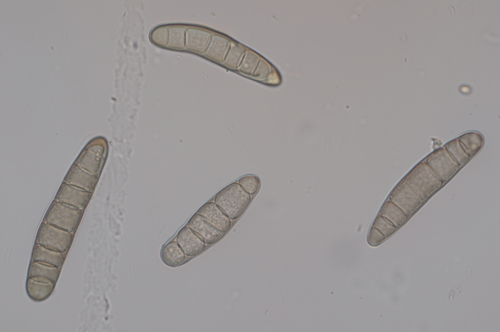
Verbatim
e0“After heating at 50 or 70°C, the observed frequency of Cochliobolus sativus in B1 declined slightly but significantly over time”
e1“barley (Hordeum vulgare) (B1, B2)”
Claim · model-written summary
Cochliobolus sativus frequency substantially increased in barley B2 at 50 or 70°C.
- Taxon
- barley (Hordeum vulgare)Hordeum vulgaree1
- Material
- B2e0
- Treatment
- heating at 50 or 70°Ce0
- Interactor
- Cochliobolus sativusBipolaris sorokinianae0pathogen
- Outcome
- frequency of Cochliobolus sativuse0
- Direction
- increasede0
Not reportedComparator
Organisms pictured · Representative pictures of the matched species, not figures from the paper.
Verbatim
e0“After heating at 50 or 70°C, the observed frequency of Cochliobolus sativus in B1 declined slightly but significantly over time, whereas it substantially increased in B2.”
e1“barley (Hordeum vulgare) (B1, B2)”
Claim · model-written summary
C. sativus incidence significantly declined in barley B2 at 80°C.
- Taxon
- barley (Hordeum vulgare)Hordeum vulgaree1
- Material
- B2e0
- Treatment
- heating at 80°Ce0
- Interactor
- C. sativusBipolaris sorokinianae0pathogen
- Outcome
- incidence of C. sativuse0
- Direction
- declinee0
Not reportedComparator
Organisms pictured · Representative pictures of the matched species, not figures from the paper.
Verbatim
e0“A significant decline in the incidence of C. sativus was observed in B2 after heating at 80°C.”
e1“barley (Hordeum vulgare) (B1, B2)”
Claim · model-written summary
P. teres was observed significantly more often in barley B1 after heating at 50 or 70°C.
- Taxon
- barley (Hordeum vulgare)Hordeum vulgaree1
- Material
- B1e0
- Treatment
- heating at 50 or 70°Ce0
- Interactor
- Pyrenophora teres
 Pyrenophora terese0pathogen
- Outcome
- Pyrenophora teres was observede0
- Direction
- more oftene0
Not reportedComparator
Organisms pictured · Representative pictures of the matched species, not figures from the paper.

Verbatim
e0“Pyrenophora teres was observed significantly more often in B1 after heating at 50 or 70°C”
e1“barley (Hordeum vulgare) (B1, B2)”
Claim · model-written summary
P. tritici-repentis detection in durum wheat AD1 and AD2 was unaffected at 50°C.
- Taxon
- wheatTriticum aestivume1
- Material
- AD1 and AD2e0
- Treatment
- heating at 50°Ce0
- Interactor
- Pyrenophora tritici-repentis
 Pyrenophora tritici-repentise0pathogen
- Outcome
- Pyrenophora tritici-repentise0
- Direction
- unaffectede0
Not reportedComparator
Organisms pictured · Representative pictures of the matched species, not figures from the paper.

Verbatim
e0“Pyrenophora tritici-repentis in AD1 and AD2 was unaffected by heating at 50°C.”
e1“Canada western amber durum wheat (AD1, AD2)”
Claim · model-written summary
P. tritici-repentis detection significantly increased over time in wheat AD2 at 70°C.
- Taxon
- wheatTriticum aestivume1
- Material
- AD2e0
- Treatment
- heated at 70°Ce0
- Interactor
- P. tritici-repentisPyrenophora tritici-repentise0pathogen
- Outcome
- detection of P. tritici-repentise0
- Direction
- increasee0
Not reportedComparator
Organisms pictured · Representative pictures of the matched species, not figures from the paper.
Verbatim
e0“the detection of P. tritici-repentis did significantly increase over time in AD2 when heated at 70°C.”
e1“Canada western amber durum wheat (AD1, AD2)”
Claim · model-written summary
P. tritici-repentis incidence in wheat AD1 initially increased and then decreased at 70°C.
- Taxon
- wheatTriticum aestivume2
- Material
- AD1e0
- Treatment
- heating at 70°Ce0
- Interactor
- Pyrenophora tritici-repentisPyrenophora tritici-repentise1pathogen
- Outcome
- observed incidence of this pathogene0
- Direction
- initially increased, then decreasede0
Not reportedComparator
Organisms pictured · Representative pictures of the matched species, not figures from the paper.
Verbatim
e0“In AD1, heating at 70°C initially increased, then decreased the observed incidence of this pathogen.”
e1“Pyrenophora tritici-repentis in AD1 and AD2 was unaffected by heating at 50°C.”
e2“Canada western amber durum wheat (AD1, AD2)”
Claim · model-written summary
C. sativus, P. teres and P. tritici-repentis remained viable after 14 days at 70°C.
- Taxon
- barley (Hordeum vulgare) (B1, B2), Canada western red spring wheat (Triticum aestivum) (RS1, RS2), and Canada western amber durum wheat (AD1, AD2)e1
- Treatment
- 14 days of heating at 70°Ce0
- Interactor
- Cochliobolus sativusBipolaris sorokinianae0pathogen
- Second interactor
- P. teresPyrenophora terese0pathogen
- Outcome
- still viablee0
- Qualifier
- P. tritici-repentise0
Not reportedComparatorDirection
Organisms pictured · Representative pictures of the matched species, not figures from the paper.
Verbatim
e0“Cochliobolus sativus, P. teres and P. tritici-repentis were still viable in the samples after 14 days of heating at 70°C”
e1“barley (Hordeum vulgare) (B1, B2), Canada western red spring wheat (Triticum aestivum) (RS1, RS2), and Canada western amber durum wheat (AD1, AD2)”
Claim · model-written summary
C. sativus was undetected after 10 days at 80°C.
- Taxon
- barley (Hordeum vulgare)Hordeum vulgaree1
- Treatment
- 10 days at 80°Ce0
- Interactor
- C. sativusBipolaris sorokinianae0pathogen
- Outcome
- C. sativus was not detectede0
Not reportedComparatorDirection
Organisms pictured · Representative pictures of the matched species, not figures from the paper.
Verbatim
e0“C. sativus was not detected after 10 days at 80°C.”
e1“barley (Hordeum vulgare) (B1, B2)”
Claim · model-written summary
Wheat germination at 12, 14 and 16% moisture was unaffected after 7 days at 70°C.
- Taxon
- wheatTriticum aestivume0
- Treatment
- heating at 70°C for 7 dayse0
- Outcome
- Germinatione0
- Direction
- unaffectede0
- Qualifier
- 12, 14, and 16% moisture contente0
Not reportedComparator
Organisms pictured · Representative pictures of the matched species, not figures from the paper.
Verbatim
e0“Germination of wheat tempered to 12, 14, and 16% moisture content was unaffected by heating at 70°C for 7 days”
Claim · model-written summary
Barley germination at the same moisture contents declined slightly after heating.
- Taxon
- barleyHordeum vulgaree0
- Treatment
- heating at 70°C for 7 dayse1
- Outcome
- germinatione0
- Direction
- declinee0
- Qualifier
- the same moisture contente0
Not reportedComparator
Organisms pictured · Representative pictures of the matched species, not figures from the paper.
Verbatim
e0“barley tempered to the same moisture content had a slight decline in germination.”
e1“Germination of wheat tempered to 12, 14, and 16% moisture content was unaffected by heating at 70°C for 7 days”
Claim · model-written summary
Most samples retained germination rates after heat regimens sufficient to eradicate F. graminearum.
- Taxon
- barley (Hordeum vulgare) (B1, B2), Canada western red spring wheat (Triticum aestivum) (RS1, RS2), and Canada western amber durum wheat (AD1, AD2)e1
- Treatment
- treatment times and temperatures sufficient to eradicate F. graminearume0
- Interactor
- F. graminearumFusarium graminearume0pathogen
- Outcome
- Germination ratese0
- Direction
- unaffectede0
Not reportedComparator
Organisms pictured · Representative pictures of the matched species, not figures from the paper.
Verbatim
e0“Germination rates in most samples were unaffected by the treatment times and temperatures sufficient to eradicate F. graminearum”
e1“barley (Hordeum vulgare) (B1, B2), Canada western red spring wheat (Triticum aestivum) (RS1, RS2), and Canada western amber durum wheat (AD1, AD2)”
Claim · model-written summary
Viability significantly declined for durum wheat AD2 at 70°C.
- Taxon
- wheatTriticum aestivume1
- Material
- AD2e0
- Treatment
- heated at 70°Ce0
- Outcome
- viabilitye0
- Direction
- declinee0
Not reportedComparator
Organisms pictured · Representative pictures of the matched species, not figures from the paper.
Verbatim
e0“a significant decline in viability was recorded for AD2 and B1 heated at 70°C.”
e1“Canada western amber durum wheat (AD1, AD2)”
Claim · model-written summary
Viability significantly declined for barley B1 at 70°C.
- Taxon
- barley (Hordeum vulgare)Hordeum vulgaree1
- Material
- B1e0
- Treatment
- heated at 70°Ce0
- Outcome
- viabilitye0
- Direction
- declinee0
Not reportedComparator
Organisms pictured · Representative pictures of the matched species, not figures from the paper.
Verbatim
e0“a significant decline in viability was recorded for AD2 and B1 heated at 70°C.”
e1“barley (Hordeum vulgare) (B1, B2)”
Claim · model-written summary
Barley B2 germination increased at 70°C.
- Taxon
- barley (Hordeum vulgare)Hordeum vulgaree1
- Material
- B2e0
- Treatment
- heated at 70°Ce0
- Outcome
- germinatione0
- Direction
- increasede0
Not reportedComparator
Organisms pictured · Representative pictures of the matched species, not figures from the paper.
Verbatim
e0“The germination of B2 increased when heated at 70°C”
e1“barley (Hordeum vulgare) (B1, B2)”
Claim · model-written summary
Barley B2 germination declined at 80°C.
- Taxon
- barley (Hordeum vulgare)Hordeum vulgaree1
- Material
- B2e0
- Treatment
- heated at 80°Ce0
- Outcome
- germinatione0
- Direction
- declinede0
Not reportedComparator
Organisms pictured · Representative pictures of the matched species, not figures from the paper.
Verbatim
e0“The germination of B2 increased when heated at 70°C, but declined when heated at 80°C.”
e1“barley (Hordeum vulgare) (B1, B2)”
Claim · model-written summary
The authors recommend thermotherapy to control movement of F. graminearum and other heat sensitive pathogens in breeding germplasm.
- Taxon
- barley (Hordeum vulgare) (B1, B2), Canada western red spring wheat (Triticum aestivum) (RS1, RS2), and Canada western amber durum wheat (AD1, AD2)e1
- Interactor
- F. graminearumFusarium graminearume0pathogen
- Outcome
- thermotherapy be applied to control national and international movements of F. graminearum and other heat-sensitive pathogens in germplasm used for research and breeding purposese0
Organisms pictured · Representative pictures of the matched species, not figures from the paper.
Verbatim
e0“It is recommended that thermotherapy be applied to control national and international movements of F. graminearum and other heat-sensitive pathogens in germplasm used for research and breeding purposes.”
e1“barley (Hordeum vulgare) (B1, B2), Canada western red spring wheat (Triticum aestivum) (RS1, RS2), and Canada western amber durum wheat (AD1, AD2)”
The same questions in other papers
heat · growth · Hordeum vulgare (barley)Results differ
19 papers in the same direction as this paper · 6 in the opposite direction
- no effect
- positive
- positive
22 papers more in this group
See all 26 papers →heat · Bipolaris sorokiniana · Hordeum vulgare (barley)Positive and negative results
1 paper in the same direction as this paper · 2 in the opposite direction
- no effect
- positive
- negative
heat · growth · Triticum aestivum (wheat)Positive and negative results
88 papers in the same direction as this paper · 42 in the opposite direction
- positive
- positive
- negative
127 papers more in this group
See all 131 papers →Claims are grouped by organism, treatment and what was measured or targeted. A paper counts as positive when any of its claims in the group is positive.