Claim · model-written summary
In both species, globoid Mg, Ca and Fe generally increased regardless of light and mineral nutrient conditions.
- Taxon
- Cucurbita maxima and Cucurbita andreana
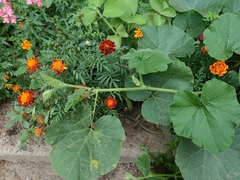 Cucurbita maxima
 Cucurbita maxima subsp. andreanat0
- Outcome
- Mg, Ca, Fee2
- Direction
- generally increasede2
- Qualifier
- regardless of light and mineral nutrient conditionse2
Not reportedMaterialGeneCompoundOrgan / stageInteractorInteractor roleSecond interactorSecond interactor roleTreatmentComparatorSettingValue
Organisms pictured · Representative pictures of the matched species, not figures from the paper.


Verbatim
e2“In both species, regardless of light and mineral nutrient conditions, K decreased markedly, Mg, Ca, Fe, Mn, and Zn generally increased, and P remained relatively constant”
t0“Cucurbita maxima and Cucurbita andreana”
Title
Penny Beecroft; John N. A. Lott Canadian Journal of Botany 1996. doi:10.1139/b96-104
Other claims from this paper (14)
- Observation Globoid element composition changed markedly during early seedling growth in Cucurbita cotyledons.
- Observation In both species, globoid K decreased markedly regardless of light and mineral nutrient conditions.
- Observation In both species, globoid Mn and Zn generally increased regardless of light and mineral nutrient conditions.
- Observation In both species, globoid P remained relatively constant regardless of light and mineral nutrient conditions.
- Mechanism Differences in globoid composition changes between the two species could be attributed, at least in part, to differences in the Ca content of mature dry embryos.
- Observation In C. andreana, which had a higher initial Ca content, globoid Ca content increased largely during seedling growth.
- Observation In C. andreana, globoid Mn did not increase significantly during seedling growth.
- Observation In C. maxima, globoid Ca increased only slightly.
- Observation In C. maxima, globoid Fe, Zn and Mn increased much more than in C. andreana.
- Intervention effect Light conditions alone did not significantly influence the changes in globoid composition.
- Intervention effect Light combined with mineral nutrients produced a more rapid degradation of globoids in later stages of growth.
- Intervention effect Mineral nutrient conditions affected mostly the elements that were initially present in large amounts in globoids.
- Observation Very large, globoid-like particles were present in some later-stage samples of both species under every growth condition.
- Observation The large particles had element compositions consistent with being composed of phytate.