Claim · model-written summary
Drought treatments significantly increased leaf proline content.
- Taxon
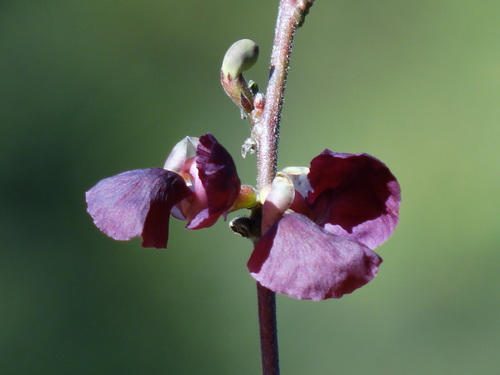
- Macroptilium bracteatum
 Macroptilium bracteatumt0
- Treatment
- Drought treatments (M2 and M3)e0
- Outcome
- leaf proline contente0
- Direction
- increasede0
Not reportedMaterialGeneCompoundOrgan / stageInteractorInteractor roleSecond interactorSecond interactor roleComparatorSettingValueQualifier
Organisms pictured · Representative pictures of the matched species, not figures from the paper.
Verbatim
t0“Macroptilium bracteatum”
e0“Drought treatments (M2 and M3) significantly (P < 0.05) decrease soil water content, leaf water potential, leaf relative water content and increased the leaf proline content”
Title
S Sowmen; L Abdullah; P D M H Karti; et al. Media Peternakan 2012. doi:10.5398/medpet.2012.35.2.133
Other claims from this paper (6)
- Intervention effect Drought treatments significantly decreased soil water content, leaf water potential, and leaf relative water content.
- Intervention effect AMF plus watering differed significantly in root dry weight from no AMF plus watering, no AMF plus drought, and AMF plus drought.
- Intervention effect Leaf water soluble carbohydrate differed significantly between M0 and M2 versus M1 and M3.
- Recommendation The authors conclude mycorrhizal inoculation is more effective under drought stress.
- Mechanism The authors attribute drought resistance to proline accumulation.
- Recommendation The authors propose proline as an indicator of drought resistance in leguminous plants.