Abstract
The objective of this experiment was to evaluate the effect of drought stress and mycorrhizal inoculation on physiological adaptation and biomass production of Macroptilium bracteatum. This experiment was arranged in completely randomized design with four treatments: M0 (no AM + watered), M1 (AM + watered), M2 (no AM + drought), and M3 (AM + drought) with three replicates. The observed variables were soil water content, leaf water potential, leaf relative water content, leaf proline, leaf water soluble carbohydrate (WSC), root and shoot dry weight. Data were analyzed by ANOVA and differences between treatments were tested by DMRT. Drought treatments (M2 and M3) significantly (P < 0.05) decrease soil water content, leaf water potential, leaf relative water content and increased the leaf proline content. The result in root and shoot dry weight appear that M1 treatment was significantly different (P < 0.05) with treatment M0, M2, and M3. For leaf WSC, M0 and M2 treatments were significantly different (P < 0.05) with treatment M1 and M3. It is concluded that mycorrhiza inoculation was more effective on M. bracteatum, in drought stress. One mechanism of drought resistance of M. bracteatum is the accumulation of osmotic compounds proline. Therefore, proline can be used as an indicator of drought resistance in leguminous plants.
Abstract from the paper’s OpenAlex record; open copy licensed cc-by-sa. Read at the source ↗
The text the model read, with the source record’s inline markup (italics, sub- and superscripts) rendered and its character entities decoded; quote offsets refer to the raw text.
Claims 7
Claim · model-written summary
Drought treatments significantly decreased soil water content, leaf water potential, and leaf relative water content.
- Taxon
- Macroptilium bracteatum
 Macroptilium bracteatumt0
- Treatment
- Drought treatments (M2 and M3)e0
- Outcome
- soil water content, leaf water potential, leaf relative water contente0
- Direction
- decreasee0
Not reportedComparator
Organisms pictured · Representative pictures of the matched species, not figures from the paper.
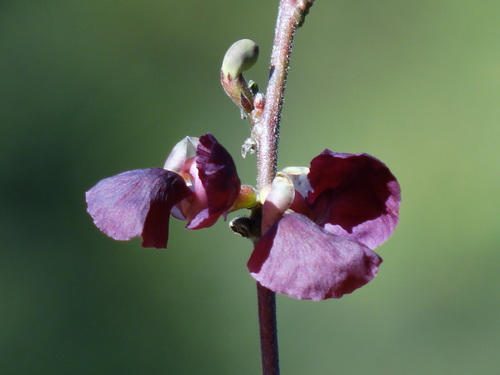
Verbatim
t0“Macroptilium bracteatum”
e0“Drought treatments (M2 and M3) significantly (P < 0.05) decrease soil water content, leaf water potential, leaf relative water content”
Claim · model-written summary
Drought treatments significantly increased leaf proline content.
- Taxon
- Macroptilium bracteatumMacroptilium bracteatumt0
- Treatment
- Drought treatments (M2 and M3)e0
- Outcome
- leaf proline contente0
- Direction
- increasede0
Not reportedComparator
Organisms pictured · Representative pictures of the matched species, not figures from the paper.
Verbatim
t0“Macroptilium bracteatum”
e0“Drought treatments (M2 and M3) significantly (P < 0.05) decrease soil water content, leaf water potential, leaf relative water content and increased the leaf proline content”
Claim · model-written summary
AMF plus watering differed significantly in root dry weight from no AMF plus watering, no AMF plus drought, and AMF plus drought.
- Taxon
- Macroptilium bracteatumMacroptilium bracteatumt0
- Treatment
- M1 (AM + watered)e1
- Interactor
- AMe1symbiont
- Outcome
- root and shoot dry weighte0
- Comparator
- M0 (no AM + watered), M1 (AM + watered), M2 (no AM + drought), and M3 (AM + drought)e1
Not reportedDirection
Organisms pictured · Representative pictures of the matched species, not figures from the paper.
Verbatim
t0“Macroptilium bracteatum”
e0“The result in root and shoot dry weight appear that M1 treatment was significantly different (P < 0.05) with treatment M0, M2, and M3”
e1“M0 (no AM + watered), M1 (AM + watered), M2 (no AM + drought), and M3 (AM + drought)”
Claim · model-written summary
Leaf water soluble carbohydrate differed significantly between M0 and M2 versus M1 and M3.
- Taxon
- Macroptilium bracteatumMacroptilium bracteatumt0
- Treatment
- M0 and M2 treatmentse0
- Interactor
- AMe1symbiont
- Outcome
- leaf WSCe0
- Comparator
- treatment M1 and M3e0
Not reportedDirection
Organisms pictured · Representative pictures of the matched species, not figures from the paper.
Verbatim
t0“Macroptilium bracteatum”
e0“For leaf WSC, M0 and M2 treatments were significantly different (P < 0.05) with treatment M1 and M3”
e1“M0 (no AM + watered), M1 (AM + watered), M2 (no AM + drought), and M3 (AM + drought)”
Claim · model-written summary
The authors conclude mycorrhizal inoculation is more effective under drought stress.
- Taxon
- M. bracteatumMacroptilium bracteatume0
- Interactor
- mycorrhizae0symbiont
- Outcome
- mycorrhiza inoculatione0
Organisms pictured · Representative pictures of the matched species, not figures from the paper.
Verbatim
e0“mycorrhiza inoculation was more effective on M. bracteatum, in drought stress”
Claim · model-written summary
The authors attribute drought resistance to proline accumulation.
- Taxon
- M. bracteatumMacroptilium bracteatume0
- Compound
- prolinee0
- Outcome
- drought resistancee0
Organisms pictured · Representative pictures of the matched species, not figures from the paper.
Verbatim
e0“One mechanism of drought resistance of M. bracteatum is the accumulation of osmotic compounds proline”
Claim · model-written summary
The authors propose proline as an indicator of drought resistance in leguminous plants.
Verbatim
e0“proline can be used as an indicator of drought resistance in leguminous plants”