
Claim · model-written summary
The FISH probe showed strong hybridisation to Bretziella fagacearum and no detectable signal in closely related Ceratocystidaceae.
- Taxon
- Red Oak
 Quercus rubrat1
- Interactor
- Bretziella fagacearum
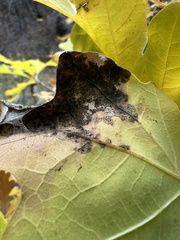 Bretziella fagacearumt0pathogen
- Outcome
- Probe specificitye0
- Comparator
- closely related Ceratocystidaceaee0
Verbatim
t0“Oak Wilt Pathogen, Bretziella fagacearum”
t1“Red Oak Host Tissues”
e0“Probe specificity was confirmed through fluorescence in situ hybridisation (FISH) and confocal laser scanning microscopy (CLSM), which showed strong hybridisation to B . fagacearum and no detectable signal in closely related Ceratocystidaceae”
Title
Martine Blais; Karandeep Chahal; Monique L. Sakalidis; et al. Forest Pathology 2026. doi:10.1111/efp.70070
Other claims from this paper (5)
- Observation FISH visualised Bretziella fagacearum ascospores on Carpophilus sayi collected from sporulating mats.
- Observation Bretziella fagacearum showed consistent localisation on terminal abdominal sternites of the vectors, and occasionally on mesoventral grooves, legs and antennae.
- Observation Bretziella fagacearum hyphae were predominantly in oak twig vessel elements and fibres, and occasionally in axial and ray parenchyma.
- Observation In infected petioles, hyphae occurred in xylem vessels, collenchyma, and parenchyma, beyond midrib tissues.
- Method / resource CLSM–FISH is established as a powerful visualisation tool for host–pathogen–vector interactions of oak wilt.
 Prunus serotina
 Castanea dentata