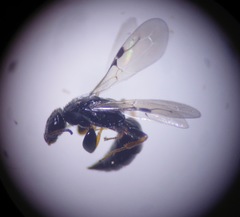
Epiphyas postvittana 73 claims

species · family Tortricidae · animal · NCBI Taxonomy ↗

Also written in claims: light-brown apple moth — NCBI synonyms: Teras postvittana

5 spellings

Epiphyas postvittana
Epiphyas postvittanaDonald Hobern · CC BY 2.0 · Wikimedia Commons ↗
Observationauthor interpretationoriginal resultbasis n/a

Claim · model-written summary

Epiphyas postvittana was the pest most frequently expected on the commodity.

Taxon
Ligustrum delavayanumLigustrum delavayanume0
Interactor
E. postvittanaEpiphyas postvittanae3pest
Outcome
expected on the commoditye3
Qualifier
most frequentlye3

Verbatim

e0

“topiary plants of Ligustrum delavayanum grafted on L. japonicum in pots imported from the UK”

✓ located verbatim in the source · abstract, characters 325–417
e3

“E. postvittana was the pest most frequently expected on the commodity”

✓ located verbatim in the source · abstract, characters 1384–1453

Title

Commodity risk assessment of Ligustrum delavayanum topiary plants grafted on Ligustrum japonicum from the UK

EFSA Panel on Plant Health (PLH); Claude Bragard; Paula Baptista; et al. EFSA Journal 2022. doi:10.2903/j.efsa.2022.7593

Other claims from this paper (3)
Observationauthor interpretationoriginal resultbasis n/a

Claim · model-written summary

Expert knowledge elicitation indicated, with 95% certainty, that 9,724 or more living sculptures per 10,000 would be free from E. postvittana.

Taxon
Ligustrum delavayanumLigustrum delavayanume0
Interactor
E. postvittanaEpiphyas postvittanae5pest
Outcome
free from E. postvittanae5
Value
9,724 or more living sculptures per 10,000e5
Qualifier
with 95% certaintye5

Verbatim

e0

“topiary plants of Ligustrum delavayanum grafted on L. japonicum in pots imported from the UK”

✓ located verbatim in the source · abstract, characters 325–417
e5

“The Expert Knowledge Elicitation indicated, with 95% certainty, that 9,724 or more living sculptures per 10,000 would be free from E. postvittana”

✓ located verbatim in the source · abstract, characters 1455–1600

Title

Commodity risk assessment of Ligustrum delavayanum topiary plants grafted on Ligustrum japonicum from the UK

EFSA Panel on Plant Health (PLH); Claude Bragard; Paula Baptista; et al. EFSA Journal 2022. doi:10.2903/j.efsa.2022.7593

Other claims from this paper (3)
Observationobservedoriginal resultpositivemeasured

Claim · model-written summary

The moth pest had poor adult survival on all plant species, below 0.3.

Taxon
plant speciese0
Interactor
E. postvittanaEpiphyas postvittanae0pest
Outcome
Survival proportion to the adult stage of the moth pest, E. postvittanae0
Value
<0.3e0

Verbatim

e0

“Survival proportion to the adult stage of the moth pest, E. postvittana, on all plant species was poor (<0.3)”

✓ located verbatim in the source · abstract, characters 2194–2303

Title

Potential ecosystem service delivery by endemic plants in New Zealand vineyards: successes and prospects

Morgan W. Shields; Jean-Marie Tompkins; David J. Saville; et al. PeerJ 2016. doi:10.7717/peerj.2042

Other claims from this paper (14)
Observationobservedoriginal resultmeasured

Claim · model-written summary

Most leafroller larvae collected on gorse and broom were Epiphyas postvittana.

Taxon
gorse and broome1
Interactor
Epiphyas postvittanaEpiphyas postvittanae1pest
Outcome
leafroller larvaee1

Verbatim

e1

“Most of the leafroller larvae collected were Epiphyas postvittana (Walker) (lightbrown apple moth LBAM) and most of these were found on gorse and broom”

✓ located verbatim in the source · abstract, characters 293–444

Title

Parasitoids of leafrollers (LepidopteraTortricidae) from scrub vegetation near horticultural areas in Nelson

P.W. Shaw; D.R. Wallis Proceedings of the New Zealand Weed Control Conference 2015. doi:10.30843/nzpp.2015.68.5805

Other claims from this paper (4)
Intervention effectobservedoriginal resultsignificant (as stated)measured

Claim · model-written summary

Secondary parasitoid clutches were larger than primary clutches in ovicide treatments.

Taxon
host plantse0
Treatment
ovicide treatmentse1
Interactor
Goniozus jacintaeGoniozus jacintaee3biocontrol_agent
Second interactor
E. postvittanaEpiphyas postvittanae3pest
Outcome
clutch sizee2
Direction
largere1
Comparator
primary clutchese1

Verbatim

e0

“among E. postvittana, its host plants, and its resident enemies in California”

✓ located verbatim in the source · abstract, characters 4487–4564
e1

“I found that secondary clutches were significantly larger than primary clutches in ovicide treatments and also experienced greater brood survivorship”

✓ located verbatim in the source · abstract, characters 1986–2135
e2

“I investigated the clutch size and handling time of G. jacintae”

✓ located verbatim in the source · abstract, characters 1707–1770
e3

“for Goniozus jacintae Farrugia, a coevolved gregarious larval ectoparasitoid of E. postvittana”

✓ located verbatim in the source · abstract, characters 1408–1502

Title

MULTITROPHIC INTERACTIONS AND THE EXOTIC LIGHT BROWN APPLE MOTH, EPIPHYAS POSTVITTANA, IN CALIFORNIA

Julie V. Hopper eScholarship (California Digital Library) 2015

Other claims from this paper (19)
Intervention effectobservedoriginal resultpositivesignificant (as stated)measured

Claim · model-written summary

The microsporidian has significant negative effects on the life-history performance of E. postvittana under laboratory conditions.

Taxon
host plantse0
Treatment
this microsporidiane1
Interactor
E. postvittanaEpiphyas postvittanae1pest
Second interactor
this microsporidiane1pathogen
Outcome
life-history performancee1
Direction
negative effectse1

Not reportedComparator

Verbatim

e0

“among E. postvittana, its host plants, and its resident enemies in California”

✓ located verbatim in the source · abstract, characters 4487–4564
e1

“I was also able to confirm that this microsporidian can be vertically transmitted and that it has significant negative effects on the life-history performance of E. postvittana under laboratory conditions”

✓ located verbatim in the source · abstract, characters 3049–3253

Title

MULTITROPHIC INTERACTIONS AND THE EXOTIC LIGHT BROWN APPLE MOTH, EPIPHYAS POSTVITTANA, IN CALIFORNIA

Julie V. Hopper eScholarship (California Digital Library) 2015

Other claims from this paper (19)
Associationobservedoriginal resultsignificant (as stated)measured

Claim · model-written summary

Plant diet had significant effects on the fitness of healthy and microsporidian-infected E. postvittana larvae.

Taxon
host plantse0
Treatment
plant diete1
Interactor
E. postvittanaEpiphyas postvittanae1pest
Second interactor
microsporidiane1pathogen
Outcome
fitnesse1

Not reportedDirection

Verbatim

e0

“among E. postvittana, its host plants, and its resident enemies in California”

✓ located verbatim in the source · abstract, characters 4487–4564
e1

“I also found significant effects of plant diet on the fitness of both healthy and microsporidian-infected E. postvittana larvae under laboratory conditions”

✓ located verbatim in the source · abstract, characters 5183–5338

Title

MULTITROPHIC INTERACTIONS AND THE EXOTIC LIGHT BROWN APPLE MOTH, EPIPHYAS POSTVITTANA, IN CALIFORNIA

Julie V. Hopper eScholarship (California Digital Library) 2015

Other claims from this paper (19)
Associationobservedoriginal resultsignificant (as stated)measured

Claim · model-written summary

Enemy-free space for E. postvittana varied significantly among plant species.

Taxon
host plantse0
Treatment
plant speciese1
Interactor
E. postvittanaEpiphyas postvittanae1pest
Outcome
extent of enemy-free spacee1

Not reportedDirection

Verbatim

e0

“among E. postvittana, its host plants, and its resident enemies in California”

✓ located verbatim in the source · abstract, characters 4487–4564
e1

“I demonstrated significant variation in the extent of enemy-free space for E. postvittana based on plant species, but not plant origin”

✓ located verbatim in the source · abstract, characters 5442–5576

Title

MULTITROPHIC INTERACTIONS AND THE EXOTIC LIGHT BROWN APPLE MOTH, EPIPHYAS POSTVITTANA, IN CALIFORNIA

Julie V. Hopper eScholarship (California Digital Library) 2015

Other claims from this paper (19)
Observationobservedoriginal resultsignificant (as stated)measured

Claim · model-written summary

Some apple leaf extracts significantly attracted LBAM larvae.

Treatment
apple leaf extractse0
Interactor
Epiphyas postvittanaEpiphyas postvittanat1pest
Outcome
LBAM larvae were significantly attractede0

Verbatim

e0

“LBAM larvae were significantly attracted to some of the apple leaf extracts”

✓ located verbatim in the source · abstract, characters 759–834
t0

“apple leaf extracts”

✓ located verbatim in the source · title, characters 54–73
t1

“Epiphyas postvittana larvae”

✓ located verbatim in the source · title, characters 23–50

Title

Olfactory responses of Epiphyas postvittana larvae to apple leaf extracts a new behavioural bioassay technique

N.J. Sullivan; L.M. Manning; K.C. Park Proceedings of the New Zealand Weed Control Conference 2015. doi:10.30843/nzpp.2015.68.5863

Other claims from this paper (2)
Method / resourceauthor interpretationoriginal resultmeasured

Claim · model-written summary

The new bioassay method was judged reliable for evaluating LBAM larval olfactory attraction.

Interactor
Epiphyas postvittanaEpiphyas postvittanat1pest
Outcome
reliable tool for evaluating the olfactory attraction of LBAM larvaee0
Value
reliablee0

Verbatim

e0

“The results indicate that the new bioassay method can be used as a reliable tool for evaluating the olfactory attraction of LBAM larvae”

✓ located verbatim in the source · abstract, characters 835–970
t0

“apple leaf extracts”

✓ located verbatim in the source · title, characters 54–73
t1

“Epiphyas postvittana larvae”

✓ located verbatim in the source · title, characters 23–50

Title

Olfactory responses of Epiphyas postvittana larvae to apple leaf extracts a new behavioural bioassay technique

N.J. Sullivan; L.M. Manning; K.C. Park Proceedings of the New Zealand Weed Control Conference 2015. doi:10.30843/nzpp.2015.68.5863

Other claims from this paper (2)