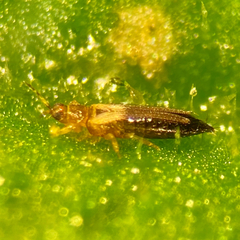
Amblyseius swirskii 23 claims

species · family Phytoseiidae · animal · NCBI Taxonomy ↗

Also written in claims: Typhlodromips swirskii · T. swirskii — NCBI synonyms: Neoseiulus swirskii · Typhlodromips swirskii

4 spellings

Amblyseius swirskii
Amblyseius swirskiiLin, G., Guertin, C., Di Paolo, SA. et al. · CC BY 4.0 · Wikimedia Commons ↗
Intervention effectobservedoriginal resultpositivemeasured

Claim · model-written summary

A. swirskii had higher predation and oviposition rates than E. degenerans on first-instar thrips.

Taxon
A. swirskiiAmblyseius swirskiie0
Treatment
first instar larvae of T. parvispinuse0
Interactor
T. parvispinusThrips parvispinuse0pest
Outcome
predation and oviposition ratese0
Direction
highere0
Comparator
E. degeneranse0

Verbatim

e0

“We evaluated the predation and oviposition rates of two predatory mites, Amblyseius swirskii (Athias-Henriot) and Euseius degenerans (Berlese), when offered first instar larvae of T. parvispinus and found that predation and oviposition rates of A. swirskii were higher than those of E. degenerans .”

✓ located verbatim in the source · abstract, characters 430–728

Title

A predatory mite as potential biological control agent of the invasive Thrips parvispinus

J. Alexandra Sierra-Monroy; Jacques A. Deere; Karen A. Muñoz Cárdenas; et al. BioControl 2025. doi:10.1007/s10526-025-10343-z

Other claims from this paper (4)
Intervention effectobservedoriginal resultpositivemeasured

Claim · model-written summary

Pollen increased juvenile survival and development of A. swirskii relative to thrips larvae alone.

Taxon
A. swirskiiAmblyseius swirskiie0
Treatment
pollene0
Outcome
juvenile survival and developmental ratee0
Direction
highere0
Comparator
diet of thrips larvae alonee0

Verbatim

e0

“A. swirskii had a higher juvenile survival and developmental rate when provided with pollen or a diet of pollen with thrips larvae than when provided with a diet of thrips larvae alone.”

✓ located verbatim in the source · abstract, characters 742–927

Title

A predatory mite as potential biological control agent of the invasive Thrips parvispinus

J. Alexandra Sierra-Monroy; Jacques A. Deere; Karen A. Muñoz Cárdenas; et al. BioControl 2025. doi:10.1007/s10526-025-10343-z

Other claims from this paper (4)
Intervention effectobservedoriginal resultpositivemeasured

Claim · model-written summary

Pollen plus thrips larvae increased juvenile survival and development relative to larvae alone.

Taxon
A. swirskiiAmblyseius swirskiie0
Treatment
diet of pollen with thrips larvaee0
Outcome
juvenile survival and developmental ratee0
Direction
highere0
Comparator
diet of thrips larvae alonee0

Verbatim

e0

“A. swirskii had a higher juvenile survival and developmental rate when provided with pollen or a diet of pollen with thrips larvae than when provided with a diet of thrips larvae alone.”

✓ located verbatim in the source · abstract, characters 742–927

Title

A predatory mite as potential biological control agent of the invasive Thrips parvispinus

J. Alexandra Sierra-Monroy; Jacques A. Deere; Karen A. Muñoz Cárdenas; et al. BioControl 2025. doi:10.1007/s10526-025-10343-z

Other claims from this paper (4)
Intervention effectobservedoriginal resultnegativemeasured

Claim · model-written summary

Huwa-San TR50 reduced predatory mite populations by 31.78% in the field and 31.97% in the laboratory.

Taxon
Typhlodromips swirskiiAmblyseius swirskiie0
Treatment
6000ppm of Huwa-San TR50e0
Outcome
population of the predatory mite, Typhlodromips swirskiie0
Direction
reducede0
Value
31.78 and 31.97%e0

Not reportedInteractorComparator

Verbatim

e0

“the population of the predatory mite, Typhlodromips swirskii was reduced by 31.78 and 31.97% for 6000ppm of Huwa-San TR50”

✓ located verbatim in the source · abstract, characters 1096–1217
t0

“Citrus Rust Mite, Phyllocoptruta oleivora”

✓ located verbatim in the source · title, characters 56–97

Title

Huwa-San TR50 as an Acaricidal Agent in Controlling the Citrus Rust Mite, Phyllocoptruta oleivora (Ashmead) (Acari: Eriophyidae)

Mahmoud M. Al-Azzazy; Saleh S. Alhewairini International Journal of Agriculture and Biology 2025. doi:10.17957/ijab/15.1217

Other claims from this paper (14)
Intervention effectobservedoriginal resultnegativemeasured

Claim · model-written summary

Abamectin reduced predatory mite populations by 88.82% in the field and 91.36% in the laboratory.

Taxon
Typhlodromips swirskiiAmblyseius swirskiie0
Treatment
abamectine0
Outcome
population of the predatory mite, Typhlodromips swirskiie0
Direction
reducede0
Value
88.82 and 91.36%e0

Not reportedComparator

Verbatim

e0

“the population of the predatory mite, Typhlodromips swirskii was reduced by 31.78 and 31.97% for 6000ppm of Huwa-San TR50; and by 88.82 and 91.36% for abamectin”

✓ located verbatim in the source · abstract, characters 1096–1256

Title

Huwa-San TR50 as an Acaricidal Agent in Controlling the Citrus Rust Mite, Phyllocoptruta oleivora (Ashmead) (Acari: Eriophyidae)

Mahmoud M. Al-Azzazy; Saleh S. Alhewairini International Journal of Agriculture and Biology 2025. doi:10.17957/ijab/15.1217

Other claims from this paper (14)
Intervention effectobservedoriginal resultnegativemeasured

Claim · model-written summary

Bifenthrin reduced predatory mite populations by 97.10% in the field and 100% in the laboratory.

Taxon
Typhlodromips swirskiiAmblyseius swirskiie0
Treatment
bifenthrine0
Outcome
population of the predatory mite, Typhlodromips swirskiie0
Direction
reducede0
Value
97.10 and 100%e0

Not reportedComparator

Verbatim

e0

“the population of the predatory mite, Typhlodromips swirskii was reduced by 31.78 and 31.97% for 6000ppm of Huwa-San TR50; and by 88.82 and 91.36% for abamectin and by 97.10 and 100% for bifenthrin”

✓ located verbatim in the source · abstract, characters 1096–1293

Title

Huwa-San TR50 as an Acaricidal Agent in Controlling the Citrus Rust Mite, Phyllocoptruta oleivora (Ashmead) (Acari: Eriophyidae)

Mahmoud M. Al-Azzazy; Saleh S. Alhewairini International Journal of Agriculture and Biology 2025. doi:10.17957/ijab/15.1217

Other claims from this paper (14)
Observationauthor interpretationoriginal resultpositivemeasured

Claim · model-written summary

The authors consider Huwa-San TR50 less toxic to the predatory mite than the alternatives.

Taxon
T. swirskiiAmblyseius swirskiie0
Treatment
Huwa-San TR50e0
Outcome
toxic to the predatory mitee0
Direction
lesse0

Verbatim

e0

“Huwa-San TR50 seems to be less toxic to the predatory mite, T. swirskii”

✓ located verbatim in the source · abstract, characters 1353–1424

Title

Huwa-San TR50 as an Acaricidal Agent in Controlling the Citrus Rust Mite, Phyllocoptruta oleivora (Ashmead) (Acari: Eriophyidae)

Mahmoud M. Al-Azzazy; Saleh S. Alhewairini International Journal of Agriculture and Biology 2025. doi:10.17957/ijab/15.1217

Other claims from this paper (14)
Observationobservedoriginal resultmeasured

Claim · model-written summary

Amblyseius swirskii peaked in early July.

Taxon
Amblyseius swirskiiAmblyseius swirskiie0
Outcome
one peake0

Verbatim

e0

“the predatory mite Amblyseius swirskii has one peak in early July”

✓ located verbatim in the source · abstract, characters 740–805

Title

Complementary description of Calacarus jasmini (Phyllocoptinae, Eriophyidae) on jasmine in Egypt, with a special remark to its abundance

Ashraf Said Elhalawany; Ahmed S. Sanad; Rabab A. Hammad Acarines: Journal of the Egyptian Society of Acarology /Acarines: Journal of the Egyptian Society of Acarology 2024. doi:10.21608/ajesa.2024.403665

Other claims from this paper (9)
Associationobservedoriginal resultmeasured

Claim · model-written summary

Phytophagous mite incidence had a highly positive relationship with A. swirskii.

Taxon
A. swirskiiAmblyseius swirskiie0
Interactor
phytophagous mitese0pest
Outcome
incidencee0
Direction
positivee0

Verbatim

e0

“The incidence of the two phytophagous mites and A. swirskii showed a highly positive relationship”

✓ located verbatim in the source · abstract, characters 986–1083

Title

Complementary description of Calacarus jasmini (Phyllocoptinae, Eriophyidae) on jasmine in Egypt, with a special remark to its abundance

Ashraf Said Elhalawany; Ahmed S. Sanad; Rabab A. Hammad Acarines: Journal of the Egyptian Society of Acarology /Acarines: Journal of the Egyptian Society of Acarology 2024. doi:10.21608/ajesa.2024.403665

Other claims from this paper (9)
Associationobservedoriginal resultsignificant (as stated)measured

Claim · model-written summary

Crop species significantly affected A. swirskii density.

Taxon
A. swirskiiAmblyseius swirskiie0
Treatment
Crop speciese0
Outcome
density of A. swirskiie0

Not reportedDirection

Verbatim

e0

“Crop species had a significant effect on the density of A. swirskii.”

✓ located verbatim in the source · abstract, characters 782–850

Title

Within-plant Distributions and Density of Amblyseius swirskii (Acari: Phytoseiidae) as Influenced by Interactions Between Plastic Mulch and Vegetable Crop Species

Mohammad A Razzak; Dakshina R Seal; Bruce Schaffer; et al. Environmental Entomology 2021. doi:10.1093/ee/nvab112

Other claims from this paper (7)