Abstract
In the biosynthetic pathway to the gibberellins (GAs), carbon-20 is removed by oxidation to give the C19-GAs, which include the biologically active plant hormones. We report the isolation of a cDNA clone encoding a GA 20-oxidase [gibberellin, 2-oxoglutarate:oxygen oxidoreductase (20-hydroxylating, oxidizing) EC 1.14.11.-] by screening a cDNA library from developing cotyledons of pumpkin (Cucurbita maxima L.) for expression of this enzyme. When mRNA from either the cotyledons or the endosperm was translated in vitro using rabbit reticulocyte lysates, the products contained GA12 20-oxidase activity. A polyclonal antiserum was raised against the amino acid sequence of a peptide released by tryptic digestion of purified GA 20-oxidase from the endosperm. A cDNA expression library in lambda gt11 was prepared from cotyledon mRNA and screened with the antiserum. The identity of positive clones was confirmed by the demonstration of GA12 20-oxidase activity in single bacteriophage plaques. Recombinant protein from a selected clone catalyzed the three-step conversions of GA12 to GA25 and of GA53 to GA17, as well as the formation of the C19-GAs, GA1, GA9, and GA20, from their respective aldehyde precursors, GA23, GA24, and GA19. The nucleotide sequence of the cDNA insert contains an open reading frame of 1158 nt encoding a protein of 386 amino acid residues. The predicted M(r) (43,321) and pI (5.3) are similar to those determined experimentally for the native GA 20-oxidase. Furthermore, the derived amino acid sequence includes sequences obtained from the N terminus and two tryptic peptides from the native enzyme. It also contains regions that are highly conserved in a group of non-heme Fe-containing dioxygenases.
Abstract from the paper’s OpenAlex record, shown for indexing and research. Copyright remains with the authors or the publisher. Read at the source ↗
The text the model read, with the source record’s inline markup (italics, sub- and superscripts) rendered and its character entities decoded; quote offsets refer to the raw text.
Claims 14
Claim · model-written summary
A cDNA clone encoding pumpkin GA 20-oxidase was isolated.
- Taxon
- pumpkin (Cucurbita maxima L.)
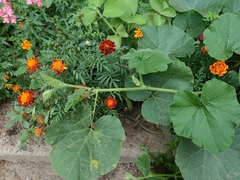 Cucurbita maximae0
- Organ / stage
- developing cotyledonse0
- Gene
- GA 20-oxidasee0
- Outcome
- isolation of a cDNA clonee0
Organisms pictured · Representative pictures of the matched species, not figures from the paper.

Verbatim
e0“We report the isolation of a cDNA clone encoding a GA 20-oxidase [gibberellin, 2-oxoglutarate:oxygen oxidoreductase (20-hydroxylating, oxidizing) EC 1.14.11.-] by screening a cDNA library from developing cotyledons of pumpkin (Cucurbita maxima L.)”
Claim · model-written summary
Translation products from cotyledon and endosperm mRNA contained GA12 20-oxidase activity.
- Taxon
- pumpkin (Cucurbita maxima L.)Cucurbita maximae1
- Organ / stage
- cotyledons or the endosperme0
- Gene
- GA12 20-oxidasee0
- Outcome
- GA12 20-oxidase activitye0
Organisms pictured · Representative pictures of the matched species, not figures from the paper.
Verbatim
e0“When mRNA from either the cotyledons or the endosperm was translated in vitro using rabbit reticulocyte lysates, the products contained GA12 20-oxidase activity.”
e1“pumpkin (Cucurbita maxima L.)”
Claim · model-written summary
Positive cDNA clones had GA12 20-oxidase activity in single bacteriophage plaques.
- Taxon
- pumpkin (Cucurbita maxima L.)Cucurbita maximae1
- Gene
- GA12 20-oxidasee0
- Outcome
- GA12 20-oxidase activitye0
Organisms pictured · Representative pictures of the matched species, not figures from the paper.
Verbatim
e0“The identity of positive clones was confirmed by the demonstration of GA12 20-oxidase activity in single bacteriophage plaques.”
e1“pumpkin (Cucurbita maxima L.)”
Claim · model-written summary
Recombinant protein converted GA12 to GA25 in three steps.
Not reportedTaxon
Verbatim
e0“Recombinant protein from a selected clone catalyzed the three-step conversions of GA12 to GA25 and of GA53 to GA17”
Claim · model-written summary
Recombinant protein converted GA53 to GA17 in three steps.
- Taxon
- pumpkin (Cucurbita maxima L.)Cucurbita maximae1
- Gene
- Recombinant proteine0
- Outcome
- GA53 to GA17e0
Organisms pictured · Representative pictures of the matched species, not figures from the paper.
Verbatim
e0“Recombinant protein from a selected clone catalyzed the three-step conversions of GA12 to GA25 and of GA53 to GA17”
e1“pumpkin (Cucurbita maxima L.)”
Claim · model-written summary
Recombinant protein formed GA1 from GA23.
- Taxon
- pumpkin (Cucurbita maxima L.)Cucurbita maximae2
- Gene
- Recombinant proteine1
- Outcome
- formation of the C19-GAs, GA1e0
Organisms pictured · Representative pictures of the matched species, not figures from the paper.
Verbatim
e0“the formation of the C19-GAs, GA1, GA9, and GA20, from their respective aldehyde precursors, GA23, GA24, and GA19”
e1“Recombinant protein from a selected clone”
e2“pumpkin (Cucurbita maxima L.)”
Claim · model-written summary
Recombinant protein formed GA9 from GA24.
- Taxon
- pumpkin (Cucurbita maxima L.)Cucurbita maximae2
- Gene
- Recombinant proteine1
- Outcome
- GA9e0
Organisms pictured · Representative pictures of the matched species, not figures from the paper.
Verbatim
e0“the formation of the C19-GAs, GA1, GA9, and GA20, from their respective aldehyde precursors, GA23, GA24, and GA19”
e1“Recombinant protein from a selected clone”
e2“pumpkin (Cucurbita maxima L.)”
Claim · model-written summary
Recombinant protein formed GA20 from GA19.
- Taxon
- pumpkin (Cucurbita maxima L.)Cucurbita maximae2
- Gene
- Recombinant proteine1
- Outcome
- GA20e0
Organisms pictured · Representative pictures of the matched species, not figures from the paper.
Verbatim
e0“the formation of the C19-GAs, GA1, GA9, and GA20, from their respective aldehyde precursors, GA23, GA24, and GA19”
e1“Recombinant protein from a selected clone”
e2“pumpkin (Cucurbita maxima L.)”
Claim · model-written summary
The cDNA open reading frame spans 1158 nt.
- Taxon
- pumpkin (Cucurbita maxima L.)Cucurbita maximae1
- Outcome
- open reading framee0
- Value
- 1158 nte0
Organisms pictured · Representative pictures of the matched species, not figures from the paper.
Verbatim
e0“The nucleotide sequence of the cDNA insert contains an open reading frame of 1158 nt encoding a protein of 386 amino acid residues.”
e1“pumpkin (Cucurbita maxima L.)”
Claim · model-written summary
The cDNA open reading frame encodes a protein of 386 amino acid residues.
- Taxon
- pumpkin (Cucurbita maxima L.)Cucurbita maximae1
- Outcome
- proteine0
- Value
- 386 amino acid residuese0
Organisms pictured · Representative pictures of the matched species, not figures from the paper.
Verbatim
e0“The nucleotide sequence of the cDNA insert contains an open reading frame of 1158 nt encoding a protein of 386 amino acid residues.”
e1“pumpkin (Cucurbita maxima L.)”
Claim · model-written summary
Predicted molecular mass was similar to that of native GA 20-oxidase.
- Taxon
- pumpkin (Cucurbita maxima L.)Cucurbita maximae1
- Gene
- GA 20-oxidasee0
- Outcome
- M(r)e0
- Direction
- similare0
- Value
- 43,321e0
- Comparator
- native GA 20-oxidasee0
Organisms pictured · Representative pictures of the matched species, not figures from the paper.
Verbatim
e0“The predicted M(r) (43,321) and pI (5.3) are similar to those determined experimentally for the native GA 20-oxidase.”
e1“pumpkin (Cucurbita maxima L.)”
Claim · model-written summary
Predicted pI was similar to that of native GA 20-oxidase.
- Taxon
- pumpkin (Cucurbita maxima L.)Cucurbita maximae1
- Gene
- GA 20-oxidasee0
- Outcome
- pIe0
- Direction
- similare0
- Value
- 5.3e0
- Comparator
- native GA 20-oxidasee0
Organisms pictured · Representative pictures of the matched species, not figures from the paper.
Verbatim
e0“The predicted M(r) (43,321) and pI (5.3) are similar to those determined experimentally for the native GA 20-oxidase.”
e1“pumpkin (Cucurbita maxima L.)”
Claim · model-written summary
Derived sequence includes N-terminal and two tryptic peptide sequences of the native enzyme.
- Taxon
- pumpkin (Cucurbita maxima L.)Cucurbita maximae1
- Outcome
- derived amino acid sequencee0
Organisms pictured · Representative pictures of the matched species, not figures from the paper.
Verbatim
e0“the derived amino acid sequence includes sequences obtained from the N terminus and two tryptic peptides from the native enzyme”
e1“pumpkin (Cucurbita maxima L.)”
Claim · model-written summary
Derived sequence contains regions conserved among non-heme iron dioxygenases.
- Taxon
- pumpkin (Cucurbita maxima L.)Cucurbita maximae2
- Outcome
- regions that are highly conserved in a group of non-heme Fe-containing dioxygenasese0
Organisms pictured · Representative pictures of the matched species, not figures from the paper.
Verbatim
e0“It also contains regions that are highly conserved in a group of non-heme Fe-containing dioxygenases.”
e1“the derived amino acid sequence”
e2“pumpkin (Cucurbita maxima L.)”