Abstract
Slices of storage tissue of red beet (Beta vulgaris L.) washed for only 1 day in distilled water readily absorb K(+) but lack a mechanism for rapid Na(+) uptake. A Na(+) transport mechanism develops if the tissue is washed for several days, and the tissue then excludes K(+) during Na(+) uptake.Both the high affinity and low affinity absorption mechanisms show a development of Na(+) transport with washing, and, in contrast to barley roots, cation selectivity in beet is not affected by the presence of calcium ions.K(+) and Na(+) do not appear to compete for binding sites at the surface of the cells, but, as in barley roots, the cations compete in some way for electrically balancing transported ions. Nevertheless, the development of Na(+) transport and the interaction of Na(+) with K(+) occur in the same way whether cation transport is balanced by Cl(-) uptake or by H(+) or HCO(3) (-) transport.
Abstract from the paper’s OpenAlex record, shown for indexing and research. Copyright remains with the authors or the publisher. Read at the source ↗
The text the model read, with the source record’s inline markup (italics, sub- and superscripts) rendered and its character entities decoded; quote offsets refer to the raw text.
Claims 8
Claim · model-written summary
After one day of washing, red beet tissue readily absorbs potassium but lacks rapid sodium uptake.
Verbatim
e0“Slices of storage tissue of red beet (Beta vulgaris L.) washed for only 1 day in distilled water readily absorb K(+) but lack a mechanism for rapid Na(+) uptake.”
Claim · model-written summary
Several days of washing develop sodium transport in red beet tissue.
Not reportedTaxonComparator
Verbatim
e0“A Na(+) transport mechanism develops if the tissue is washed for several days”
Claim · model-written summary
Washed red beet tissue excludes potassium during sodium uptake.
Not reportedTaxon
Verbatim
e0“the tissue then excludes K(+) during Na(+) uptake”
Claim · model-written summary
High affinity and low affinity absorption mechanisms develop sodium transport with washing.
- Outcome
- Na(+) transporte0
- Direction
- developmente0
- Qualifier
- high affinity and low affinity absorption mechanismse0
Not reportedTaxon
Verbatim
e0“Both the high affinity and low affinity absorption mechanisms show a development of Na(+) transport with washing”
Claim · model-written summary
Calcium ions do not affect cation selectivity in beet, unlike barley roots.
- Taxon
- beet
 Beta vulgarise0
- Treatment
- presence of calcium ionse0
- Outcome
- cation selectivitye0
- Direction
- not affectede0
- Comparator
- barley rootse0
Organisms pictured · Representative pictures of the matched species, not figures from the paper.
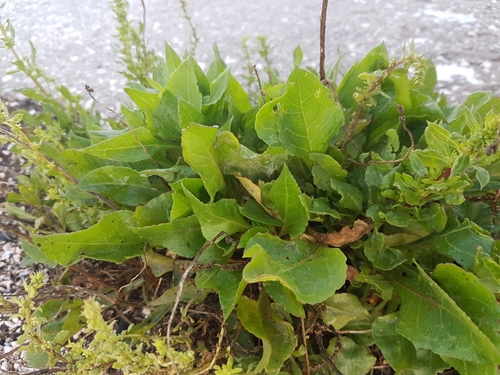
Verbatim
e0“in contrast to barley roots, cation selectivity in beet is not affected by the presence of calcium ions”
Claim · model-written summary
Potassium and sodium appear not to compete for cell surface binding sites.
Not reportedTaxon
Verbatim
e0“K(+) and Na(+) do not appear to compete for binding sites at the surface of the cells”
Claim · model-written summary
Potassium and sodium compete to balance transported ions electrically.
Not reportedTaxon
Verbatim
e0“the cations compete in some way for electrically balancing transported ions”
Claim · model-written summary
Sodium transport development and its interaction with potassium are the same under chloride uptake and hydrogen or bicarbonate transport.
- Outcome
- development of Na(+) transport and the interaction of Na(+) with K(+)e0
- Direction
- in the same waye0
- Qualifier
- whether cation transport is balanced by Cl(-) uptake or by H(+) or HCO(3) (-) transporte0
Not reportedTaxon
Verbatim
e0“the development of Na(+) transport and the interaction of Na(+) with K(+) occur in the same way whether cation transport is balanced by Cl(-) uptake or by H(+) or HCO(3) (-) transport”