Abstract
The effects of carbofuran on the transmission of maize chlorotic dwarf virus (MCDV) and maize dwarf mosaic virus (MDMV) to a susceptible field corn hybrid were evaluated in a greenhouse-laboratory study. The incidence of MCDV and MDMV in plants treated with an amount of carbofuran equivalent to 1.46 kg (AI)/ha of soil incorporated at planting was compared with that in untreated control plants. Graminella nigrifrons (Forbes) and Rhopalosiphum maidis (Fitch), the respective vectors of MCDV and MDMV, transmitted MCDV and MDMV to untreated, three-leaf-stage corn plants at rates averaging 89.2 and 64.4%, respectively, when 7 leafhoppers or 15 aphids were used per plant. Carbofuran treatment significantly reduced transmission of MCDV by G. nigrifrons, resulting in a disease incidence of 12.8%. Reduction of MCDV in treated plants was due to the 90.8% mortality of G. nigrifrons within 4 h after placement on the plant. Carbofuran treatment did not affect the transmission of MDMV by R. maidis but did reduce R. maidis populations by 80.4% within 24 h, thus suggesting possible reduction of the secondary spread of virus in field situations.
Abstract from the paper’s OpenAlex record, shown for indexing and research. Copyright remains with the authors or the publisher. Read at the source ↗
The text the model read, with the source record’s inline markup (italics, sub- and superscripts) rendered and its character entities decoded; quote offsets refer to the raw text.
Claims 7
Claim · model-written summary
Untreated corn had MCDV transmission averaging 89.2% from G. nigrifrons.
- Taxon
- corn
 Zea mays subsp. mayse0
- Organ / stage
- three-leaf-stagee0
- Interactor
- Graminella nigrifrons (Forbes)
 Graminella nigrifronse0pest
- Outcome
- transmitted MCDVe0
- Value
- 89.2e0
- Qualifier
- 7 leafhopperse0
Organisms pictured · Representative pictures of the matched species, not figures from the paper.


Verbatim
e0“Graminella nigrifrons (Forbes) and Rhopalosiphum maidis (Fitch), the respective vectors of MCDV and MDMV, transmitted MCDV and MDMV to untreated, three-leaf-stage corn plants at rates averaging 89.2 and 64.4%, respectively, when 7 leafhoppers or 15 aphids were used per plant.”
Claim · model-written summary
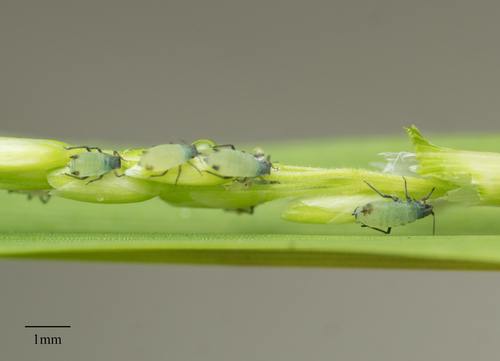
Untreated corn had MDMV transmission averaging 64.4% from R. maidis.
- Taxon
- cornZea mays subsp. mayse0
- Organ / stage
- three-leaf-stagee0
- Interactor
- Rhopalosiphum maidis (Fitch)
 Rhopalosiphum maidise0pest
- Outcome
- MDMVe0
- Value
- 64.4%e0
- Qualifier
- 15 aphidse0
Organisms pictured · Representative pictures of the matched species, not figures from the paper.
Verbatim
e0“Graminella nigrifrons (Forbes) and Rhopalosiphum maidis (Fitch), the respective vectors of MCDV and MDMV, transmitted MCDV and MDMV to untreated, three-leaf-stage corn plants at rates averaging 89.2 and 64.4%, respectively, when 7 leafhoppers or 15 aphids were used per plant.”
Claim · model-written summary
Carbofuran significantly reduced MCDV transmission by G. nigrifrons, leaving 12.8% disease incidence.
- Taxon
- field corne2
- Treatment
- Carbofuran treatmente0
- Interactor
- MCDVe0pathogen
- Second interactor
- G. nigrifronsGraminella nigrifronse0pest
- Outcome
- transmission of MCDVe0
- Direction
- reducede0
- Value
- 12.8%e0
- Comparator
- untreated control plantse1
Organisms pictured · Representative pictures of the matched species, not figures from the paper.
Verbatim
e0“Carbofuran treatment significantly reduced transmission of MCDV by G. nigrifrons, resulting in a disease incidence of 12.8%.”
e1“untreated control plants”
e2“susceptible field corn hybrid”
Claim · model-written summary
Carbofuran caused 90.8% mortality of G. nigrifrons within four hours.
- Taxon
- CornZea mays subsp. mayst0
- Treatment
- carbofurane1
- Interactor
- G. nigrifronsGraminella nigrifronse0pest
- Outcome
- mortality of G. nigrifronse0
- Value
- 90.8%e0
- Qualifier
- within 4 he0
- Comparator
- untreated control plantse2
Not reportedDirection
Organisms pictured · Representative pictures of the matched species, not figures from the paper.
Verbatim
e0“Reduction of MCDV in treated plants was due to the 90.8% mortality of G. nigrifrons within 4 h after placement on the plant.”
e1“The effects of carbofuran on the transmission”
e2“untreated control plants”
t0“Field Corn”
Claim · model-written summary
Carbofuran did not affect MDMV transmission by R. maidis.
- Taxon
- CornZea mays subsp. mayst0
- Treatment
- Carbofuran treatmente0
- Interactor
- MDMVMaize dwarf mosaic viruse0pathogen
- Second interactor
- R. maidisRhopalosiphum maidise0pest
- Outcome
- transmission of MDMVe0
- Direction
- did not affecte0
- Comparator
- untreated control plantse1
Organisms pictured · Representative pictures of the matched species, not figures from the paper.
Verbatim
e0“Carbofuran treatment did not affect the transmission of MDMV by R. maidis but did reduce R. maidis populations by 80.4% within 24 h”
e1“untreated control plants”
t0“Field Corn”
Claim · model-written summary
Carbofuran reduced R. maidis populations by 80.4% within 24 hours.
- Taxon
- CornZea mays subsp. mayst0
- Treatment
- Carbofuran treatmente0
- Interactor
- R. maidisRhopalosiphum maidise0pest
- Outcome
- R. maidis populationse0
- Direction
- reducee0
- Value
- 80.4%e0
- Qualifier
- within 24 he0
- Comparator
- untreated control plantse1
Organisms pictured · Representative pictures of the matched species, not figures from the paper.
Verbatim
e0“Carbofuran treatment did not affect the transmission of MDMV by R. maidis but did reduce R. maidis populations by 80.4% within 24 h”
e1“untreated control plants”
t0“Field Corn”
Claim · model-written summary
The authors suggested carbofuran could reduce secondary viral spread in fields.
- Taxon
- CornZea mays subsp. mayst0
- Outcome
- possible reduction of the secondary spread of viruse0
- Setting
- field situationse0
Organisms pictured · Representative pictures of the matched species, not figures from the paper.
Verbatim
e0“thus suggesting possible reduction of the secondary spread of virus in field situations.”
t0“Field Corn”
The same questions in other papers
carbofuran · Graminella nigrifrons · Zea mays (maize)Results agree
1 paper in the same direction as this paper
- positive
carbofuran · disease · Zea mays (maize)Results agree
2 papers in the same direction as this paper
- positive
- positive
Claims are grouped by organism, treatment and what was measured or targeted. A paper counts as positive when any of its claims in the group is positive.