Abstract
Superoxide dismutase (SOD) activity is closely associated with stress tolerance of creeping bentgrass [ Agrostis stoloniferous L . var. palustris ( Huds .) Farw (syn. A. palustris Huds.)]. This study was conducted to investigate the influence of two plant growth regulators (PGRs) on the endogenous antioxidant SOD level and photochemical activity in `Penncross' creeping bentgrass grown under two fertilizer regimes. Mature `Penncross' was treated monthly with TE at 0.44 g a.i./100 m 2 and PPC at 3.37 g a.i./100 m 2 from May through November at the Virginia Tech Turfgrass Research Center, Blacksburg, Va. Foliar application of TE and PPC increased SOD activity, photochemical activity, and Fm730/Fm690 ratio of creeping bentgrass under the two fertilization regimes as well as when the grass was exposed to a low soil moisture environment. TE reduced clipping weight consistently regardless of the fertilization regime. In contrast, PPC increased clipping weight slightly. Both TE and PPC significantly reduced Dollar spot disease ( Sclerotinia homoeocarpa Bennett) under both high and low fertilization regimes. No significant fertilization × PGR interactions for SOD, photochemical activity of PS II, and Fm730/Fm690 were observed in well-watered or drought stressed bentgrass. Improvement in stress tolerance of creeping bentgrass by the PGRs appears to be associated partially with an increase of endogenous SOD activity. Chemical names used: trinexapac-ethyl (TE); propiconazole (PPC).
Abstract from the paper’s OpenAlex record, shown for indexing and research. Copyright remains with the authors or the publisher. Read at the source ↗
The text the model read, with the source record’s inline markup (italics, sub- and superscripts) rendered and its character entities decoded; quote offsets refer to the raw text.
Claims 8
Claim · model-written summary
TE increased SOD activity, photochemical activity and Fm730/Fm690 under both fertilization regimes and low moisture.
- Taxon
- creeping bentgrass
 Agrostis stoloniferae0
- Treatment
- TEe0
- Outcome
- SOD activity, photochemical activity, and Fm730/Fm690 ratioe0
- Direction
- increasede0
- Qualifier
- under the two fertilization regimes as well as when the grass was exposed to a low soil moisture environmente0
Not reportedComparator
Organisms pictured · Representative pictures of the matched species, not figures from the paper.

Verbatim
e0“Foliar application of TE and PPC increased SOD activity, photochemical activity, and Fm730/Fm690 ratio of creeping bentgrass under the two fertilization regimes as well as when the grass was exposed to a low soil moisture environment”
Claim · model-written summary
PPC increased SOD activity, photochemical activity and Fm730/Fm690 under both fertilization regimes and low moisture.
- Taxon
- creeping bentgrassAgrostis stoloniferae0
- Treatment
- PPCe0
- Outcome
- SOD activity, photochemical activity, and Fm730/Fm690 ratioe0
- Direction
- increasede0
Not reportedComparator
Organisms pictured · Representative pictures of the matched species, not figures from the paper.
Verbatim
e0“Foliar application of TE and PPC increased SOD activity, photochemical activity, and Fm730/Fm690 ratio of creeping bentgrass under the two fertilization regimes as well as when the grass was exposed to a low soil moisture environment”
Claim · model-written summary
TE consistently reduced bentgrass clipping weight.
- Taxon
- creeping bentgrassAgrostis stoloniferat0
- Treatment
- TEe0
- Outcome
- clipping weighte0
- Direction
- reducede0
Not reportedComparator
Organisms pictured · Representative pictures of the matched species, not figures from the paper.
Verbatim
e0“TE reduced clipping weight consistently regardless of the fertilization regime”
t0“Creeping Bentgrass”
Claim · model-written summary
PPC slightly increased bentgrass clipping weight.
- Taxon
- creeping bentgrassAgrostis stoloniferat0
- Treatment
- PPCe0
- Outcome
- clipping weighte0
- Direction
- increasede0
Not reportedComparator
Organisms pictured · Representative pictures of the matched species, not figures from the paper.
Verbatim
e0“PPC increased clipping weight slightly”
t0“Creeping Bentgrass”
Claim · model-written summary
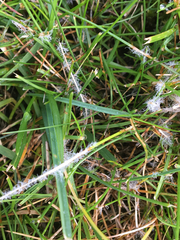
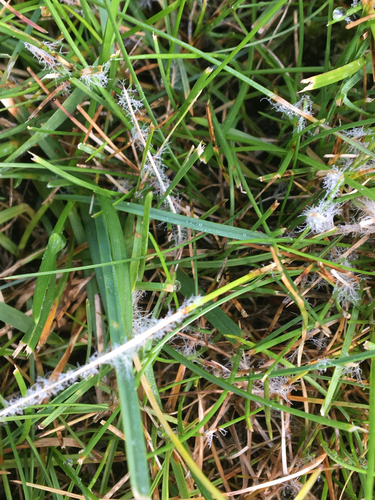
TE significantly reduced Dollar spot disease under high and low fertilization.
- Taxon
- creeping bentgrassAgrostis stoloniferat0
- Treatment
- TEe0
- Interactor
- Sclerotinia homoeocarpa
 Clarireedia homoeocarpae0pathogen
- Outcome
- Dollar spot diseasee0
- Direction
- reducede0
Not reportedComparator
Organisms pictured · Representative pictures of the matched species, not figures from the paper.
Verbatim
e0“Both TE and PPC significantly reduced Dollar spot disease ( Sclerotinia homoeocarpa Bennett) under both high and low fertilization regimes”
t0“Creeping Bentgrass”
Claim · model-written summary
PPC significantly reduced Dollar spot disease under high and low fertilization.
- Taxon
- creeping bentgrassAgrostis stoloniferat0
- Treatment
- PPCe0
- Interactor
- Sclerotinia homoeocarpaClarireedia homoeocarpae0pathogen
- Outcome
- Dollar spot diseasee0
- Direction
- reducede0
Not reportedComparator
Organisms pictured · Representative pictures of the matched species, not figures from the paper.
Verbatim
e0“Both TE and PPC significantly reduced Dollar spot disease ( Sclerotinia homoeocarpa Bennett) under both high and low fertilization regimes”
t0“Creeping Bentgrass”
Claim · model-written summary
Fertilization and PGR had no significant interaction for SOD activity, PS II photochemical activity or Fm730/Fm690 under wet or dry conditions.
Verbatim
e0“No significant fertilization × PGR interactions for SOD, photochemical activity of PS II, and Fm730/Fm690 were observed in well-watered or drought stressed bentgrass”
Claim · model-written summary
The authors associated improved stress tolerance after PGR treatment partly with increased endogenous SOD activity.
- Taxon
- creeping bentgrassAgrostis stoloniferae0
- Treatment
- PGRse0
- Gene
- SODe0
- Outcome
- stress tolerancee0
- Qualifier
- appears to be associated partiallye0
Organisms pictured · Representative pictures of the matched species, not figures from the paper.
Verbatim
e0“Improvement in stress tolerance of creeping bentgrass by the PGRs appears to be associated partially with an increase of endogenous SOD activity”
The same questions in other papers
propiconazole · Clarireedia homoeocarpa · Agrostis stolonifera (creeping bent grass)Positive and negative results
1 paper in the same direction as this paper · 1 in the opposite direction
- no effect
- positive
trinexapac-ethyl · Clarireedia homoeocarpa · Agrostis stolonifera (creeping bent grass)Results agree
1 paper in the same direction as this paper
- positive
trinexapac-ethyl · physiology: antioxidant enzymes · Agrostis stolonifera (creeping bent grass)Results agree
1 paper in the same direction as this paper
- positive
Claims are grouped by organism, treatment and what was measured or targeted. A paper counts as positive when any of its claims in the group is positive.