Abstract
The objective of this work was to evaluate the effect of cover crops and timing of pre-emergence herbicide applications on soybean yield under no-tillage system. The experiment consisted of four cover crops (Panicum maximum, Urochloa ruziziensis, U. brizantha, and pearl millet) and fallow, in addition to four herbicide timings (30, 20, 10, and 0 days before soybean sowing), under no-tillage system (NTS), and of two control treatments under conventional tillage system (CTS). The experimental design was a completely randomized block, in a split-plot arrangement, with three replicates. Soybean under fallow, P. maximum, U. ruziziensis, U. brizantha, and pearl millet in the NTS and soybean under U. brizantha in the CTS did not differ significantly regarding yield. Soybean under fallow in the CTS significantly reduced yield when compared to the other treatments. The amount of straw on soil surface did not significantly affect soybean yield. Chemical management of P. maximum and U. brizantha near the soybean sowing date causes significant damage in soybean yield. However, herbicide timing in fallow, U. ruziziensis, and pearl millet does not affect soybean yield.
Abstract from the paper’s OpenAlex record; open copy licensed cc-by. Read at the source ↗
The text the model read, with the source record’s inline markup (italics, sub- and superscripts) rendered and its character entities decoded; quote offsets refer to the raw text.
Claims 8
Claim · model-written summary
Soybean yields under the listed no-tillage covers and U. brizantha conventional tillage did not differ significantly.
Organisms pictured · Representative pictures of the matched species, not figures from the paper.

Verbatim
e0“Soybean under fallow, P. maximum, U. ruziziensis, U. brizantha, and pearl millet in the NTS and soybean under U. brizantha in the CTS did not differ significantly regarding yield.”
Claim · model-written summary
Conventional-tillage fallow significantly reduced soybean yield versus other treatments.
- Taxon
- Soybean
 Glycine maxe0
- Treatment
- fallow in the CTSe0
- Outcome
- yielde0
- Direction
- reducede0
- Comparator
- other treatmentse0
Organisms pictured · Representative pictures of the matched species, not figures from the paper.
Verbatim
e0“Soybean under fallow in the CTS significantly reduced yield when compared to the other treatments.”
Claim · model-written summary
Soil surface straw amount had no significant association with soybean yield.
- Taxon
- soybeanGlycine maxe0
- Treatment
- amount of straw on soil surfacee0
- Outcome
- soybean yielde0
- Direction
- did not significantly affecte0
Organisms pictured · Representative pictures of the matched species, not figures from the paper.
Verbatim
e0“The amount of straw on soil surface did not significantly affect soybean yield.”
Claim · model-written summary
Managing P. maximum chemically near sowing significantly damaged soybean yield.
- Taxon
- soybeanGlycine maxe0
- Treatment
- Chemical management of P. maximume0
- Interactor
- P. maximum
 Megathyrsus maximuse0weed
- Outcome
- soybean yielde0
- Direction
- damagee0
Not reportedComparator
Organisms pictured · Representative pictures of the matched species, not figures from the paper.

Verbatim
e0“Chemical management of P. maximum and U. brizantha near the soybean sowing date causes significant damage in soybean yield.”
Claim · model-written summary
Managing U. brizantha chemically near sowing significantly damaged soybean yield.
- Taxon
- soybeanGlycine maxe0
- Treatment
- Chemical management of P. maximum and U. brizanthae0
- Interactor
- U. brizantha
 Urochloa brizanthae0weed
- Outcome
- soybean yielde0
- Direction
- damagee0
Not reportedComparator
Organisms pictured · Representative pictures of the matched species, not figures from the paper.

Verbatim
e0“Chemical management of P. maximum and U. brizantha near the soybean sowing date causes significant damage in soybean yield.”
Claim · model-written summary
Herbicide timing in fallow did not affect soybean yield.
- Taxon
- soybeanGlycine maxe0
- Treatment
- herbicide timing in fallowe0
- Outcome
- soybean yielde0
- Direction
- does not affecte0
Not reportedComparator
Organisms pictured · Representative pictures of the matched species, not figures from the paper.
Verbatim
e0“herbicide timing in fallow, U. ruziziensis, and pearl millet does not affect soybean yield.”
Claim · model-written summary
Herbicide timing with U. ruziziensis did not affect soybean yield.
- Taxon
- soybeanGlycine maxe0
- Treatment
- herbicide timinge0
- Interactor
- U. ruziziensis
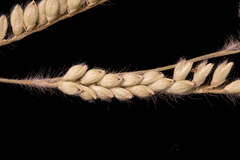 Urochloa ruziziensise0weed
- Outcome
- soybean yielde0
- Direction
- does not affecte0
Not reportedComparator
Organisms pictured · Representative pictures of the matched species, not figures from the paper.

Verbatim
e0“herbicide timing in fallow, U. ruziziensis, and pearl millet does not affect soybean yield.”
Claim · model-written summary
Herbicide timing with pearl millet did not affect soybean yield.
- Taxon
- soybeanGlycine maxe0
- Treatment
- herbicide timinge0
- Interactor
- pearl millet
 Cenchrus americanuse0weed
- Outcome
- soybean yielde0
- Direction
- does not affecte0
Not reportedComparator
Organisms pictured · Representative pictures of the matched species, not figures from the paper.

Verbatim
e0“herbicide timing in fallow, U. ruziziensis, and pearl millet does not affect soybean yield.”
The same questions in other papers
Megathyrsus maximus · yield · Glycine max (soybean)Positive and negative results
3 in the opposite direction
- positive
- positive
- positive
Urochloa brizantha · yield · Glycine max (soybean)Positive and negative results
6 papers in the same direction as this paper · 4 in the opposite direction
- no effect
- negative
- no effect
7 papers more in this group
See all 11 papers →rotation · yield · Glycine max (soybean)Positive and negative results
36 papers in the same direction as this paper · 107 in the opposite direction
- positive
- positive
- positive
140 papers more in this group
See all 144 papers →tillage · yield · Glycine max (soybean)Positive and negative results
125 papers in the same direction as this paper · 264 in the opposite direction
- positive
- positive
- positive
386 papers more in this group
See all 390 papers →herbicide · yield · Glycine max (soybean)Positive and negative results
137 papers in the same direction as this paper · 322 in the opposite direction
- positive
- positive
- positive
456 papers more in this group
See all 460 papers →Claims are grouped by organism, treatment and what was measured or targeted. A paper counts as positive when any of its claims in the group is positive.