Abstract
A variety of organic materials such as humic substances, seaweed extracts (SWE), organic matter, and amino acids are being used as fertilizer supplements in commercial turfgrass management. Among them, SWE and humic acid (HA) are widely used in various biostimulant product formulations. These compounds have been reported to contain phytohormones and osmoprotectants such as cytokinins, auxins, polyamines, and betaines. Manufacturer claims are that these products may supplement standard fertility programs by reducing mineral nutrient requirements while improving stress tolerance. There is a lack of season-long, field-based evidence to support these claims. This study was conducted to investigate the influence of monthly field applications of SWE, HA, and high and low seasonal fertilization regimes on the physiological health of fairway-height creeping bentgrass ( Agrostis stolonifera L.). Plots were treated monthly with SWE at 16 mg·m -2 and HA (70% a.i.) at 38 mg·m -2 alone, or in combination, and were grown under low (20 kg·ha -1 /month) or high nitrogen (50 kg·ha -1 /month) fertilization regimes during 1996 and 1997. Endogenous antioxidant superoxide dismutase (SOD) activity, photochemical activity (PA), and turf quality were measured in July of each year. Superoxide dismutase activity was increased by 46% to 181%, accompanied by a PA increase of 9% to 18%, and improved visual quality of bentgrass in both years. There was no significant fertilization × supplement interaction. Although not part of our original objectives, it was noted that significantly less dollar spot ( Sclerotinia homoeocarpa F.T. Bennett ) disease incidence occurred in supplement-treated bentgrass. Our results indicate that increased SOD activity in July due to SWE and/or HA applications improved overall physiological health, irrespective of fertilization regime. This suggests that these compounds may be beneficial supplements for reducing standard fertilizer and fungicide inputs, while maintaining adequate creeping bentgrass health.
Abstract from the paper’s OpenAlex record, shown for indexing and research. Copyright remains with the authors or the publisher. Read at the source ↗
The text the model read, with the source record’s inline markup (italics, sub- and superscripts) rendered and its character entities decoded; quote offsets refer to the raw text.
Claims 7
Claim · model-written summary
Supplement application increased bentgrass SOD activity by 46% to 181%.
- Taxon
- Creeping Bentgrass
 Agrostis stoloniferat0
- Treatment
- SWE at 16 mg·m -2 and HA (70% a.i.) at 38 mg·m -2 alone, or in combinatione1
- Outcome
- Superoxide dismutase activitye0
- Direction
- increasede0
- Value
- 46% to 181%e0
Not reportedComparator
Organisms pictured · Representative pictures of the matched species, not figures from the paper.

Verbatim
e0“Superoxide dismutase activity was increased by 46% to 181%”
e1“Plots were treated monthly with SWE at 16 mg·m -2 and HA (70% a.i.) at 38 mg·m -2 alone, or in combination”
t0“Creeping Bentgrass”
Claim · model-written summary
Supplement application increased photochemical activity by 9% to 18%.
- Taxon
- Creeping BentgrassAgrostis stoloniferat0
- Treatment
- SWE at 16 mg·m -2 and HA (70% a.i.) at 38 mg·m -2 alone, or in combinatione1
- Outcome
- PAe0
- Direction
- increasee0
- Value
- 9% to 18%e0
Not reportedComparator
Organisms pictured · Representative pictures of the matched species, not figures from the paper.
Verbatim
e0“a PA increase of 9% to 18%”
e1“Plots were treated monthly with SWE at 16 mg·m -2 and HA (70% a.i.) at 38 mg·m -2 alone, or in combination”
t0“Creeping Bentgrass”
Claim · model-written summary
Supplement application improved visual bentgrass quality in both years.
- Taxon
- bentgrasse0
- Treatment
- SWE at 16 mg·m -2 and HA (70% a.i.) at 38 mg·m -2 alone, or in combinatione1
- Outcome
- visual quality of bentgrasse0
- Direction
- improvede0
Not reportedComparator
Verbatim
e0“improved visual quality of bentgrass in both years”
e1“Plots were treated monthly with SWE at 16 mg·m -2 and HA (70% a.i.) at 38 mg·m -2 alone, or in combination”
Claim · model-written summary
There was no significant interaction between fertilization and supplement.
- Taxon
- Creeping BentgrassAgrostis stoloniferat0
- Outcome
- fertilization × supplement interactione0
Organisms pictured · Representative pictures of the matched species, not figures from the paper.
Verbatim
e0“There was no significant fertilization × supplement interaction”
t0“Creeping Bentgrass”
Claim · model-written summary
Supplement treated bentgrass had significantly less dollar spot incidence.
- Taxon
- bentgrasse0
- Treatment
- supplement-treatede0
- Interactor
- Sclerotinia homoeocarpa F.T. Bennett
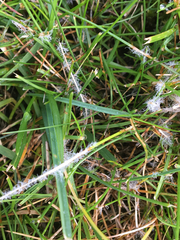 Clarireedia homoeocarpae0pathogen
- Outcome
- dollar spot ( Sclerotinia homoeocarpa F.T. Bennett ) disease incidencee0
- Direction
- lesse0
Not reportedComparator
Organisms pictured · Representative pictures of the matched species, not figures from the paper.
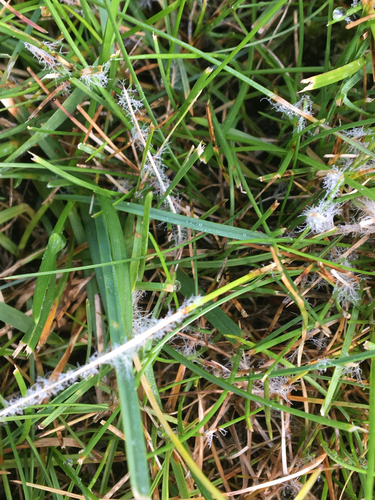
Verbatim
e0“significantly less dollar spot ( Sclerotinia homoeocarpa F.T. Bennett ) disease incidence occurred in supplement-treated bentgrass”
Claim · model-written summary
The authors attributed improved overall physiological health to increased SOD under SWE or HA regardless of fertilization.
- Taxon
- Creeping BentgrassAgrostis stoloniferat0
- Treatment
- SWE and/or HA applicationse0
- Outcome
- overall physiological healthe0
- Qualifier
- irrespective of fertilization regimee0
Organisms pictured · Representative pictures of the matched species, not figures from the paper.
Verbatim
e0“increased SOD activity in July due to SWE and/or HA applications improved overall physiological health, irrespective of fertilization regime”
t0“Creeping Bentgrass”
Claim · model-written summary
The authors suggest supplements may reduce fertilizer and fungicide inputs while maintaining bentgrass health.
- Taxon
- creeping bentgrassAgrostis stoloniferae0
- Outcome
- reducing standard fertilizer and fungicide inputs, while maintaining adequate creeping bentgrass healthe0
Organisms pictured · Representative pictures of the matched species, not figures from the paper.
Verbatim
e0“these compounds may be beneficial supplements for reducing standard fertilizer and fungicide inputs, while maintaining adequate creeping bentgrass health”
The same questions in other papers
other · physiology: antioxidant enzymes · Agrostis stolonifera (creeping bent grass)Positive and negative results
1 paper in the same direction as this paper · 1 in the opposite direction
- no effect
- positive
other · physiology: photosynthesis · Agrostis stolonifera (creeping bent grass)Positive and negative results
2 papers in the same direction as this paper · 1 in the opposite direction
- positive
- no effect
- positive
Claims are grouped by organism, treatment and what was measured or targeted. A paper counts as positive when any of its claims in the group is positive.