Abstract
Many Plant Growth-Promoting Rhizobacteria (PGPR) are able to enhance root growth, mineral availability, and nutrient use efficiency of crops. The aim of this project is to screen commercially available PGPR formulations and lab strains to increase wheat growth and yield in combination with an optimized nitrogen (N) fertilizer application scheme. This could lead to a significant reduction of N fertilizer application without affecting the subsequent grain yields. The screened products collection includes (1) Mix1 (a mix of Azospirillum sp., Azorhizobium sp., and Azoarcus sp.), (2) Mix2 (a mix of Mix1 complemented with two strains of phosphorus-solubilizing Bacillus sp.), (3) Bacillus amyloliquefaciens a, (4) B. subtilis, and (5) B. amyloliquefaciens b. These products were screened under greenhouse and field conditions in 2014 by using spring and winter wheat varieties, respectively. Under greenhouse conditions, there was a significant increase in root dry weight and in root per shoot ratio of plants inoculated with Mix1. Under field conditions, the interaction between PGPR inoculation and different N fertilizer doses was assessed. The grain yield was negatively impacted by low N fertilizer applications. Under such conditions, the inoculation of the wheat rhizosphere with B. subtilis increased the grain yield by 15% relative to the water control. However, in the field trial, the variability between plot replicates was high and lead to non-significant results. Based on these results, modified screening strategies for PGPR selection were set up for the next trials.
Abstract from the paper’s OpenAlex record; open copy licensed other-oa. Read at the source ↗
The text the model read, with the source record’s inline markup (italics, sub- and superscripts) rendered and its character entities decoded; quote offsets refer to the raw text.
Claims 5
Claim · model-written summary
Mix1 inoculation significantly increased wheat root dry weight and root per shoot ratio in the greenhouse.
- Taxon
- wheat
 Triticum aestivume1
- Treatment
- inoculated with Mix1e0
- Interactor
- Azospirillum sp.
 Azospirillume2symbiont
- Second interactor
- Azorhizobium sp.
 Azorhizobiume2symbiont
- Outcome
- root dry weight and in root per shoot ratioe0
- Direction
- increasee0
- Qualifier
- Azoarcus sp.e2
- Setting
- greenhouse conditionse0
Not reportedComparator
Organisms pictured · Representative pictures of the matched species, not figures from the paper.


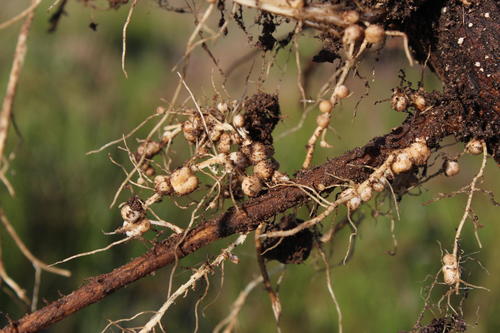
Verbatim
e0“Under greenhouse conditions, there was a significant increase in root dry weight and in root per shoot ratio of plants inoculated with Mix1.”
e1“increase wheat growth and yield”
e2“Mix1 (a mix of Azospirillum sp., Azorhizobium sp., and Azoarcus sp.)”
Claim · model-written summary
Low nitrogen fertilizer applications negatively affected wheat grain yield in the field.
- Taxon
- wheatTriticum aestivume1
- Treatment
- low N fertilizer applicationse0
- Outcome
- grain yielde0
- Direction
- negatively impactede0
- Setting
- field triale2
Not reportedComparator
Organisms pictured · Representative pictures of the matched species, not figures from the paper.
Verbatim
e0“The grain yield was negatively impacted by low N fertilizer applications.”
e1“inoculation of the wheat rhizosphere”
e2“in the field trial, the variability between plot replicates was high and lead to non-significant results.”
Claim · model-written summary
Under low nitrogen, B. subtilis inoculation increased wheat grain yield by 15% relative to water control, but field results were non-significant.
- Taxon
- wheatTriticum aestivume0
- Treatment
- inoculation of the wheat rhizosphere with B. subtilise0
- Interactor
- B. subtilis
 Bacillus subtilise0symbiont
- Outcome
- grain yielde0
- Direction
- increasede0
- Value
- 15%e0
- Qualifier
- low N fertilizer applicationse1
- Comparator
- water controle0
- Setting
- field triale2
Organisms pictured · Representative pictures of the matched species, not figures from the paper.

Verbatim
e0“Under such conditions, the inoculation of the wheat rhizosphere with B. subtilis increased the grain yield by 15% relative to the water control.”
e1“low N fertilizer applications”
e2“in the field trial, the variability between plot replicates was high and lead to non-significant results.”
Claim · model-written summary
Field plot replicates showed high variability.
- Taxon
- wheatTriticum aestivume1
- Outcome
- variability between plot replicatese0
- Direction
- highe0
- Setting
- field triale0
Organisms pictured · Representative pictures of the matched species, not figures from the paper.
Verbatim
e0“in the field trial, the variability between plot replicates was high and lead to non-significant results.”
e1“increase wheat growth and yield”
Claim · model-written summary
Modified PGPR screening strategies were established for subsequent trials.
- Taxon
- wheatTriticum aestivume1
- Outcome
- modified screening strategies for PGPR selectione0
Not reportedComparator
Organisms pictured · Representative pictures of the matched species, not figures from the paper.
Verbatim
e0“Based on these results, modified screening strategies for PGPR selection were set up for the next trials.”
e1“increase wheat growth and yield”
The same questions in other papers
Bacillus subtilis · yield · Triticum aestivum (wheat)Results agree
22 papers in the same direction as this paper
- positive
- positive
- positive
19 papers more in this group
See all 23 papers →inoculation · Azospirillum · Triticum aestivum (wheat)Positive and negative results
8 papers in the same direction as this paper · 1 reporting no difference from an alternative
- no effect
- positive
- positive
6 papers more in this group
See all 10 papers →inoculation · yield · Triticum aestivum (wheat)Positive and negative results
548 papers in the same direction as this paper · 60 in the opposite direction · 5 reporting no difference from an alternative
- negative
- negative
- negative
610 papers more in this group
See all 614 papers →nitrogen · yield · Triticum aestivum (wheat)Positive and negative results
323 papers in the same direction as this paper · 1,737 in the opposite direction
- positive
- positive
- positive
2,057 papers more in this group
See all 2,061 papers →fertilization · yield · Triticum aestivum (wheat)Positive and negative results
322 papers in the same direction as this paper · 3,115 in the opposite direction
- positive
- positive
- positive
3,434 papers more in this group
See all 3,438 papers →Claims are grouped by organism, treatment and what was measured or targeted. A paper counts as positive when any of its claims in the group is positive.