Abstract
Helianthemum songaricum Schrenk is an ancient relic plant mainly distributed in the Dzungaria of Xinjiang Uygur Autonomous Region and the western Ordos of Inner Mongolia Autonomous Region. H. songaricum Schrenk is an important source of scientific information to study the origin and migration of desert plants in central Asia. However,due to environmental degradation caused by human activities,such as overgrazing during the past decades,its population and distribution area has declined rapidly,with substantial changes in the plant community structure. In order to gather information on its transpiration rate through contactless and non-invasive methods,we measured H. songaricum Schrenk leaf temperature using infrared thermal imaging technology and assessed the transpiration rate of the species by applying theThree-temperature model. The sample area was set up at a typical H. songaricum Schrenk community,covering an area of about 1106.857 m2 in the Western Ordos National Nature Reserve. In this sample area,we selected three plant sizes( large,medium and small),with five strains per plant size,making a total of fifteen plants as the sample group. The FLUKE-Ti55 far infrared thermal imager has been applied to the determination of H. songaricum Schrenk leaf temperature. The experimental results were summarized as follows: the diurnal variation pattern of transpiration rate( Tr) was a one-peak curve with the maximum Tr value at 15: 00 and the minimum at 17: 00. Different crown breadths of H. songaricum Schrenk had different Tr values,but followed the same pattern. The Tr value was smaller for the smaller H. songaricum Schrenk plants. The Tr value of the larger H. songaricum Schrenk was greater than the smaller one,with an increase of 125.37%.The leaf temperature was higher than the ambient air temperature with the difference reaching a maximum of 9.58 K and a minimum of 0.71 K. The leaf temperature with treatments of large,medium and small H. songaricum Schrenk was 306.14,306.58,and 308. 62,respectively. The leaf temperature of the smaller H. songaricum Schrenk is greater than the larger plant by 2.48 K. The transpiration transfer coefficient of the different canopy plant H. songaricum Schrenk were different showing it was inversely proportional to its crown size,with transpiration transfer coefficient decreasing with increasing canopy. The transpiration transfer coefficient of the large,medium and small H. songaricum Schrenk were 0.41,0.48,and0.76,respectively,with the transpiration transfer coefficient of the smaller plant recording higher levels than the larger one,with an increase of 85%; There was an inverse relationship between the diurnal variation pattern of the transpiration rate and the transpiration transfer coefficient. The smaller the crown breadth of H. songaricum Schrenk,the worse the root area water condition was,and the harder the water stress. The highest transpiration rate was recorded as 9.42 × 10⁻⁶MJ m-2d-1when the plant's crown size was the largest and at 15: 00,its Tr value reached a maximum of 1. 42 × 10-5MJ m-2d-1. In addition,the lowest transpiration transfer coefficient was 0. 41. To summarize,this paper proved that non-invasive and contactless measurement techniques for determination of transpiration rates of H. songaricum Schrenk are feasible.
Abstract from the paper’s OpenAlex record, shown for indexing and research. Copyright remains with the authors or the publisher. Read at the source ↗
The text the model read, with the source record’s inline markup (italics, sub- and superscripts) rendered and its character entities decoded; quote offsets refer to the raw text.
Claims 17
Claim · model-written summary
Transpiration had a one-peak diurnal curve, maximal at 15: 00 and minimal at 17: 00.
- Taxon
- H. songaricum Schrenk
 Helianthemum songaricume1
- Outcome
- transpiration ratee0
- Direction
- maximume0
- Value
- 15: 00e0
Organisms pictured · Representative pictures of the matched species, not figures from the paper.
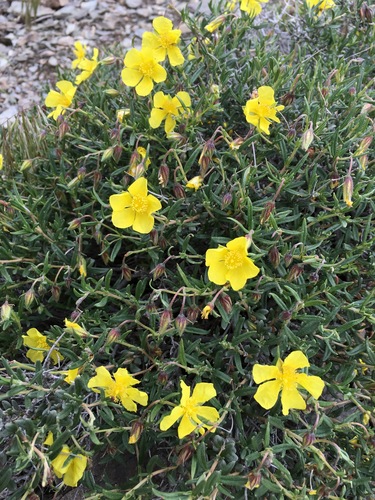
Verbatim
e0“the diurnal variation pattern of transpiration rate( Tr) was a one-peak curve with the maximum Tr value at 15: 00 and the minimum at 17: 00.”
e1“we measured H. songaricum Schrenk leaf temperature”
Claim · model-written summary
Smaller Helianthemum plants had lower transpiration than larger plants, with the larger exceeding the smaller by 125.37%.
- Taxon
- H. songaricum SchrenkHelianthemum songaricume0
- Material
- larger H. songaricum Schrenke0
- Outcome
- Tr valuee0
- Direction
- greatere0
- Value
- 125.37%e0
- Comparator
- smaller onee0
Organisms pictured · Representative pictures of the matched species, not figures from the paper.
Verbatim
e0“The Tr value of the larger H. songaricum Schrenk was greater than the smaller one,with an increase of 125.37%.”
Claim · model-written summary
Leaf temperature exceeded ambient air temperature by 0.71 to 9.58 K.
- Taxon
- H. songaricum SchrenkHelianthemum songaricume1
- Outcome
- leaf temperaturee0
- Direction
- highere0
- Value
- 9.58 Ke0
- Qualifier
- 0.71 Ke0
- Comparator
- ambient air temperaturee0
Organisms pictured · Representative pictures of the matched species, not figures from the paper.
Verbatim
e0“The leaf temperature was higher than the ambient air temperature with the difference reaching a maximum of 9.58 K and a minimum of 0.71 K.”
e1“we measured H. songaricum Schrenk leaf temperature”
Claim · model-written summary
Large Helianthemum plants had leaf temperature 306.14.
- Taxon
- H. songaricum SchrenkHelianthemum songaricume0
- Material
- largee0
- Outcome
- leaf temperaturee0
- Value
- 306.14e0
Not reportedDirection
Organisms pictured · Representative pictures of the matched species, not figures from the paper.
Verbatim
e0“The leaf temperature with treatments of large,medium and small H. songaricum Schrenk was 306.14,306.58,and 308. 62,respectively.”
Claim · model-written summary
Medium Helianthemum plants had leaf temperature 306.58.
- Taxon
- H. songaricum SchrenkHelianthemum songaricume0
- Material
- mediume0
- Outcome
- leaf temperaturee0
- Value
- 306.58e0
Not reportedDirection
Organisms pictured · Representative pictures of the matched species, not figures from the paper.
Verbatim
e0“The leaf temperature with treatments of large,medium and small H. songaricum Schrenk was 306.14,306.58,and 308. 62,respectively.”
Claim · model-written summary
Small Helianthemum plants had leaf temperature 308. 62.
- Taxon
- H. songaricum SchrenkHelianthemum songaricume0
- Material
- smalle0
- Outcome
- leaf temperaturee0
- Value
- 308. 62e0
Not reportedDirection
Organisms pictured · Representative pictures of the matched species, not figures from the paper.
Verbatim
e0“The leaf temperature with treatments of large,medium and small H. songaricum Schrenk was 306.14,306.58,and 308. 62,respectively.”
Claim · model-written summary
Smaller plants had leaf temperature 2.48 K greater than larger plants.
- Taxon
- H. songaricum SchrenkHelianthemum songaricume0
- Material
- smaller H. songaricum Schrenke0
- Outcome
- leaf temperaturee0
- Direction
- greatere0
- Value
- 2.48 Ke0
- Comparator
- larger plante0
Organisms pictured · Representative pictures of the matched species, not figures from the paper.
Verbatim
e0“The leaf temperature of the smaller H. songaricum Schrenk is greater than the larger plant by 2.48 K.”
Claim · model-written summary
Transpiration transfer coefficient decreased as canopy size increased.
- Taxon
- H. songaricum SchrenkHelianthemum songaricume1
- Material
- canopye0
- Outcome
- transpiration transfer coefficiente0
- Direction
- decreasinge0
Organisms pictured · Representative pictures of the matched species, not figures from the paper.
Verbatim
e0“transpiration transfer coefficient decreasing with increasing canopy”
e1“we measured H. songaricum Schrenk leaf temperature”
Claim · model-written summary
Large Helianthemum plants had transpiration transfer coefficient 0.41.
- Taxon
- H. songaricum SchrenkHelianthemum songaricume0
- Material
- largee0
- Outcome
- transpiration transfer coefficiente0
- Value
- 0.41e0
Organisms pictured · Representative pictures of the matched species, not figures from the paper.
Verbatim
e0“The transpiration transfer coefficient of the large,medium and small H. songaricum Schrenk were 0.41,0.48,and0.76,respectively”
Claim · model-written summary
Medium Helianthemum plants had transpiration transfer coefficient 0.48.
- Taxon
- H. songaricum SchrenkHelianthemum songaricume0
- Material
- mediume0
- Outcome
- transpiration transfer coefficiente0
- Value
- 0.48e0
Organisms pictured · Representative pictures of the matched species, not figures from the paper.
Verbatim
e0“The transpiration transfer coefficient of the large,medium and small H. songaricum Schrenk were 0.41,0.48,and0.76,respectively”
Claim · model-written summary
Small Helianthemum plants had transpiration transfer coefficient 0.76.
- Taxon
- H. songaricum SchrenkHelianthemum songaricume0
- Material
- smalle0
- Outcome
- transpiration transfer coefficiente0
- Value
- 0.76e0
Organisms pictured · Representative pictures of the matched species, not figures from the paper.
Verbatim
e0“The transpiration transfer coefficient of the large,medium and small H. songaricum Schrenk were 0.41,0.48,and0.76,respectively”
Claim · model-written summary
The smaller plants had an 85% higher transpiration transfer coefficient than larger plants.
- Taxon
- H. songaricum SchrenkHelianthemum songaricume1
- Outcome
- transpiration transfer coefficiente0
- Direction
- highere0
- Value
- 85%e0
Organisms pictured · Representative pictures of the matched species, not figures from the paper.
Verbatim
e0“the transpiration transfer coefficient of the smaller plant recording higher levels than the larger one,with an increase of 85%”
e1“we measured H. songaricum Schrenk leaf temperature”
Claim · model-written summary
Diurnal transpiration rate varied inversely with transpiration transfer coefficient.
- Taxon
- H. songaricum SchrenkHelianthemum songaricume1
- Material
- transpiration transfer coefficiente0
- Outcome
- transpiration ratee0
Not reportedDirection
Organisms pictured · Representative pictures of the matched species, not figures from the paper.
Verbatim
e0“There was an inverse relationship between the diurnal variation pattern of the transpiration rate and the transpiration transfer coefficient.”
e1“we measured H. songaricum Schrenk leaf temperature”
Claim · model-written summary
Smaller crown breadth was associated with worse root-area water condition and harder water stress.
- Taxon
- H. songaricum SchrenkHelianthemum songaricume0
- Material
- crown breadthe0
- Outcome
- root area water conditione0
- Direction
- worsee0
Organisms pictured · Representative pictures of the matched species, not figures from the paper.
Verbatim
e0“The smaller the crown breadth of H. songaricum Schrenk,the worse the root area water condition was,and the harder the water stress.”
Claim · model-written summary
The largest-crown plant had the highest transpiration rate, 9.42 × 10⁻⁶MJ m-2d-1.
- Taxon
- H. songaricum SchrenkHelianthemum songaricume1
- Outcome
- transpiration ratee0
- Direction
- higheste0
- Value
- 9.42 × 10⁻⁶MJ m-2d-1e0
Organisms pictured · Representative pictures of the matched species, not figures from the paper.
Verbatim
e0“The highest transpiration rate was recorded as 9.42 × 10⁻⁶MJ m-2d-1when the plant's crown size was the largest”
e1“we measured H. songaricum Schrenk leaf temperature”
Claim · model-written summary
At 15: 00, its transpiration rate reached 1. 42 × 10-5MJ m-2d-1.
- Taxon
- H. songaricum SchrenkHelianthemum songaricume1
- Outcome
- Tr valuee0
- Direction
- maximume0
- Value
- 1. 42 × 10-5MJ m-2d-1e0
Organisms pictured · Representative pictures of the matched species, not figures from the paper.
Verbatim
e0“at 15: 00,its Tr value reached a maximum of 1. 42 × 10-5MJ m-2d-1”
e1“we measured H. songaricum Schrenk leaf temperature”
Claim · model-written summary
Contactless thermal imaging was feasible for determining transpiration rates.
- Taxon
- H. songaricum SchrenkHelianthemum songaricume0
- Outcome
- determination of transpiration ratese0
- Qualifier
- feasiblee0
Not reportedComparatorValue
Organisms pictured · Representative pictures of the matched species, not figures from the paper.
Verbatim
e0“non-invasive and contactless measurement techniques for determination of transpiration rates of H. songaricum Schrenk are feasible.”