Claim · model-written summary
Smaller plants had leaf temperature 2.48 K greater than larger plants.
- Taxon
- H. songaricum Schrenk
 Helianthemum songaricume0
- Material
- smaller H. songaricum Schrenke0
- Outcome
- leaf temperaturee0
- Direction
- greatere0
- Value
- 2.48 Ke0
- Comparator
- larger plante0
Not reportedGeneCompoundOrgan / stageInteractorInteractor roleSecond interactorSecond interactor roleTreatmentSettingQualifier
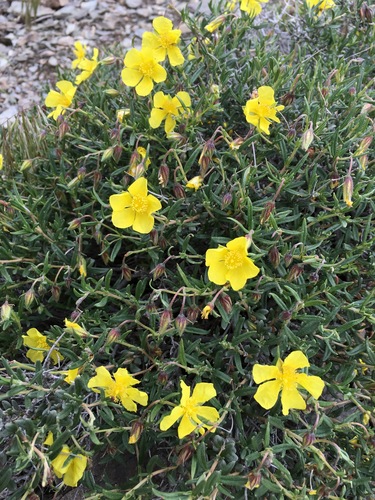
Organisms pictured · Representative pictures of the matched species, not figures from the paper.
Verbatim
e0“The leaf temperature of the smaller H. songaricum Schrenk is greater than the larger plant by 2.48 K.”
Title
Gao Yon Acta Ecologica Sinica 2014
Other claims from this paper (16)
- Observation Transpiration had a one-peak diurnal curve, maximal at 15: 00 and minimal at 17: 00.
- Observation Smaller Helianthemum plants had lower transpiration than larger plants, with the larger exceeding the smaller by 125.37%.
- Observation Leaf temperature exceeded ambient air temperature by 0.71 to 9.58 K.
- Observation Large Helianthemum plants had leaf temperature 306.14.
- Observation Medium Helianthemum plants had leaf temperature 306.58.
- Observation Small Helianthemum plants had leaf temperature 308. 62.
- Association Transpiration transfer coefficient decreased as canopy size increased.
- Observation Large Helianthemum plants had transpiration transfer coefficient 0.41.
- Observation Medium Helianthemum plants had transpiration transfer coefficient 0.48.
- Observation Small Helianthemum plants had transpiration transfer coefficient 0.76.
- Observation The smaller plants had an 85% higher transpiration transfer coefficient than larger plants.
- Association Diurnal transpiration rate varied inversely with transpiration transfer coefficient.
- Association Smaller crown breadth was associated with worse root-area water condition and harder water stress.
- Observation The largest-crown plant had the highest transpiration rate, 9.42 × 10⁻⁶MJ m-2d-1.
- Observation At 15: 00, its transpiration rate reached 1. 42 × 10-5MJ m-2d-1.
- Method / resource Contactless thermal imaging was feasible for determining transpiration rates.