Claim · model-written summary
At 15: 00, its transpiration rate reached 1. 42 × 10-5MJ m-2d-1.
- Taxon
- H. songaricum Schrenk
 Helianthemum songaricume1
- Outcome
- Tr valuee0
- Direction
- maximume0
- Value
- 1. 42 × 10-5MJ m-2d-1e0
Not reportedMaterialGeneCompoundOrgan / stageInteractorInteractor roleSecond interactorSecond interactor roleTreatmentComparatorSettingQualifier
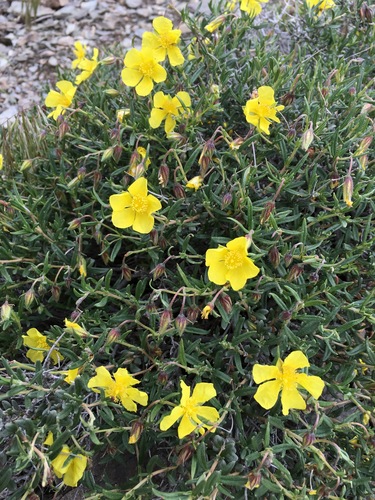
Organisms pictured · Representative pictures of the matched species, not figures from the paper.
Verbatim
e0“at 15: 00,its Tr value reached a maximum of 1. 42 × 10-5MJ m-2d-1”
e1“we measured H. songaricum Schrenk leaf temperature”
Title
Gao Yon Acta Ecologica Sinica 2014
Other claims from this paper (16)
- Observation Transpiration had a one-peak diurnal curve, maximal at 15: 00 and minimal at 17: 00.
- Observation Smaller Helianthemum plants had lower transpiration than larger plants, with the larger exceeding the smaller by 125.37%.
- Observation Leaf temperature exceeded ambient air temperature by 0.71 to 9.58 K.
- Observation Large Helianthemum plants had leaf temperature 306.14.
- Observation Medium Helianthemum plants had leaf temperature 306.58.
- Observation Small Helianthemum plants had leaf temperature 308. 62.
- Observation Smaller plants had leaf temperature 2.48 K greater than larger plants.
- Association Transpiration transfer coefficient decreased as canopy size increased.
- Observation Large Helianthemum plants had transpiration transfer coefficient 0.41.
- Observation Medium Helianthemum plants had transpiration transfer coefficient 0.48.
- Observation Small Helianthemum plants had transpiration transfer coefficient 0.76.
- Observation The smaller plants had an 85% higher transpiration transfer coefficient than larger plants.
- Association Diurnal transpiration rate varied inversely with transpiration transfer coefficient.
- Association Smaller crown breadth was associated with worse root-area water condition and harder water stress.
- Observation The largest-crown plant had the highest transpiration rate, 9.42 × 10⁻⁶MJ m-2d-1.
- Method / resource Contactless thermal imaging was feasible for determining transpiration rates.