Abstract
ABSTRACT Research on the performance of cover crops in crop systems of annual crops in the Brazilian state of Piauí contributes to increases in yield, greater efficiency of fertilizers and mitigation of environmental impacts. The aim of this study was to evaluate the performance of cover crops in terms of biomass production and the accumulation and release of nutrients during the crop season (November to April) in an oxisol in the Brazilian Cerrado in the state of Piauí that was submitted to different crop production systems including soybeans, maize and upland rice. The experiment was established during the 2010/11 and 2011/12 crop years in the rural area near the municipality of Bom Jesus, Piauí. The experimental design was a randomized block in a split-plot array. Different soil management systems (conventional and no-till) were evaluated in the main plots. Different crop production systems consisting of cover crops sown in the off-season (April to November), and annual crops sown during the crop season (November to April) were implemented in the subplots. The crop production systems that included Urochloa ruziziensis and Pennisetum glaucum overseeded on soybeans and Urochloa ruziziensis simultaneously intercropped with maize stood out in terms of biomass production and the accumulation and release of nutrients. Yields of maize and upland rice declined when sown under newly implemented no-till soil management.
Abstract from the paper’s OpenAlex record; open copy licensed cc-by. Read at the source ↗
The text the model read, with the source record’s inline markup (italics, sub- and superscripts) rendered and its character entities decoded; quote offsets refer to the raw text.
Claims 8
Claim · model-written summary
Urochloa ruziziensis overseeded on soybeans stood out for biomass production.
- Taxon
- Urochloa ruziziensis
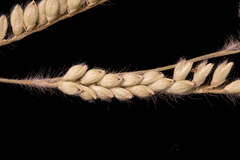 Urochloa ruziziensise0
- Treatment
- overseeded on soybeanse0
- Outcome
- biomass productione0
- Direction
- stood oute0
Not reportedComparator
Organisms pictured · Representative pictures of the matched species, not figures from the paper.

Verbatim
e0“The crop production systems that included Urochloa ruziziensis and Pennisetum glaucum overseeded on soybeans and Urochloa ruziziensis simultaneously intercropped with maize stood out in terms of biomass production and the accumulation and release of nutrients.”
Claim · model-written summary
Pennisetum glaucum overseeded on soybeans stood out for biomass production.
- Taxon
- Pennisetum glaucum
 Cenchrus americanuse0
- Treatment
- overseeded on soybeanse0
- Outcome
- biomass productione0
- Direction
- stood oute0
Not reportedComparator
Organisms pictured · Representative pictures of the matched species, not figures from the paper.

Verbatim
e0“The crop production systems that included Urochloa ruziziensis and Pennisetum glaucum overseeded on soybeans and Urochloa ruziziensis simultaneously intercropped with maize stood out in terms of biomass production and the accumulation and release of nutrients.”
Claim · model-written summary
Urochloa ruziziensis intercropped with maize stood out for biomass production.
- Taxon
- Urochloa ruziziensisUrochloa ruziziensise0
- Treatment
- simultaneously intercropped with maizee0
- Outcome
- biomass productione0
- Direction
- stood oute0
Not reportedComparator
Organisms pictured · Representative pictures of the matched species, not figures from the paper.
Verbatim
e0“Urochloa ruziziensis simultaneously intercropped with maize stood out in terms of biomass production and the accumulation and release of nutrients.”
Claim · model-written summary
Urochloa ruziziensis overseeded on soybeans stood out for nutrient accumulation and release.
- Taxon
- Urochloa ruziziensisUrochloa ruziziensise0
- Treatment
- overseeded on soybeanse0
- Outcome
- accumulation and release of nutrientse0
- Direction
- stood oute0
Not reportedComparator
Organisms pictured · Representative pictures of the matched species, not figures from the paper.
Verbatim
e0“The crop production systems that included Urochloa ruziziensis and Pennisetum glaucum overseeded on soybeans and Urochloa ruziziensis simultaneously intercropped with maize stood out in terms of biomass production and the accumulation and release of nutrients.”
Claim · model-written summary
Pennisetum glaucum overseeded on soybeans stood out for nutrient accumulation and release.
- Taxon
- Pennisetum glaucumCenchrus americanuse0
- Treatment
- overseeded on soybeanse0
- Outcome
- accumulation and release of nutrientse0
- Direction
- stood oute0
Not reportedComparator
Organisms pictured · Representative pictures of the matched species, not figures from the paper.
Verbatim
e0“The crop production systems that included Urochloa ruziziensis and Pennisetum glaucum overseeded on soybeans and Urochloa ruziziensis simultaneously intercropped with maize stood out in terms of biomass production and the accumulation and release of nutrients.”
Claim · model-written summary
Urochloa ruziziensis intercropped with maize stood out for nutrient accumulation and release.
- Taxon
- Urochloa ruziziensisUrochloa ruziziensise0
- Treatment
- simultaneously intercropped with maizee0
- Outcome
- accumulation and release of nutrientse0
- Direction
- stood oute0
Not reportedComparator
Organisms pictured · Representative pictures of the matched species, not figures from the paper.
Verbatim
e0“Urochloa ruziziensis simultaneously intercropped with maize stood out in terms of biomass production and the accumulation and release of nutrients.”
Claim · model-written summary
Maize yield declined under newly implemented no-till management.
 Zea mays
Not reportedComparator
Organisms pictured · Representative pictures of the matched species, not figures from the paper.

Verbatim
e0“Yields of maize and upland rice declined when sown under newly implemented no-till soil management.”
Claim · model-written summary
Upland rice yield declined under newly implemented no-till management.
- Taxon
- upland rice
 Oryza sativae0
- Treatment
- newly implemented no-till soil managemente0
- Outcome
- Yields of maize and upland ricee0
- Direction
- declinede0
Not reportedComparator
Organisms pictured · Representative pictures of the matched species, not figures from the paper.

Verbatim
e0“Yields of maize and upland rice declined when sown under newly implemented no-till soil management.”
The same questions in other papers
Glycine max · nutrient: content · Cenchrus americanus (pearl millet)Results agree
1 paper in the same direction as this paper
- positive
Glycine max · yield · Cenchrus americanus (pearl millet)Results agree
4 papers in the same direction as this paper
- positive
- positive
- positive
1 paper more in this group
See all 5 papers →tillage · yield · Oryza sativa (rice)Positive and negative results
141 papers in the same direction as this paper · 587 in the opposite direction
- positive
- positive
- positive
725 papers more in this group
See all 729 papers →tillage · yield · Zea mays (maize)Positive and negative results
286 papers in the same direction as this paper · 812 in the opposite direction
- positive
- positive
- positive
1,095 papers more in this group
See all 1,099 papers →intercropping · yield · Urochloa ruziziensis (Congo grass)Results agree
3 papers in the same direction as this paper
- positive
- positive
- positive
Claims are grouped by organism, treatment and what was measured or targeted. A paper counts as positive when any of its claims in the group is positive.