Abstract
Abstract Herbicide drift may have unintended impacts on native vegetation, adversely affecting individual species and plant communities. To determine the potential ecological effects of herbicide drift, small plant community plots were constructed using 9 perennial species found in different Willamette Valley (OR, USA) grassland habitats. Studies were conducted at 2 Oregon State University (Corvallis, OR, USA) farms in 2 separate years, with single and combined treatments of 0.01 to 0.2× field application rates (f.a.r.) of 1119 g ha−1 for glyphosate (active ingredient [a.i.] of 830 g ha−1 acid glyphosate) and 560 g ha−1 a.i. for dicamba. Plant responses were percentage of cover, number of reproductive structures, mature and immature seed production, and vegetative biomass. Herbicide effects differed with species, year, and, to a lesser extent, farm. Generally, 0.1 to 0.2× f.a.r. of the herbicides were required to affect reproduction in Camassia leichtlinii, Elymus glaucus, Eriophyllum lanatum, Festuca idahoensis, Iris tenax, and Prunella vulgaris. Eriophyllum lanatum also had a significant increase in percentage of immature seed dry weight with 0.01× f.a.r. of dicamba or the combination of glyphosate plus dicamba. Other species showed similar trends, but fewer significant responses. These studies indicated potential effects of low levels of herbicides on reproduction of native plants, and demonstrated a protocol whereby species growing in a constructed plant community can be evaluated for ecological responses. Environ Toxicol Chem 2017;36:2799–2813. Published 2017 SETAC. This article is a US government work and, as such, is in the public domain in the United States of America.
Abstract from the paper’s OpenAlex record; open copy licensed public-domain. Read at the source ↗
The text the model read, with the source record’s inline markup (italics, sub- and superscripts) rendered and its character entities decoded; quote offsets refer to the raw text.
Claims 11
Claim · model-written summary
Herbicide effects varied by species, year, and farm.
Verbatim
e0“Herbicide effects differed with species, year, and, to a lesser extent, farm”
Claim · model-written summary
High subfield herbicide rates generally affected Camassia leichtlinii reproduction.
- Taxon
- Camassia leichtlinii
 Camassia leichtliniie0
- Treatment
- 0.1 to 0.2× f.a.r. of the herbicidese0
- Outcome
- reproductione0
Not reportedComparatorDirection
Organisms pictured · Representative pictures of the matched species, not figures from the paper.

Verbatim
e0“0.1 to 0.2× f.a.r. of the herbicides were required to affect reproduction in Camassia leichtlinii, Elymus glaucus, Eriophyllum lanatum, Festuca idahoensis, Iris tenax, and Prunella vulgaris”
Claim · model-written summary
High subfield herbicide rates generally affected Elymus glaucus reproduction.
- Taxon
- Elymus glaucus
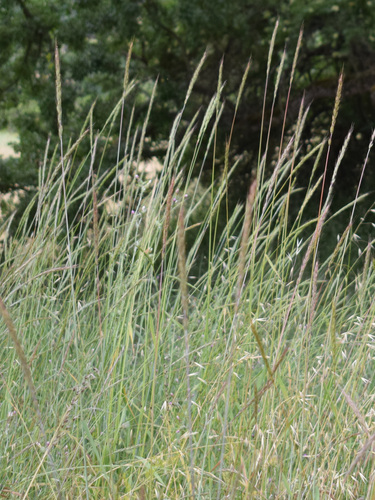
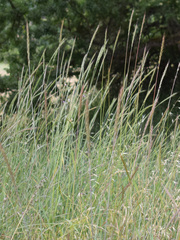 Elymus glaucuse0
- Treatment
- 0.1 to 0.2× f.a.r. of the herbicidese0
- Outcome
- reproductione0
Not reportedComparatorDirection
Organisms pictured · Representative pictures of the matched species, not figures from the paper.
Verbatim
e0“0.1 to 0.2× f.a.r. of the herbicides were required to affect reproduction in Camassia leichtlinii, Elymus glaucus, Eriophyllum lanatum, Festuca idahoensis, Iris tenax, and Prunella vulgaris”
Claim · model-written summary
High subfield herbicide rates generally affected Eriophyllum lanatum reproduction.
- Taxon
- Eriophyllum lanatum
 Eriophyllum lanatume0
- Treatment
- 0.1 to 0.2× f.a.r. of the herbicidese0
- Outcome
- reproductione0
Not reportedComparatorDirection
Organisms pictured · Representative pictures of the matched species, not figures from the paper.

Verbatim
e0“0.1 to 0.2× f.a.r. of the herbicides were required to affect reproduction in Camassia leichtlinii, Elymus glaucus, Eriophyllum lanatum, Festuca idahoensis, Iris tenax, and Prunella vulgaris”
Claim · model-written summary
High subfield herbicide rates generally affected Festuca idahoensis reproduction.
- Taxon
- Festuca idahoensis
 Festuca idahoensise0
- Treatment
- 0.1 to 0.2× f.a.r. of the herbicidese0
- Outcome
- reproductione0
Not reportedComparatorDirection
Organisms pictured · Representative pictures of the matched species, not figures from the paper.

Verbatim
e0“0.1 to 0.2× f.a.r. of the herbicides were required to affect reproduction in Camassia leichtlinii, Elymus glaucus, Eriophyllum lanatum, Festuca idahoensis, Iris tenax, and Prunella vulgaris”
Claim · model-written summary
High subfield herbicide rates generally affected Iris tenax reproduction.
- Taxon
- Iris tenax
 Iris tenaxe0
- Treatment
- 0.1 to 0.2× f.a.r. of the herbicidese0
- Outcome
- reproductione0
Not reportedComparatorDirection
Organisms pictured · Representative pictures of the matched species, not figures from the paper.

Verbatim
e0“0.1 to 0.2× f.a.r. of the herbicides were required to affect reproduction in Camassia leichtlinii, Elymus glaucus, Eriophyllum lanatum, Festuca idahoensis, Iris tenax, and Prunella vulgaris”
Claim · model-written summary
High subfield herbicide rates generally affected Prunella vulgaris reproduction.
- Taxon
- Prunella vulgaris
 Prunella vulgarise0
- Treatment
- 0.1 to 0.2× f.a.r. of the herbicidese0
- Outcome
- reproductione0
Not reportedComparatorDirection
Organisms pictured · Representative pictures of the matched species, not figures from the paper.

Verbatim
e0“0.1 to 0.2× f.a.r. of the herbicides were required to affect reproduction in Camassia leichtlinii, Elymus glaucus, Eriophyllum lanatum, Festuca idahoensis, Iris tenax, and Prunella vulgaris”
Claim · model-written summary
Dicamba at 0.01 times field rate increased Eriophyllum immature seed dry weight percentage.
- Taxon
- Eriophyllum lanatumEriophyllum lanatume0
- Treatment
- 0.01× f.a.r. of dicambae0
- Outcome
- percentage of immature seed dry weighte0
- Direction
- increasee0
Not reportedComparator
Organisms pictured · Representative pictures of the matched species, not figures from the paper.
Verbatim
e0“Eriophyllum lanatum also had a significant increase in percentage of immature seed dry weight with 0.01× f.a.r. of dicamba or the combination of glyphosate plus dicamba”
Claim · model-written summary
Combined glyphosate and dicamba increased Eriophyllum immature seed dry weight percentage.
- Taxon
- Eriophyllum lanatumEriophyllum lanatume0
- Treatment
- the combination of glyphosate plus dicambae0
- Outcome
- percentage of immature seed dry weighte0
- Direction
- increasee0
Not reportedComparator
Organisms pictured · Representative pictures of the matched species, not figures from the paper.
Verbatim
e0“Eriophyllum lanatum also had a significant increase in percentage of immature seed dry weight with 0.01× f.a.r. of dicamba or the combination of glyphosate plus dicamba”
Claim · model-written summary
Other species showed similar trends with fewer significant responses.
Verbatim
e0“Other species showed similar trends, but fewer significant responses”
Claim · model-written summary
The constructed-community protocol allowed ecological response evaluation.
Not reportedValue
Verbatim
e0“demonstrated a protocol whereby species growing in a constructed plant community can be evaluated for ecological responses”