Abstract
As an alternative to synthetic pesticides, natural materials such as plant extracts and microbes have been considered to control plant diseases. In this study, methanol extracts of 120 plants were explored for in vivo antifungal activity against Rhizoctonia solani, Botrytis cinerea, Phytophthora infestans, Puccinia triticina, and Blumeria graminis f. sp. hordei. Of the 120 plant extracts, eight plant extracts exhibited a disease control efficacy of more than 90% against at least one of five plant diseases. In particular, a methanol extract of Curcuma zedoaria rhizomes exhibited strong activity against wheat leaf rust caused by P. triticina. When the C. zedoaria methanol extracts were partitioned with various solvents, the layers of n-hexane, methylene chloride, and ethyl acetate showed disease control values of 100, 80, and 43%, respectively, against wheat leaf rust. From the C. zedoaria rhizome extracts, an antifungal substance was isolated and identified as a sesquiterpene ketolactone based on the mass and nuclear magnetic resonance spectral data. The active compound controlled the development of rice sheath blight, wheat leaf rust, and tomato late blight. Considering the in vivo antifungal activities of the sesquiterpene ketolactone and the C. zedoaria extracts, these results suggest that C. zedoaria can be used as a potent fungicide in organic agriculture.
Abstract from the paper’s OpenAlex record, shown for indexing and research. Copyright remains with the authors or the publisher. Read at the source ↗
The text the model read, with the source record’s inline markup (italics, sub- and superscripts) rendered and its character entities decoded; quote offsets refer to the raw text.
Claims 8
Claim · model-written summary
Eight of 120 plant extracts achieved over 90% disease control against at least one of five plant diseases.
- Treatment
- eight plant extractse0
- Outcome
- disease control efficacye0
- Direction
- more thane0
- Value
- more than 90%e0
Not reportedTaxonComparator
Verbatim
e0“Of the 120 plant extracts, eight plant extracts exhibited a disease control efficacy of more than 90% against at least one of five plant diseases.”
Claim · model-written summary
Curcuma zedoaria methanol rhizome extract strongly controlled wheat leaf rust.
- Taxon
- wheat
 Triticum aestivume0
- Treatment
- methanol extract of Curcuma zedoaria rhizomese0
- Interactor
- P. triticina
 Puccinia triticinae0pathogen
- Outcome
- wheat leaf ruste0
- Direction
- strong activitye0
Not reportedComparator
Organisms pictured · Representative pictures of the matched species, not figures from the paper.


Verbatim
e0“a methanol extract of Curcuma zedoaria rhizomes exhibited strong activity against wheat leaf rust caused by P. triticina.”
Claim · model-written summary
The n-hexane layer of Curcuma zedoaria extract gave 100% control of wheat leaf rust.
- Taxon
- wheatTriticum aestivume0
- Treatment
- n-hexanee0
- Outcome
- disease control valuese0
- Direction
- controle0
- Value
- 100e0
Not reportedComparator
Organisms pictured · Representative pictures of the matched species, not figures from the paper.
Verbatim
e0“the layers of n-hexane, methylene chloride, and ethyl acetate showed disease control values of 100, 80, and 43%, respectively, against wheat leaf rust.”
Claim · model-written summary
The methylene chloride layer gave 80% control of wheat leaf rust.
- Taxon
- wheatTriticum aestivume0
- Treatment
- methylene chloridee0
- Outcome
- disease control valuese0
- Direction
- controle0
- Value
- 80e0
Not reportedComparator
Organisms pictured · Representative pictures of the matched species, not figures from the paper.
Verbatim
e0“the layers of n-hexane, methylene chloride, and ethyl acetate showed disease control values of 100, 80, and 43%, respectively, against wheat leaf rust.”
Claim · model-written summary
The ethyl acetate layer gave 43% control of wheat leaf rust.
- Taxon
- wheatTriticum aestivume0
- Treatment
- ethyl acetatee0
- Outcome
- disease control valuese0
- Direction
- controle0
- Value
- 43%e0
Not reportedComparator
Organisms pictured · Representative pictures of the matched species, not figures from the paper.
Verbatim
e0“the layers of n-hexane, methylene chloride, and ethyl acetate showed disease control values of 100, 80, and 43%, respectively, against wheat leaf rust.”
Claim · model-written summary
An antifungal sesquiterpene ketolactone was isolated from Curcuma zedoaria rhizome extracts.
- Taxon
- C. zedoaria
 Curcuma zedoariae0
- Organ / stage
- rhizomee0
- Outcome
- sesquiterpene ketolactonee0
Organisms pictured · Representative pictures of the matched species, not figures from the paper.
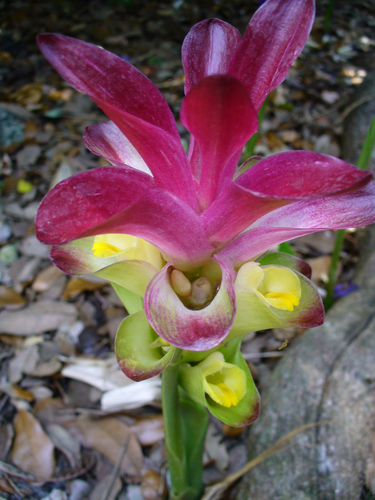
Verbatim
e0“From the C. zedoaria rhizome extracts, an antifungal substance was isolated and identified as a sesquiterpene ketolactone”
Claim · model-written summary
The active compound controlled rice sheath blight, wheat leaf rust and tomato late blight.
- Taxon
- rice
 Oryza sativae0
- Treatment
- active compounde0
- Outcome
- development of rice sheath blight, wheat leaf rust, and tomato late blighte0
- Direction
- controllede0
Not reportedComparator
Organisms pictured · Representative pictures of the matched species, not figures from the paper.

Verbatim
e0“The active compound controlled the development of rice sheath blight, wheat leaf rust, and tomato late blight.”
Claim · model-written summary
The authors suggest Curcuma zedoaria as a fungicide in organic agriculture.
- Taxon
- C. zedoariaCurcuma zedoariae0
- Outcome
- potent fungicide in organic agriculturee0
Organisms pictured · Representative pictures of the matched species, not figures from the paper.
Verbatim
e0“these results suggest that C. zedoaria can be used as a potent fungicide in organic agriculture.”
The same questions in other papers
ethyl acetate · control · Triticum aestivum (wheat)Results agree
1 paper in the same direction as this paper
- positive
botanical · Puccinia triticina · Triticum aestivum (wheat)Results agree
6 papers in the same direction as this paper
- positive
- positive
- positive
3 papers more in this group
See all 7 papers →Claims are grouped by organism, treatment and what was measured or targeted. A paper counts as positive when any of its claims in the group is positive.