Abstract
Basyuni M, Sagami H, Baba S, Oku H. 2019. Response of polyisoprenoid concentration and profile in three groups of mangrove seedlings of coping with long-term salinity. Biodiversitas 20: 320-326. The response of polyisoprenoid (polyprenol and dolichol) concentration and distribution was investigated with three groups mechanism of coping with salinity: a secreting mangrove species of Avicennia officinalis, a non-secreting species (excluder) of Bruguiera cylindrica, and a salt-accumulating species of Xylocarpus granatum. The seedlings of three mangroves were grown under 0 and 3% salinity concentration for five months. Polyisoprenoids in the lipid extracts were examined by two-dimensional thin layer chromatography (2D-TLC). The pattern of the polyprenols and dolichols in the leaves and roots were categorized as two types (I and II). In category I, dolichols dominated over polyprenols, however, in category II, the existence of both polyprenols and dolichols was found. In the leaves, type-I was observed in A. officinalis under 0 and 3% salinity. On the other hand, type-II was found in B. cylindrica and X. granatum under 0 and 3% salt concentrations. A similar pattern was found in the roots, A. officinalis (type-I), and that in B. cylindrica and X. granatum was type-II. This finding depicted that the seedlings of A. officinalis, B. cylindrica, and X. granatum leaves and roots imply no change in the distribution type: the categories were distributed as type I or II under 0% salt concentrations, as well as type-I or II under 3% salt concentrations. This study implied that polyisoprenoids may play a protective function against salinity in the mangrove leaves and roots of three groups scheme (secreting, excluding, and accumulating) of salt management.
Abstract from the paper’s OpenAlex record, shown for indexing and research. Copyright remains with the authors or the publisher. Read at the source ↗
The text the model read, with the source record’s inline markup (italics, sub- and superscripts) rendered and its character entities decoded; quote offsets refer to the raw text.
Claims 8
Claim · model-written summary
Avicennia officinalis leaves showed the type-I polyisoprenoid pattern under 0 and 3% salinity.
- Taxon
- A. officinalis
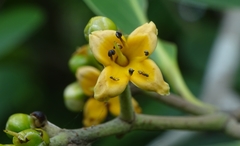 Avicennia officinalise1
- Organ / stage
- leavese1
- Treatment
- 0 and 3% salinitye1
- Outcome
- type-Ie1
Organisms pictured · Representative pictures of the matched species, not figures from the paper.

Verbatim
e1“In the leaves, type-I was observed in A. officinalis under 0 and 3% salinity”
Claim · model-written summary
Avicennia officinalis roots showed the type-I polyisoprenoid pattern.
- Taxon
- A. officinalisAvicennia officinalise2
- Organ / stage
- rootse2
- Outcome
- type-Ie2
Organisms pictured · Representative pictures of the matched species, not figures from the paper.
Verbatim
e2“A similar pattern was found in the roots, A. officinalis (type-I)”
Claim · model-written summary
Bruguiera cylindrica leaves showed the type-II polyisoprenoid pattern under 0 and 3% salt concentrations.
- Taxon
- B. cylindrica
 Bruguiera cylindricae3
- Organ / stage
- leavese1
- Treatment
- 0 and 3% salt concentrationse3
- Outcome
- type-IIe3
Organisms pictured · Representative pictures of the matched species, not figures from the paper.

Verbatim
e1“In the leaves, type-I was observed in A. officinalis under 0 and 3% salinity”
e3“On the other hand, type-II was found in B. cylindrica and X. granatum under 0 and 3% salt concentrations”
Claim · model-written summary
Xylocarpus granatum leaves showed the type-II polyisoprenoid pattern under 0 and 3% salt concentrations.
- Taxon
- X. granatum
 Xylocarpus granatume3
- Organ / stage
- leavese1
- Treatment
- 0 and 3% salt concentrationse3
- Outcome
- type-IIe3
Organisms pictured · Representative pictures of the matched species, not figures from the paper.

Verbatim
e1“In the leaves, type-I was observed in A. officinalis under 0 and 3% salinity”
e3“On the other hand, type-II was found in B. cylindrica and X. granatum under 0 and 3% salt concentrations”
Claim · model-written summary
Bruguiera cylindrica roots showed the type-II polyisoprenoid pattern.
- Taxon
- B. cylindricaBruguiera cylindricae4
- Organ / stage
- rootse2
- Outcome
- type-IIe4
Organisms pictured · Representative pictures of the matched species, not figures from the paper.
Verbatim
e2“A similar pattern was found in the roots, A. officinalis (type-I)”
e4“and that in B. cylindrica and X. granatum was type-II”
Claim · model-written summary
Xylocarpus granatum roots showed the type-II polyisoprenoid pattern.
- Taxon
- X. granatumXylocarpus granatume4
- Organ / stage
- rootse2
- Outcome
- type-IIe4
Organisms pictured · Representative pictures of the matched species, not figures from the paper.
Verbatim
e2“A similar pattern was found in the roots, A. officinalis (type-I)”
e4“and that in B. cylindrica and X. granatum was type-II”
Claim · model-written summary
The polyisoprenoid distribution type did not change between 0% and 3% salt concentrations in leaves and roots of the three mangrove species.
- Taxon
- A. officinalis, B. cylindrica, and X. granatumBruguiera cylindricaXylocarpus granatumAvicennia officinalise5
- Organ / stage
- leaves and rootse5
- Treatment
- 3% salt concentrationse5
- Outcome
- distribution typee5
- Direction
- no changee5
- Comparator
- 0% salt concentrationse5
Organisms pictured · Representative pictures of the matched species, not figures from the paper.
Verbatim
e5“the seedlings of A. officinalis, B. cylindrica, and X. granatum leaves and roots imply no change in the distribution type: the categories were distributed as type I or II under 0% salt concentrations, as well as type-I or II under 3% salt concentrations”
Claim · model-written summary
Polyisoprenoids may play a protective function against salinity in mangrove leaves and roots.
Verbatim
e6“This study implied that polyisoprenoids may play a protective function against salinity in the mangrove leaves and roots”