Abstract
Although the production of extranuptial nectar is a common strategy of indirect defence against herbivores among tropical plants, the presence of extranuptial nectaries in reproductive structures is rare, especially in ant-plants. This is because the presence of ants in reproductive organs can generate conflicts between the partners, as ants can inhibit the activity of pollinators or even castrate their host plants. Here we evaluate the hypothesis that the ant-plant Miconia tococa produces nectar in its petals which attracts ants and affects fruit set. Floral buds were analysed using anatomical and histochemical techniques. The frequency and behaviour of floral visitors were recorded in field observations. Finally, an ant exclusion experiment was conducted to evaluate the effect of ant presence on fruit production. The petals of M. tococa have a secretory epidermis that produces sugary compounds. Nectar production occurred during the floral bud stage and attracted 17 species of non-obligate ants (i.e. have a facultative association with ant-plants). Ants foraged only on floral buds, and thus did not affect the activity of pollinators in the neighbouring open flowers. The presence of ants in the inflorescences increased fruit production by 15%. To our knowledge, the production of extranuptial nectar in the reproductive structures of a myrmecophyte is very rare, with few records in the literature. Although studies show conflicts between the partners in the ant-plant interaction, ants that forage on M. tococa floral buds protect the plant against floral herbivores without affecting bee pollination.
Abstract from the paper’s OpenAlex record, shown for indexing and research. Copyright remains with the authors or the publisher. Read at the source ↗
The text the model read, with the source record’s inline markup (italics, sub- and superscripts) rendered and its character entities decoded; quote offsets refer to the raw text.
Claims 7
Claim · model-written summary
Miconia petals have a secretory epidermis producing sugary compounds.
- Taxon
- Miconia tococa
 Miconia tococat0
- Organ / stage
- petalse0
- Outcome
- secretory epidermis that produces sugary compoundse0
Organisms pictured · Representative pictures of the matched species, not figures from the paper.
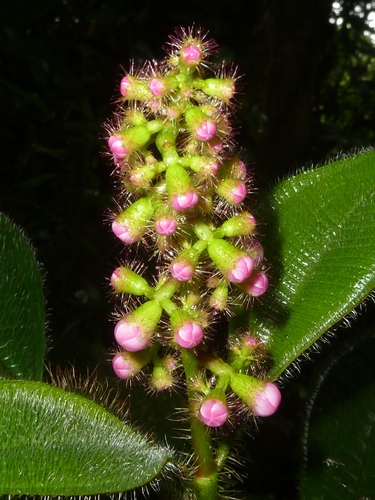
Verbatim
e0“The petals of M. tococa have a secretory epidermis that produces sugary compounds.”
t0“Miconia tococa”
Claim · model-written summary
Nectar production occurred during the floral bud stage.
- Taxon
- Miconia tococaMiconia tococat0
- Organ / stage
- floral bud stagee0
- Outcome
- Nectar productione0
Organisms pictured · Representative pictures of the matched species, not figures from the paper.
Verbatim
e0“Nectar production occurred during the floral bud stage”
t0“Miconia tococa”
Claim · model-written summary
The nectar attracted 17 non obligate ant species.
- Taxon
- Miconia tococaMiconia tococat0
- Interactor
- antsFormicidaee0other
- Outcome
- attracted 17 species of non-obligate antse0
- Value
- 17 speciese0
Organisms pictured · Representative pictures of the matched species, not figures from the paper.
Verbatim
e0“attracted 17 species of non-obligate ants”
t0“Miconia tococa”
Claim · model-written summary
Ants foraged only on floral buds.
- Taxon
- Miconia tococaMiconia tococat0
- Interactor
- AntsFormicidaee0other
- Outcome
- Ants foraged only on floral budse0
Organisms pictured · Representative pictures of the matched species, not figures from the paper.
Verbatim
e0“Ants foraged only on floral buds”
t0“Miconia tococa”
Claim · model-written summary
Ant foraging did not affect pollinator activity in nearby open flowers.
- Taxon
- Miconia tococaMiconia tococat0
- Interactor
- AntsFormicidaee1other
- Outcome
- activity of pollinators in the neighbouring open flowerse0
- Direction
- did not affecte0
Organisms pictured · Representative pictures of the matched species, not figures from the paper.
Verbatim
e0“did not affect the activity of pollinators in the neighbouring open flowers”
e1“Ants foraged only on floral buds”
t0“Miconia tococa”
Claim · model-written summary
Ant presence increased fruit production by 15%.
- Taxon
- Miconia tococaMiconia tococat0
- Treatment
- presence of ants in the inflorescencese0
- Interactor
- antsFormicidaee0other
- Outcome
- fruit productione0
- Direction
- increasede0
- Value
- 15%e0
Not reportedComparator
Organisms pictured · Representative pictures of the matched species, not figures from the paper.
Verbatim
e0“The presence of ants in the inflorescences increased fruit production by 15%.”
t0“Miconia tococa”
Claim · model-written summary
Ants on floral buds protected Miconia against floral herbivores.
- Taxon
- Miconia tococaMiconia tococat0
- Interactor
- floral herbivorese0herbivore
- Second interactor
- antsFormicidaee0other
- Outcome
- protect the plant against floral herbivorese0
Organisms pictured · Representative pictures of the matched species, not figures from the paper.
Verbatim
e0“ants that forage on M. tococa floral buds protect the plant against floral herbivores”
t0“Miconia tococa”