Abstract
In order to evaluate the improvement of rubber productivity of rubber trees by late upward tapping. A study was conducted at SCASO (Société Civile Agricole du Sud-Ouest) on the PB 260 clone of the active metabolic class. The experimental set-up is a Fisher block design with eight treatments and three replications. The treatments compared were bled in reverse in the eleventh year of harvest, in quarter spiral every 3, 4, 5 and 6 days, with stimulation frequencies of 6, 8, 10, 12 and 13 times a year. The parameters measured were rubber production, isodiametric growth, sensitivity to dry notching of trees and physiological profile. The results show that the different latex harvesting technologies improve the rubber productivity of PB 260 (5469 kg.ha-1.yr-1) with a low dry-nut rate (1.2%) and satisfactory radial vegetative growth (3.9cm.yr-1). The physiological profile of the trees is balanced, but the treatments significantly influenced the different parameters except sucrose. Trees bled in S/4U d3 gave better results due to their high yield with an acceptable dry notch rate. Late reverse tapping is therefore a good latex harvesting technology for improving rubber productivity after down tapping.
Abstract from the paper’s OpenAlex record, shown for indexing and research. Copyright remains with the authors or the publisher. Read at the source ↗
The text the model read, with the source record’s inline markup (italics, sub- and superscripts) rendered and its character entities decoded; quote offsets refer to the raw text.
Claims 7
Claim · model-written summary
Different latex harvesting technologies improved rubber productivity of PB 260 to 5469 kg per hectare per year compared with down tapping.
- Taxon
- Hevea brasiliensis
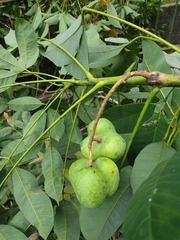 Hevea brasiliensist0
- Material
- PB 260e1
- Treatment
- different latex harvesting technologiese1
- Outcome
- rubber productivitye1
- Direction
- improvee1
- Value
- 5469 kg.ha-1.yr-1e1
- Comparator
- down tappinge4
- Setting
- Southwestern Cote d'Ivoiret0
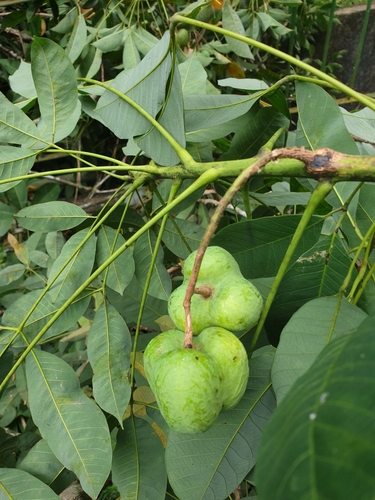
Organisms pictured · Representative pictures of the matched species, not figures from the paper.
Verbatim
t0“Effect of Late Upward Tapping on the Productivity of the Metabolically Active Hevea brasiliensis Clone PB 260 in Southwestern Cote d'Ivoire”
e1“The results show that the different latex harvesting technologies improve the rubber productivity of PB 260 (5469 kg.ha-1.yr-1) with a low dry-nut rate (1.2%) and satisfactory radial vegetative growth (3.9cm.yr-1)”
e4“Late reverse tapping is therefore a good latex harvesting technology for improving rubber productivity after down tapping”
Claim · model-written summary
Latex harvesting technologies gave a low dry-nut rate of 1.2% in PB 260.
- Taxon
- Hevea brasiliensisHevea brasiliensist0
- Material
- PB 260e1
- Outcome
- dry-nut ratee1
- Value
- 1.2%e1
- Qualifier
- low dry-nut ratee1
Organisms pictured · Representative pictures of the matched species, not figures from the paper.
Verbatim
t0“Effect of Late Upward Tapping on the Productivity of the Metabolically Active Hevea brasiliensis Clone PB 260 in Southwestern Cote d'Ivoire”
e1“The results show that the different latex harvesting technologies improve the rubber productivity of PB 260 (5469 kg.ha-1.yr-1) with a low dry-nut rate (1.2%) and satisfactory radial vegetative growth (3.9cm.yr-1)”
Claim · model-written summary
Latex harvesting technologies gave satisfactory radial vegetative growth of 3.9 cm per year in PB 260.
- Taxon
- Hevea brasiliensisHevea brasiliensist0
- Material
- PB 260e1
- Outcome
- radial vegetative growthe1
- Value
- 3.9cm.yr-1e1
- Qualifier
- satisfactorye1
Organisms pictured · Representative pictures of the matched species, not figures from the paper.
Verbatim
t0“Effect of Late Upward Tapping on the Productivity of the Metabolically Active Hevea brasiliensis Clone PB 260 in Southwestern Cote d'Ivoire”
e1“The results show that the different latex harvesting technologies improve the rubber productivity of PB 260 (5469 kg.ha-1.yr-1) with a low dry-nut rate (1.2%) and satisfactory radial vegetative growth (3.9cm.yr-1)”
Claim · model-written summary
The physiological profile of the trees was balanced.
- Taxon
- Hevea brasiliensisHevea brasiliensist0
- Outcome
- physiological profile of the treese2
- Qualifier
- balancede2
Organisms pictured · Representative pictures of the matched species, not figures from the paper.
Verbatim
t0“Effect of Late Upward Tapping on the Productivity of the Metabolically Active Hevea brasiliensis Clone PB 260 in Southwestern Cote d'Ivoire”
e2“The physiological profile of the trees is balanced, but the treatments significantly influenced the different parameters except sucrose”
Claim · model-written summary
The tapping treatments significantly influenced the physiological and growth parameters, except sucrose.
- Taxon
- Hevea brasiliensisHevea brasiliensist0
- Treatment
- the treatmentse2
- Outcome
- the different parameterse2
- Qualifier
- except sucrosee2
Organisms pictured · Representative pictures of the matched species, not figures from the paper.
Verbatim
t0“Effect of Late Upward Tapping on the Productivity of the Metabolically Active Hevea brasiliensis Clone PB 260 in Southwestern Cote d'Ivoire”
e2“The physiological profile of the trees is balanced, but the treatments significantly influenced the different parameters except sucrose”
Claim · model-written summary
Trees bled in S/4U d3 gave better results, with high yield and an acceptable dry notch rate.
- Taxon
- Hevea brasiliensisHevea brasiliensist0
- Treatment
- S/4U d3e3
- Outcome
- yielde3
- Direction
- bettere3
Not reportedComparator
Organisms pictured · Representative pictures of the matched species, not figures from the paper.
Verbatim
t0“Effect of Late Upward Tapping on the Productivity of the Metabolically Active Hevea brasiliensis Clone PB 260 in Southwestern Cote d'Ivoire”
e3“Trees bled in S/4U d3 gave better results due to their high yield with an acceptable dry notch rate”
Claim · model-written summary
Late reverse tapping is a good latex harvesting technology for improving rubber productivity after down tapping (authors recommendation).
- Taxon
- Hevea brasiliensisHevea brasiliensist0
- Treatment
- Late reverse tappinge4
- Outcome
- improving rubber productivitye4
- Comparator
- down tappinge4
Organisms pictured · Representative pictures of the matched species, not figures from the paper.
Verbatim
t0“Effect of Late Upward Tapping on the Productivity of the Metabolically Active Hevea brasiliensis Clone PB 260 in Southwestern Cote d'Ivoire”
e4“Late reverse tapping is therefore a good latex harvesting technology for improving rubber productivity after down tapping”