Abstract
Lesion mimic mutants (LMMs) are valuable genetic resources for unraveling plant defense responses including programmed cell death. Here, we identified a rice (Oryza sativa) LMM, spotted leaf 38 (spl38), and demonstrated that spl38 is essential for the formation of hypersensitive response-like lesions and innate immunity. Map-based cloning revealed that SPL38 encodes MEDIATOR SUBUNIT 16 (OsMED16). The spl38 mutant showed enhanced resistance to rice pathogens Magnaporthe oryzae and Xanthomonas oryzae pv. oryzae (Xoo) and exhibited delayed flowering, while OsMED16-overexpressing plants showed increased rice susceptibility to M. oryzae. The OsMED16-edited rice lines were phenotypically similar to the spl38 mutant but were extremely weak, exhibited growth retardation, and eventually died. The C-terminus of OsMED16 showed interaction with the positive immune regulator PATHOGENESIS RELATED 3 (OsPR3), resulting in the competitive repression of its chitinase and chitin-binding activities. Furthermore, the ospr3 osmed16 double mutants did not exhibit the lesion mimic phenotype of the spl38 mutant. Strikingly, OsMED16 exhibited an opposite function in plant defense relative to that of Arabidopsis (Arabidopsis thaliana) AtMED16, most likely because of 2 amino acid substitutions between the monocot and dicot MED16s tested. Collectively, our findings suggest that OsMED16 negatively regulates cell death and immunity in rice, probably via the OsPR3-mediated chitin signaling pathway.
Abstract from the paper’s OpenAlex record, shown for indexing and research. Copyright remains with the authors or the publisher. Read at the source ↗
The text the model read, with the source record’s inline markup (italics, sub- and superscripts) rendered and its character entities decoded; quote offsets refer to the raw text.
Claims 15
Claim · model-written summary
The spl38 mutant is essential for hypersensitive response-like lesions and innate immunity.
- Taxon
- rice
 Oryza sativae1
- Gene
- spl38e1
- Outcome
- formation of hypersensitive response-like lesions and innate immunitye1
Organisms pictured · Representative pictures of the matched species, not figures from the paper.

Verbatim
e1“Here, we identified a rice (Oryza sativa) LMM, spotted leaf 38 (spl38), and demonstrated that spl38 is essential for the formation of hypersensitive response-like lesions and innate immunity”
Claim · model-written summary
SPL38 encodes MEDIATOR SUBUNIT 16 (OsMED16).
- Taxon
- riceOryza sativae1
- Gene
- SPL38e2
- Outcome
- encodes MEDIATOR SUBUNIT 16e2
Organisms pictured · Representative pictures of the matched species, not figures from the paper.
Verbatim
e1“Here, we identified a rice (Oryza sativa) LMM, spotted leaf 38 (spl38), and demonstrated that spl38 is essential for the formation of hypersensitive response-like lesions and innate immunity”
e2“Map-based cloning revealed that SPL38 encodes MEDIATOR SUBUNIT 16 (OsMED16)”
Claim · model-written summary
The spl38 mutant showed enhanced resistance to Magnaporthe oryzae.
- Taxon
- riceOryza sativae1
- Material
- spl38 mutante3
- Interactor
- Magnaporthe oryzae
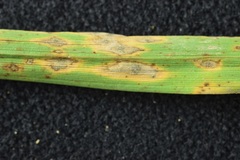 Pyricularia oryzaee3pathogen
- Outcome
- resistancee3
- Direction
- enhancede3
Organisms pictured · Representative pictures of the matched species, not figures from the paper.
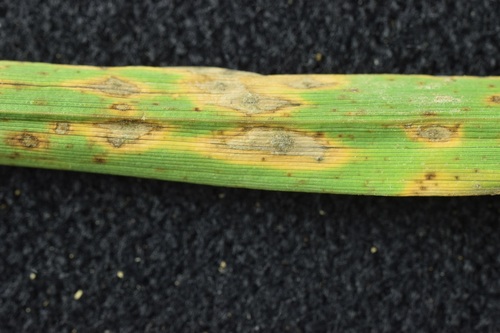
Verbatim
e1“Here, we identified a rice (Oryza sativa) LMM, spotted leaf 38 (spl38), and demonstrated that spl38 is essential for the formation of hypersensitive response-like lesions and innate immunity”
e3“The spl38 mutant showed enhanced resistance to rice pathogens Magnaporthe oryzae and Xanthomonas oryzae pv. oryzae (Xoo) and exhibited delayed flowering”
Claim · model-written summary
The spl38 mutant showed enhanced resistance to Xanthomonas oryzae pv. oryzae (Xoo).
- Taxon
- riceOryza sativae1
- Material
- spl38 mutante3
- Interactor
- Xanthomonas oryzae pv. oryzae
 Xanthomonas oryzae pv. oryzaee3pathogen
- Outcome
- resistancee3
- Direction
- enhancede3
Organisms pictured · Representative pictures of the matched species, not figures from the paper.

Verbatim
e1“Here, we identified a rice (Oryza sativa) LMM, spotted leaf 38 (spl38), and demonstrated that spl38 is essential for the formation of hypersensitive response-like lesions and innate immunity”
e3“The spl38 mutant showed enhanced resistance to rice pathogens Magnaporthe oryzae and Xanthomonas oryzae pv. oryzae (Xoo) and exhibited delayed flowering”
Claim · model-written summary
OsMED16-overexpressing plants showed increased susceptibility to Magnaporthe oryzae.
- Taxon
- riceOryza sativae4
- Treatment
- OsMED16-overexpressing plantse4
- Interactor
- M. oryzaePyricularia oryzaee4pathogen
- Outcome
- susceptibilitye4
- Direction
- increasede4
Not reportedComparator
Organisms pictured · Representative pictures of the matched species, not figures from the paper.
Verbatim
e4“OsMED16-overexpressing plants showed increased rice susceptibility to M. oryzae”
Claim · model-written summary
OsMED16-edited rice lines were phenotypically similar to the spl38 mutant.
- Taxon
- riceOryza sativae1
- Material
- OsMED16-edited rice linese5
- Outcome
- phenotypically similare5
- Comparator
- the spl38 mutante5
Organisms pictured · Representative pictures of the matched species, not figures from the paper.
Verbatim
e1“Here, we identified a rice (Oryza sativa) LMM, spotted leaf 38 (spl38), and demonstrated that spl38 is essential for the formation of hypersensitive response-like lesions and innate immunity”
e5“The OsMED16-edited rice lines were phenotypically similar to the spl38 mutant but were extremely weak, exhibited growth retardation, and eventually died”
Claim · model-written summary
OsMED16-edited rice lines showed growth retardation and were extremely weak.
- Taxon
- riceOryza sativae1
- Treatment
- OsMED16-edited rice linese5
- Outcome
- growthe5
- Direction
- retardatione5
- Qualifier
- extremely weake5
Not reportedComparator
Organisms pictured · Representative pictures of the matched species, not figures from the paper.
Verbatim
e1“Here, we identified a rice (Oryza sativa) LMM, spotted leaf 38 (spl38), and demonstrated that spl38 is essential for the formation of hypersensitive response-like lesions and innate immunity”
e5“The OsMED16-edited rice lines were phenotypically similar to the spl38 mutant but were extremely weak, exhibited growth retardation, and eventually died”
Claim · model-written summary
OsMED16-edited rice lines eventually died.
- Taxon
- riceOryza sativae1
- Material
- OsMED16-edited rice linese5
- Outcome
- eventually diede5
Organisms pictured · Representative pictures of the matched species, not figures from the paper.
Verbatim
e1“Here, we identified a rice (Oryza sativa) LMM, spotted leaf 38 (spl38), and demonstrated that spl38 is essential for the formation of hypersensitive response-like lesions and innate immunity”
e5“The OsMED16-edited rice lines were phenotypically similar to the spl38 mutant but were extremely weak, exhibited growth retardation, and eventually died”
Claim · model-written summary
The ospr3 osmed16 double mutants did not exhibit the lesion mimic phenotype of the spl38 mutant.
- Taxon
- riceOryza sativae1
- Treatment
- ospr3 osmed16 double mutantse6
- Outcome
- lesion mimic phenotypee6
- Direction
- did not exhibite6
- Comparator
- the spl38 mutante6
Organisms pictured · Representative pictures of the matched species, not figures from the paper.
Verbatim
e1“Here, we identified a rice (Oryza sativa) LMM, spotted leaf 38 (spl38), and demonstrated that spl38 is essential for the formation of hypersensitive response-like lesions and innate immunity”
e6“Furthermore, the ospr3 osmed16 double mutants did not exhibit the lesion mimic phenotype of the spl38 mutant”
Claim · model-written summary
The C-terminus of OsMED16 interacts with OsPR3.
- Taxon
- riceOryza sativae1
- Gene
- OsPR3e7
- Outcome
- interactione7
- Qualifier
- C-terminus of OsMED16e7
Organisms pictured · Representative pictures of the matched species, not figures from the paper.
Verbatim
e1“Here, we identified a rice (Oryza sativa) LMM, spotted leaf 38 (spl38), and demonstrated that spl38 is essential for the formation of hypersensitive response-like lesions and innate immunity”
e7“The C-terminus of OsMED16 showed interaction with the positive immune regulator PATHOGENESIS RELATED 3 (OsPR3), resulting in the competitive repression of its chitinase and chitin-binding activities”
Claim · model-written summary
OsMED16 competitively represses the chitinase and chitin-binding activities of OsPR3.
- Taxon
- riceOryza sativae1
- Gene
- OsPR3e7
- Outcome
- chitinase and chitin-binding activitiese7
- Direction
- competitive repressione7
Organisms pictured · Representative pictures of the matched species, not figures from the paper.
Verbatim
e1“Here, we identified a rice (Oryza sativa) LMM, spotted leaf 38 (spl38), and demonstrated that spl38 is essential for the formation of hypersensitive response-like lesions and innate immunity”
e7“The C-terminus of OsMED16 showed interaction with the positive immune regulator PATHOGENESIS RELATED 3 (OsPR3), resulting in the competitive repression of its chitinase and chitin-binding activities”
Claim · model-written summary
OsMED16 has an opposite function in plant defense relative to Arabidopsis AtMED16.
- Taxon
- riceOryza sativae1
- Outcome
- function in plant defensee7
- Direction
- oppositee7
- Comparator
- AtMED16e7
Organisms pictured · Representative pictures of the matched species, not figures from the paper.
Verbatim
e1“Here, we identified a rice (Oryza sativa) LMM, spotted leaf 38 (spl38), and demonstrated that spl38 is essential for the formation of hypersensitive response-like lesions and innate immunity”
e7“Strikingly, OsMED16 exhibited an opposite function in plant defense relative to that of Arabidopsis (Arabidopsis thaliana) AtMED16, most likely because of 2 amino acid substitutions between the monocot and dicot MED16s tested”
Claim · model-written summary
The opposite defense function of OsMED16 is most likely due to two amino acid substitutions between monocot and dicot MED16s.
- Taxon
- riceOryza sativae1
- Outcome
- opposite function in plant defensee7
- Qualifier
- most likely because of 2 amino acid substitutionse7
Organisms pictured · Representative pictures of the matched species, not figures from the paper.
Verbatim
e1“Here, we identified a rice (Oryza sativa) LMM, spotted leaf 38 (spl38), and demonstrated that spl38 is essential for the formation of hypersensitive response-like lesions and innate immunity”
e7“Strikingly, OsMED16 exhibited an opposite function in plant defense relative to that of Arabidopsis (Arabidopsis thaliana) AtMED16, most likely because of 2 amino acid substitutions between the monocot and dicot MED16s tested”
Claim · model-written summary
OsMED16 negatively regulates cell death and immunity in rice, probably via the OsPR3-mediated chitin signaling pathway.
- Taxon
- riceOryza sativae0
- Gene
- OsMED16e0
- Outcome
- cell death and immunitye0
- Direction
- negatively regulatese0
- Qualifier
- probably via the OsPR3-mediated chitin signaling pathwaye0
Organisms pictured · Representative pictures of the matched species, not figures from the paper.
Verbatim
e0“Collectively, our findings suggest that OsMED16 negatively regulates cell death and immunity in rice, probably via the OsPR3-mediated chitin signaling pathway”
Claim · model-written summary
The spl38 mutant exhibited delayed flowering.
- Taxon
- riceOryza sativae1
- Material
- spl38 mutante3
- Outcome
- floweringe3
- Direction
- delayede3
Organisms pictured · Representative pictures of the matched species, not figures from the paper.
Verbatim
e1“Here, we identified a rice (Oryza sativa) LMM, spotted leaf 38 (spl38), and demonstrated that spl38 is essential for the formation of hypersensitive response-like lesions and innate immunity”
e3“The spl38 mutant showed enhanced resistance to rice pathogens Magnaporthe oryzae and Xanthomonas oryzae pv. oryzae (Xoo) and exhibited delayed flowering”