Abstract
The potential of cannabinoids to address public health challenges has stimulated exploration into alternative sources and production technologies. Radula marginata, an endemic Aotearoa/New Zealand liverwort, produces the bibenzyl cannabinoid perrottetinene (PET), analogous to Cannabis psychoactive tetrahydrocannabinol (THC). Structural differences between PET and THC could alter therapeutic interactions and mitigate adverse side effects. To understand the cannabinoid production potential of R. marginata, we analyzed 75 collections from three locations across several seasons, collaborating with kaitiaki Māori (indigenous guardians). Metabolic plasticity of the phytocannabinoids and plant growth was assessed under controlled growth conditions, and in in vitro culture. Perrottetinene diol (trans-PTD), analogous to cannabidiol (trans-CBD), and its acid precursor (PTDA), were identified and fully characterized from nature for the first time. Bibenzyl-4-geranyl (BB4G), analogous to cannabigerol (CBG), and its corresponding acid (BB4GA), were also isolated. Radula marginata showed chemotypes dominated by PET, PTD, or BB4G, in striking analogy to the main Cannabis chemotypes. These site-selective chemotypes persisted after growth under artificial lighting and in in vitro progeny, suggesting genetic control. These results expand phytocannabinoid knowledge through the discovery of PTD analogous to CBD. They add a new dimension to liverwort cannabinoids and suggest convergent evolution of biosynthesis in two distant plant lineages.
Abstract from the paper’s OpenAlex record; open copy licensed cc-by-nc. Read at the source ↗
The text the model read, with the source record’s inline markup (italics, sub- and superscripts) rendered and its character entities decoded; quote offsets refer to the raw text.
Claims 8
Claim · model-written summary
Perrottetinene diol was identified and characterized from nature for the first time.
- Taxon
- Radula marginata
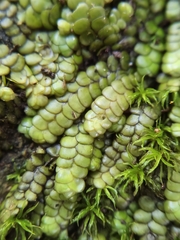 Radula marginatat0
- Outcome
- Perrottetinene diol (trans-PTD)e0
- Qualifier
- identified and fully characterized from nature for the first timee0
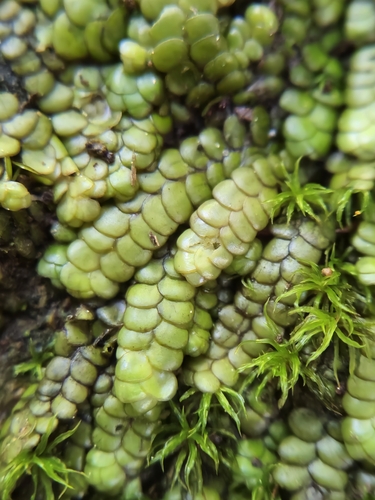
Organisms pictured · Representative pictures of the matched species, not figures from the paper.
Verbatim
e0“Perrottetinene diol (trans-PTD), analogous to cannabidiol (trans-CBD), and its acid precursor (PTDA), were identified and fully characterized from nature for the first time.”
t0“Radula marginata”
Claim · model-written summary
The acid precursor PTDA was identified and characterized from nature for the first time.
- Taxon
- Radula marginataRadula marginatat0
- Outcome
- PTDAe0
- Qualifier
- identified and fully characterized from nature for the first timee0
Organisms pictured · Representative pictures of the matched species, not figures from the paper.
Verbatim
e0“Perrottetinene diol (trans-PTD), analogous to cannabidiol (trans-CBD), and its acid precursor (PTDA), were identified and fully characterized from nature for the first time.”
t0“Radula marginata”
Claim · model-written summary
Bibenzyl-4-geranyl was isolated.
- Taxon
- Radula marginataRadula marginatat0
- Outcome
- Bibenzyl-4-geranyl (BB4G)e0
Organisms pictured · Representative pictures of the matched species, not figures from the paper.
Verbatim
e0“Bibenzyl-4-geranyl (BB4G), analogous to cannabigerol (CBG), and its corresponding acid (BB4GA), were also isolated.”
t0“Radula marginata”
Claim · model-written summary
The corresponding acid BB4GA was isolated.
- Taxon
- Radula marginataRadula marginatat0
- Outcome
- BB4GAe0
Organisms pictured · Representative pictures of the matched species, not figures from the paper.
Verbatim
e0“Bibenzyl-4-geranyl (BB4G), analogous to cannabigerol (CBG), and its corresponding acid (BB4GA), were also isolated.”
t0“Radula marginata”
Claim · model-written summary
Radula marginata had PET, PTD, or BB4G dominated chemotypes.
- Taxon
- Radula marginataRadula marginatae0
- Outcome
- chemotypes dominated by PET, PTD, or BB4Ge0
Organisms pictured · Representative pictures of the matched species, not figures from the paper.
Verbatim
e0“Radula marginata showed chemotypes dominated by PET, PTD, or BB4G, in striking analogy to the main Cannabis chemotypes.”
Claim · model-written summary
Site-selective chemotypes persisted under artificial lighting and in vitro progeny.
- Taxon
- Radula marginataRadula marginatat0
- Outcome
- site-selective chemotypese0
- Qualifier
- persisted after growth under artificial lighting and in in vitro progenye0
Organisms pictured · Representative pictures of the matched species, not figures from the paper.
Verbatim
e0“These site-selective chemotypes persisted after growth under artificial lighting and in in vitro progeny, suggesting genetic control.”
t0“Radula marginata”
Claim · model-written summary
Persistence of chemotypes suggests genetic control.
- Taxon
- Radula marginataRadula marginatat0
- Outcome
- site-selective chemotypese0
- Qualifier
- genetic controle0
Organisms pictured · Representative pictures of the matched species, not figures from the paper.
Verbatim
e0“These site-selective chemotypes persisted after growth under artificial lighting and in in vitro progeny, suggesting genetic control.”
t0“Radula marginata”
Claim · model-written summary
The findings suggest convergent evolution of cannabinoid biosynthesis in two plant lineages.
- Taxon
- Radula marginataRadula marginatat0
- Outcome
- convergent evolution of biosynthesise0
- Qualifier
- two distant plant lineagese0
Organisms pictured · Representative pictures of the matched species, not figures from the paper.
Verbatim
e0“They add a new dimension to liverwort cannabinoids and suggest convergent evolution of biosynthesis in two distant plant lineages.”
t0“Radula marginata”