Abstract
Abstract Postharvest fungal decay threatens fruit and vegetable quality and safety, and the movement of produce across borders facilitates the spread of cosmopolitan pathogens. Comprehensive molecular data from such cross-border supply chains remain limited. A total of 78 symptomatic and asymptomatic samples of tomato, capsicum, grape, strawberry, zucchini, lemon, apple, pear, and banana were collected from an international produce market. Fungi were isolated on PDA (Rose Bengal dye) and characterized through sequencing of the ITS rDNA region, followed by phylogenetic placement against type and epitype sequences. Pathogenicity was assessed on corresponding healthy hosts using wounded and non-wounded inoculations. Lesion diameters were analyzed non-parametrically: Kruskal–Wallis (10,000-permutation p) with Dunn–Benjamini–Hochberg, and exact Wilcoxon with Cliff’s δ (95% CI) for wounded vs non-wounded within isolates. Twenty-seven isolates were resolved into 19 species across nine genera. Penicillium (9 isolates), Aspergillus (5), Fusarium (4), and Talaromyces (4) dominated. Some taxa infected intact tissues, including Mucor irregularis on zucchini and Fusarium inflexum on banana. Others, such as Penicillium expansum (apple), Talaromyces aculeatus and Fusarium falciforme (lemon), required wounds. On tomato, Penicillium oxalicum produced the largest lesions regardless of wounding. Significant effects were host‑ and isolate‑specific; a wounding effect was detected for grape (GL88). Fruits and vegetables act as vehicles for fungal pathogens that cross borders and establish themselves in new environments. Molecular characterization revealed a diverse set of cosmopolitan taxa with distinct host and wound dependencies. Effective biosecurity measures and careful handling are critical to limit the transboundary risks of postharvest fungal decay.
Abstract from the paper’s OpenAlex record; open copy licensed cc-by. Read at the source ↗
The text the model read, with the source record’s inline markup (italics, sub- and superscripts) rendered and its character entities decoded; quote offsets refer to the raw text.
Claims 13
Claim · model-written summary
Mucor irregularis infected intact zucchini tissue.
- Taxon
- zucchini
 Cucurbita pepo subsp. pepoe1
- Interactor
- Mucor irregularisMucor irregularise1pathogen
- Outcome
- infected intact tissuese1
Organisms pictured · Representative pictures of the matched species, not figures from the paper.

Verbatim
e1“Some taxa infected intact tissues, including Mucor irregularis on zucchini and Fusarium inflexum on banana”
Claim · model-written summary
Fusarium inflexum infected intact banana tissue.
- Taxon
- bananae1
- Interactor
- Fusarium inflexumFusarium inflexume1pathogen
- Outcome
- infected intact tissuese1
Verbatim
e1“Some taxa infected intact tissues, including Mucor irregularis on zucchini and Fusarium inflexum on banana”
Claim · model-written summary
Penicillium expansum required wounds to infect apple.
- Taxon
- apple
 Malus domesticae1
- Treatment
- woundse1
- Interactor
- Penicillium expansum
 Penicillium expansume1pathogen
- Outcome
- required woundse1
- Comparator
- non-wounded inoculationse2
Not reportedDirection
Organisms pictured · Representative pictures of the matched species, not figures from the paper.


Verbatim
e1“Others, such as Penicillium expansum (apple), Talaromyces aculeatus and Fusarium falciforme (lemon), required wounds”
e2“Pathogenicity was assessed on corresponding healthy hosts using wounded and non-wounded inoculations”
Claim · model-written summary
Talaromyces aculeatus and Fusarium falciforme required wounds to infect lemon.
- Taxon
- lemon
 Citrus ×limone1
- Treatment
- woundse1
- Interactor
- Talaromyces aculeatusTalaromyces aculeatuse1pathogen
- Second interactor
- Fusarium falciformeFusarium falciformee1pathogen
- Outcome
- required woundse1
- Comparator
- non-wounded inoculationse2
Not reportedDirection
Organisms pictured · Representative pictures of the matched species, not figures from the paper.

Verbatim
e1“Others, such as Penicillium expansum (apple), Talaromyces aculeatus and Fusarium falciforme (lemon), required wounds”
e2“Pathogenicity was assessed on corresponding healthy hosts using wounded and non-wounded inoculations”
Claim · model-written summary
On tomato, Penicillium oxalicum produced the largest lesions regardless of wounding.
- Taxon
- tomato
 Solanum lycopersicume1
- Interactor
- Penicillium oxalicum
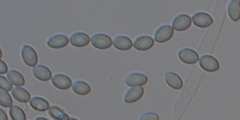 Penicillium oxalicume1pathogen
- Outcome
- largest lesionse1
- Qualifier
- regardless of woundinge1
Organisms pictured · Representative pictures of the matched species, not figures from the paper.


Verbatim
e1“On tomato, Penicillium oxalicum produced the largest lesions regardless of wounding”
Claim · model-written summary
A wounding effect was detected on grape for isolate GL88.
- Taxon
- grapee1
- Treatment
- woundinge1
- Interactor
- GL88e1pathogen
- Outcome
- wounding effecte1
- Comparator
- non-wounded inoculationse2
Not reportedDirection
Verbatim
e1“a wounding effect was detected for grape (GL88)”
e2“Pathogenicity was assessed on corresponding healthy hosts using wounded and non-wounded inoculations”
Claim · model-written summary
Twenty-seven isolates were resolved into 19 species across nine genera.
Verbatim
e1“Twenty-seven isolates were resolved into 19 species across nine genera”
e2“A total of 78 symptomatic and asymptomatic samples of tomato, capsicum, grape, strawberry, zucchini, lemon, apple, pear, and banana were collected from an international produce market”
Claim · model-written summary
Penicillium (9 isolates) dominated the isolates.
- Taxon
- tomato, capsicum, grape, strawberry, zucchini, lemon, apple, pear, and bananae2
- Interactor
- Penicillium
 Penicilliume3pathogen
- Outcome
- dominatede3
- Value
- 9 isolatese3
Organisms pictured · Representative pictures of the matched species, not figures from the paper.

Verbatim
e2“A total of 78 symptomatic and asymptomatic samples of tomato, capsicum, grape, strawberry, zucchini, lemon, apple, pear, and banana were collected from an international produce market”
e3“Penicillium (9 isolates), Aspergillus (5), Fusarium (4), and Talaromyces (4) dominated”
Claim · model-written summary
Aspergillus (5 isolates) dominated the isolates.
- Taxon
- tomato, capsicum, grape, strawberry, zucchini, lemon, apple, pear, and bananae2
- Interactor
- Aspergillus
 Aspergilluse3pathogen
- Outcome
- dominatede3
- Value
- 5e3
Organisms pictured · Representative pictures of the matched species, not figures from the paper.

Verbatim
e2“A total of 78 symptomatic and asymptomatic samples of tomato, capsicum, grape, strawberry, zucchini, lemon, apple, pear, and banana were collected from an international produce market”
e3“Penicillium (9 isolates), Aspergillus (5), Fusarium (4), and Talaromyces (4) dominated”
Claim · model-written summary
Fusarium (4 isolates) dominated the isolates.
- Taxon
- tomato, capsicum, grape, strawberry, zucchini, lemon, apple, pear, and bananae2
- Outcome
- dominatede3
- Value
- 4e3
 Fusarium
Organisms pictured · Representative pictures of the matched species, not figures from the paper.

Verbatim
e2“A total of 78 symptomatic and asymptomatic samples of tomato, capsicum, grape, strawberry, zucchini, lemon, apple, pear, and banana were collected from an international produce market”
e3“Penicillium (9 isolates), Aspergillus (5), Fusarium (4), and Talaromyces (4) dominated”
Claim · model-written summary
Talaromyces (4 isolates) dominated the isolates.
- Taxon
- tomato, capsicum, grape, strawberry, zucchini, lemon, apple, pear, and bananae2
- Interactor
- TalaromycesTalaromycese3pathogen
- Outcome
- dominatede3
- Value
- 4e3
Verbatim
e2“A total of 78 symptomatic and asymptomatic samples of tomato, capsicum, grape, strawberry, zucchini, lemon, apple, pear, and banana were collected from an international produce market”
e3“Penicillium (9 isolates), Aspergillus (5), Fusarium (4), and Talaromyces (4) dominated”
Claim · model-written summary
Effective biosecurity measures and careful handling are critical to limit transboundary risks of postharvest fungal decay.
Verbatim
e2“A total of 78 symptomatic and asymptomatic samples of tomato, capsicum, grape, strawberry, zucchini, lemon, apple, pear, and banana were collected from an international produce market”
e4“Effective biosecurity measures and careful handling are critical to limit the transboundary risks of postharvest fungal decay”
Claim · model-written summary
Fruits and vegetables act as vehicles for fungal pathogens that cross borders.
Verbatim
e2“A total of 78 symptomatic and asymptomatic samples of tomato, capsicum, grape, strawberry, zucchini, lemon, apple, pear, and banana were collected from an international produce market”
e5“Fruits and vegetables act as vehicles for fungal pathogens that cross borders and establish themselves in new environments”