View: List Claim type Research area Organism Taxon as written Decade Paper Association observed original result measured Claim · model-written summary
Aphid glucosinolate concentration correlated positively with parasitoid performance .
parasitoid e0 pest performance of the parasitoid e0 Verbatim
e0 “Glucosinolate concentration in B. brassicae correlated negatively with performance of the predator, but positively with performance of the parasitoid ”
✓ located verbatim in the source · abstract, characters 937–1086 t0 “three ecotypes of Arabidopsis thaliana ”
✓ located verbatim in the source · abstract, characters 398–436 Other claims from this paper (6) Observation observed original result no effect measured Claim · model-written summary
Caterpillar and parasitoid performance was consistent among host plants.
caterpillar e0 pest performance metrics e0 Verbatim
e0 “performance metrics of both the caterpillar and parasitoid were consistent among host plants ”
✓ located verbatim in the source · abstract, characters 905–997 e1 “three varieties of cultivated Brassica oleracea (L.) ”
✓ located verbatim in the source · abstract, characters 634–686 Other claims from this paper (13) Intervention effect observed original result no effect measured Claim · model-written summary
Parasitoid (Cotesia melanoscelus) performance did not vary in relation to CO2 environment (ambient versus elevated).
Cotesia melanoscelus e2 CO[sub 2] environment e0 Parasitoid performance e3 not in relation e0 Verbatim
e0 “not in relation to CO[sub 2] environment ”
✓ located verbatim in the source · abstract, characters 882–922 e1 “grown under ambient or elevated CO[sub 2] conditions ”
✓ located verbatim in the source · abstract, characters 225–277 e2 “the parasitoid Cotesia melanoscelus ”
✓ located verbatim in the source · abstract, characters 151–186 e3 “Parasitoid performance varied ”
✓ located verbatim in the source · abstract, characters 814–843 Other claims from this paper (4) Mechanism hypothesis original result basis n/a Claim · model-written summary
Immune enhancement may explain reduced parasitoid performance when hosts are reared on toxic plants.
parasitoid e7 biocontrol_agent reduced parasitoid performance e7 immune enhancement e7 Verbatim
e7 “Importantly, our data also suggest an alternative mechanism (i.e. immune enhancement) for reduced parasitoid performance when reared from hosts on toxic plants via tritrophic interactions ”
✓ located verbatim in the source · abstract, characters 1847–2034 Other claims from this paper (6) Observation observed original result positive measured Claim · model-written summary
Spodoptera frugiperda on maize was the preferred and best host and host plant combination for parasitoid performance .
parasitoid performance e0 Verbatim
e0 “the preferred and best combination of host and host plant for parasitoid performance was S. frugiperda on maize. ”
✓ located verbatim in the source · abstract, characters 1273–1385 Other claims from this paper (5) Recommendation author interpretation original result positive basis n/a Claim · model-written summary
The authors suggest incorporating buckwheat into cover crop mixes to improve parasitoid performance .
incorporating buckwheat into cover crop mixes could enhance parasitoid performance e0 Verbatim
t0 “Wheat Stem Sawfly ”
✓ located verbatim in the source · title, characters 155–172 e0 “incorporating buckwheat into cover crop mixes could enhance parasitoid performance ”
✓ located verbatim in the source · abstract, characters 729–811 Other claims from this paper (4) Association observed original result positive measured Claim · model-written summary
Parasitoid performance was better on S. latifascia reared on cultivated rather than wild lima bean.
parasitoid performance e0 wild lima bean e0 Verbatim
e0 “parasitoid performance was best when S. latifascia was reared on leaves of cultivated compared to wild lima bean. ”
✓ located verbatim in the source · abstract, characters 1749–1862 Other claims from this paper (5) Association observed original result significant (as stated) measured Claim · model-written summary
Host plant identity and parasitoid performance interact significantly.
parasitoid performance e1 Not reported Direction
Verbatim
e0 “interactions between two parasitoid s, Aphidius matricariae and Aphidius ervi , shape aphid suppression across seedlings from ten apple cultivars ”
✓ located verbatim in the source · abstract, characters 313–456 e1 “Results revealed significant interactions between host plant identity and parasitoid performance ”
✓ located verbatim in the source · abstract, characters 595–691 Other claims from this paper (11) Association observed original result measured Claim · model-written summary
Herbivore performance was less negatively affected by plant quality than parasitoid performance .
Herbivore e0 herbivore Herbivore performance e0 less negatively affected e0 Verbatim
e0 “Herbivore performance was less negatively affected than parasitoid performance by differences in plant quality. ”
✓ located verbatim in the source · abstract, characters 590–701 t0 “Bunias orientalis
✓ located verbatim in the source · title, characters 127–144 Other claims from this paper (10) Association observed original result measured Claim · model-written summary
Drought-by-fertilizer interactions had small effects on parasitoid performance relative to main effects.
drought and fertiliser e0 parasitoid performance e0 not have a large effect e0 Verbatim
e0 “Interactions between the drought and fertiliser did not have a large effect on aphid or parasitoid performance , compared with the strong main effects found for each treatment ”
✓ located verbatim in the source · abstract, characters 1847–2021 Other claims from this paper (8) Lexical search (BM25). All words must match; if nothing does, any word. Organism names also match every spelling of the same organism. No semantic search yet.
 Arabidopsis thalianat0
 Brevicoryne brassicaee0herbivore
 Brassica oleracea
 Zea mays
 Spodoptera frugiperda
 Triticum aestivum
 Phaseolus lunatus
 Spodoptera latifascia
 Malus domestica
 Aphidius ervi
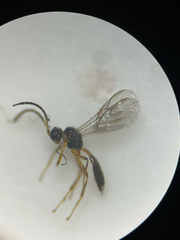 Aphidius matricariae
 Bunias orientalis