View: List Claim type Research area Organism Taxon as written Decade Paper Method / resource observed original result positive measured Claim · model-written summary
The LAMP reactions detected pathogen DNA down to 100 pg·μL−1.
60 °C for 60 min e0 Verbatim
e0 “The se reactions at 60 °C for 60 min had a detection limit of 100 pg·μL−1 ”
✓ located verbatim in the source · abstract, characters 550–622 t0 “Rice ”
✓ located verbatim in the source · title, characters 96–100 t1 “Rice ”
✓ located verbatim in the source · title, characters 96–100 Other claims from this paper (1) Observation observed original result measured Claim · model-written summary
Yellow rust reactions of 147 T. urartu accessions varied from susceptibility to strong resistance.
varied from susceptibility to strong resistance e2 Verbatim
e1 “Here, we evaluated the yellow rust (caused by Puccinia striiformis f. sp. tritici , Pst) reactions of 147 T. urartu accessions collected from different parts of the FC ”
✓ located verbatim in the source · abstract, characters 200–366 e2 “The reactions varied from susceptibility to strong resistance ”
✓ located verbatim in the source · abstract, characters 368–429 Other claims from this paper (8) Mechanism author interpretation original result positive measured Claim · model-written summary
The authors infer that extensive cell and wall reactions , including suberin deposition, initially defend resistant carnation and help confine the pathogen .
final pathogen confinement e0 extensive cell reactions and wall modifications, including suberin deposition in hyperplastic tissue e0 Verbatim
e0 “extensive cell reactions and wall modifications, including suberin deposition in hyperplastic tissue, are the main initial factors of defence conducive to final pathogen confinement ”
✓ located verbatim in the source · abstract, characters 1091–1272 t0 “carnation (Dianthus caryophyllus ) ”
✓ located verbatim in the source · title, characters 61–94 t1 “Fusarium oxysporum f. sp. dianthi
✓ located verbatim in the source · title, characters 129–162 Other claims from this paper (5) Observation observed original result measured Claim · model-written summary
Wheat varietal reactions to Pyrenochaeta -associated internode discolouration resembled reactions to C. sativus at other sites.
varietal reaction pattern e0 Verbatim
e0 “Discolouration of the sub-crown internode associated with Pyrenochaeta sp. in one experiment gave a varietal reaction pattern similar to that obtained with C. sativus at other sites ”
✓ located verbatim in the source · abstract, characters 588–769 t0 “wheat in Queensland ”
✓ located verbatim in the source · title, characters 58–77 Other claims from this paper (6) Observation observed original result measured Claim · model-written summary
Temperature, wheat genotype, pathogen isolate and scored leaf influenced seedling stripe rust reactions .
Stripe rust reactions e0 temperature, wheat genotype, pathogen isolate, and the leaf (first or second) e0 Verbatim
e0 “Stripe rust reactions on wheat seedlings with Yr17 were influenced by temperature, wheat genotype, pathogen isolate, and the leaf (first or second) used to assess the seedling reaction. ”
✓ located verbatim in the source · abstract, characters 744–929 Other claims from this paper (5) Observation observed original result measured Claim · model-written summary
Five pearl millet genotypes showed differential reactions to tested isolates.
ICMB 02444, ICMB 93333, ICMB 97222, 863B, and ICMR 06222 e0 Differential reactions to the test isolates e0 Verbatim
e0 “Differential reactions to the test isolates were recorded on ICMB 02444, ICMB 93333, ICMB 97222, 863B, and ICMR 06222 ”
✓ located verbatim in the source · abstract, characters 539–656 t0 “Pearl Millet Blast Pathogen Magnaporthe grisea ”
✓ located verbatim in the source · title, characters 28–74 Other claims from this paper (8) Observation observed original result positive measured Claim · model-written summary
E. turcicum hyphal growth was scanty in resistant maize reactions and abundant in susceptible reactions .
susceptible reaction e0 Verbatim
e0 “Hyphal growth was scanty in the resistant reaction and abundant in the susceptible reaction. ”
✓ located verbatim in the source · abstract, characters 817–909 t0 “maize plants to invasion by Exserohilum turcicum ”
✓ located verbatim in the source · title, characters 38–86 Other claims from this paper (8) Observation observed original result measured Claim · model-written summary
Wheat genotypes differed in the ir reactions to fungal inoculation.
different reactions e0 Verbatim
e0 “When inoculated with the fungus wheat genotypes exhibited different reactions ”
✓ located verbatim in the source · abstract, characters 827–904 t0 “FUSARIUM GRAMINEARUM ”
✓ located verbatim in the source · title, characters 22–42 Other claims from this paper (5) Observation observed original result measured Claim · model-written summary
Rubber clones varied in the ir reactions to Colletotrichum isolates.
varied reactions e0 Verbatim
t0 “rubber tree to Colletotrichum spp. ”
✓ located verbatim in the source · title, characters 21–55 e0 “Clones had varied reactions to the different isolates used in inoculations. ”
✓ located verbatim in the source · abstract, characters 868–943 Other claims from this paper (5) Observation observed original result measured Claim · model-written summary
All three non-segregating pepper populations showed variable reactions to the pathogen .
the resistant parent, the susceptible parent and the F 1 e0 range of reactions to S. rolfsii e0 Verbatim
e0 “The plants within all three non-segregating populations ( the resistant parent, the susceptible parent and the F 1 ) displayed a range of reactions to S. rolfsii . ”
✓ located verbatim in the source · abstract, characters 439–601 Other claims from this paper (2) Lexical search (BM25). All words must match; if nothing does, any word. Organism names also match every spelling of the same organism. No semantic search yet.
 Oryza sativat0
 Triticum urartu
 Puccinia striiformis f. sp. tritici
 Dianthus caryophyllus
 Fusarium oxysporum f. sp. dianthi
 Triticum aestivum
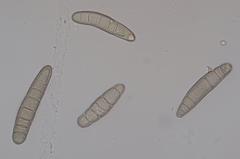 Bipolaris sorokiniana
 Cenchrus americanus
 Pyricularia grisea
 Zea mays
 Exserohilum turcicum
 Fusarium graminearum
 Hevea brasiliensis
 Colletotrichum
 Agroathelia rolfsii