View: List Claim type Research area Organism Taxon as written Decade Paper Observation observed original result positive measured Claim · model-written summary
Rotam 4 and Rodade resisted biovar 3 and two biovar 1 races.
resistant to biovar 3 and two races of biovar 1 e0 Not reported Taxon
Verbatim
e0 “`Rotam 4' and `Rodade' were resistant to biovar 3 and two races of biovar 1 ”
✓ located verbatim in the source · abstract, characters 722–797 Other claims from this paper (7) Observation observed original result measured Claim · model-written summary
Strains belonged to race 1 biovar 3 and race 1 biovar 4.
solanaceous vegetables e1 race 1 biovar 3 and race 1 biovar 4 e0 Verbatim
e0 “Intraspecific identification of strains revealed the presence of race 1 biovar 3 and race 1 biovar 4. ”
✓ located verbatim in the source · abstract, characters 703–804 e1 “solanaceous vegetables on the Andaman Islands, India ”
✓ located verbatim in the source · abstract, characters 45–97 Other claims from this paper (8) Observation observed original result measured Claim · model-written summary
Sixteen isolates were biovar 4.
Verbatim
e0 “16 belonged to biovar 4 ”
✓ located verbatim in the source · abstract, characters 1178–1201 t0 “Cucurbita maxima
✓ located verbatim in the source · title, characters 100–116 Other claims from this paper (12) Observation observed original result positive measured Claim · model-written summary
Biovar 4 was not pathogenic on eggplant rootstock.
Biovar 4 e0 pathogen without pathogenicity on eggplant rootstock e0 Verbatim
e0 “Biovar 4 was the dormant type without pathogenicity on eggplant rootstock ”
✓ located verbatim in the source · abstract, characters 1293–1366 Other claims from this paper (6) Observation observed original result measured Claim · model-written summary
Nineteen percent of isolates were Biovar 4.
Verbatim
e0 “the rest 19% isolates were identified as Biovar 4 ”
✓ located verbatim in the source · abstract, characters 1405–1454 e1 “isolates of R. solanacearum ”
✓ located verbatim in the source · abstract, characters 1337–1364 Other claims from this paper (12) Observation observed original result measured Claim · model-written summary
Korean biovar 2 isolates were pathologically and genetically distinct from biovar 3 and 4 isolates.
Korean biovar 2 isolates e4 pathologically as well as genetically e4 biovar 3 and 4 isolates e4 Verbatim
e0 “93 RSSC isolates responsible for potato bacterial wilt in Korea ”
✓ located verbatim in the source · abstract, characters 207–270 e4 “Korean biovar 2 isolates were distinct from biovar 3 and 4 isolates pathologically as well as genetically ”
✓ located verbatim in the source · abstract, characters 827–932 Other claims from this paper (10) Observation observed original result measured Claim · model-written summary
Rotam 4 and Rodade resisted biovar 3 and UW 275.
Rotam 4 and Rodade e0 resistant to biovar 3 and one race of biovar 1 (UW 275) e0 Verbatim
e0 “Rotam 4 and Rodade were resistant to biovar 3 and one race of biovar 1 (UW 275) ”
✓ located verbatim in the source · abstract, characters 598–677 t0 “TOMATO ”
✓ located verbatim in the source · title, characters 62–68 Other claims from this paper (8) Observation observed original result measured Claim · model-written summary
Race 1 biovar 3 and race 1 biovar 4 wilted plants with similar aggressiveness.
solanaceous vegetables e2 wilted plants with similar aggressiveness e0 Verbatim
e0 “Both biovar s wilted plants with similar aggressiveness. ”
✓ located verbatim in the source · abstract, characters 805–860 e1 “race 1 biovar 3 and race 1 biovar 4 ”
✓ located verbatim in the source · abstract, characters 768–803 e2 “solanaceous vegetables on the Andaman Islands, India ”
✓ located verbatim in the source · abstract, characters 45–97 t0 “Ralstonia solanacearum
✓ located verbatim in the source · title, characters 13–35 Other claims from this paper (8) Observation observed original result measured Claim · model-written summary
36 isolates of R. solanacearum were biovar 4.
Verbatim
e5 “36 isolates were biovar 4 ”
✓ located verbatim in the source · abstract, characters 1318–1343 t0 “Greenhouses Cultivating tomato Plants ”
✓ located verbatim in the source · title, characters 57–94 Other claims from this paper (10) Observation observed original result measured Claim · model-written summary
Biovar 4 accounted for 73% of the pepper isolates.
Verbatim
e0 “The bacterial isolates consisted of biovar 3 (27%) and biovar 4 (73%). ”
✓ located verbatim in the source · abstract, characters 950–1020 e1 “All R. solanacearum isolates from peppers were race 1. ”
✓ located verbatim in the source · abstract, characters 895–949 Other claims from this paper (6) Lexical search (BM25). All words must match; if nothing does, any word. Organism names also match every spelling of the same organism. No semantic search yet.
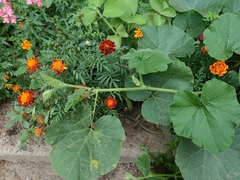 Cucurbita maxima
 Solanum melongena
 Ralstonia solanacearum
 Solanum tuberosum
 Solanum lycopersicum
 Capsicum