Scoliidae 13 claims

family · order Hymenoptera · 8 taxa · NCBI Taxonomy ↗

8 entries

Observationobservedoriginal resultmeasured

Claim · model-written summary

The basal labellum region closely mimics the thorax and wings of the female wasp, a visual and tactile mimicry of the pollinating wasp.

Taxon
Ophrys speculumOphrys speculumt0
Organ / stage
basal labellum regione3
Interactor
Dasyscolia ciliataDasyscolia ciliatae1pollinator
Outcome
closely mimicse3

Verbatim

t0

“Ophrys speculum”

✓ located verbatim in the source · title, characters 52–67
e1

“the male Dasyscolia ciliata wasp”

✓ located verbatim in the source · abstract, characters 242–274
e3

“the basal labellum region closely mimics the female wasp’s thorax and wings”

✓ located verbatim in the source · abstract, characters 1164–1239

Title

Osmophore Structure and Labellum Micromorphology in Ophrys speculum (Orchidaceae): New Interpretations of Floral Features and Implications for a Specific Sexually Deceptive Pollination Interaction

Ana Francisco; Lia Ascensão Plants 2024. doi:10.3390/plants13101413

Other claims from this paper (2)
Observationobservedoriginal resultpositivemeasured

Claim · model-written summary

Large wasps of Scoliidae pollinated the flowers.

Taxon
Disa englerianaDisa englerianae0
Interactor
ScoliidaeScoliidaee0pollinator
Outcome
pollinatede0

Verbatim

e0

“the flowers of Disa engleriana are pollinated by large wasps (Eumeninae and Scoliidae) and carpenter bees”

✓ located verbatim in the source · abstract, characters 937–1042

Title

Pollination of Disa engleriana (Orchidaceae): Floral modifications for deposition of pollinaria on the abdomen of large bees and wasps

Steven D. Johnson Flora 2024. doi:10.1016/j.flora.2024.152491

Other claims from this paper (4)
Observationobservedoriginal resultmeasured

Claim · model-written summary

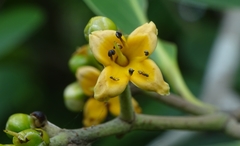
Campsomeriella annulata annulata foraged on fallen Firmiana simplex flowers on shrubs in an urban park in central Japan.

Taxon
Firmiana simplexFirmiana simplexe0
Interactor
Campsomeriella annulata annulataCampsomeriella annulatae0pollinator
Outcome
foraging on Firmiana simplex flowerse0
Setting
an urban park in central Japane0

Verbatim

e0

“Campsomeriella annulata annulata (Fabricius, 1793) (Hymenoptera: Scoliidae), was observed foraging on Firmiana simplex flowers that had fallen onto shrubs in an urban park in central Japan.”

✓ located verbatim in the source · abstract, characters 16–205

Title

Observations of the scoliid wasp Campsomeriella annulata annulata (Fabricius, 1793) foraging on fallen Firmiana simplex flowers

Kazuo Yamazaki Entomological Communications 2024. doi:10.37486/2675-1305.ec06034

Other claims from this paper (1)
Observationobservedoriginal resultmeasured

Claim · model-written summary

Two natural enemies of the genera Tiphia and Micromeriella were found, uncommon for FAW.

Taxon
maizeZea mayse3
Interactor
TiphiaTiphiae1biocontrol_agent
Second interactor
MicromeriellaMicromeriellae1biocontrol_agent
Outcome
presence of two natural enemies belonging to the genus Tiphia and Micromeriellae1
Qualifier
uncommon to FAWe1

Verbatim

e1

“Our study reveals the presence of two natural enemies belonging to the genus Tiphia and Micromeriella , uncommon to FAW”

✓ located verbatim in the source · abstract, characters 1220–1339
e3

“Significant differences in the number of parasitoids were observed in polycropping, with the highest recovery of 12 ± 10% from maize + cowpeas + pumpkin and watermelon mixed cropping”

✓ located verbatim in the source · abstract, characters 1341–1523

Title

Abundance, diversity and richness of natural enemies of the fall armyworm, Spodoptera frugiperda (J.E. Smith) (Lepidoptera: Noctuidae), in Zambia

Gilson Chipabika; Philemon H. Sohati; Fathiya Mbarak Khamis; et al. Frontiers in Insect Science 2023. doi:10.3389/finsc.2023.1091084

Other claims from this paper (11)
Intervention effectobservedoriginal resultpositivemeasured

Claim · model-written summary

Natural regeneration had highest solitary wasp family richness and mown cover lowest.

Taxon
vinest0
Treatment
natural regeneration treatmente0
Interactor
Solitary waspMegascolia flavifronse0other
Outcome
Solitary wasp family richnesse0
Direction
higheste0
Comparator
mown treatmente0

Verbatim

e0

“Solitary wasp family richness was highest in the natural regeneration treatment and lowest in the mown treatment.”

✓ located verbatim in the source · abstract, characters 1101–1214
t0

“vines”

✓ located verbatim in the source · title, characters 25–30

Title

Sown wildflowers between vines increase beneficial insect abundance and richness in a British vineyard

Janine Griffiths‐Lee; Balin Davenport; Bradley Foster; et al. Agricultural and Forest Entomology 2022. doi:10.1111/afe.12538

Other claims from this paper (5)
Observationobservedoriginal resultsignificant (as stated)measured

Claim · model-written summary

Campsomeriella collaris had longer flower handling time than Apis florea.

Taxon
Avicennia officinalisAvicennia officinalise0
Interactor
C. collarisCampsomeriella collarise0pollinator
Outcome
handling timee0
Direction
higheste0
Comparator
A. floreae0

Verbatim

e0

“C. collaris, however, had the highest and most significant handling time for Avicennia officinalis than A. florea.”

✓ located verbatim in the source · abstract, characters 983–1097

Title

Foraging activity and breeding system of Avicennia officinalis L. (Avicenniaceae) in Kerala, India

K. Vinaya; C.F. Binoy Journal of Threatened Taxa 2022. doi:10.11609/jott.7999.14.11.22098-22104

Other claims from this paper (6)
Observationobservedoriginal resultmeasured

Claim · model-written summary

Two natural enemies were identified with meagre populations.

Taxon
coconutt0
Interactor
Chelisochus morie0biocontrol_agent
Second interactor
Campsomeriella collarisCampsomeriella collarise0biocontrol_agent
Outcome
level of population was meagree0

Verbatim

e0

“Natural enemies viz., Chelisochus mori, and Campsomeriella collaris were identified, and the level of population was meagre.”

✓ located verbatim in the source · abstract, characters 320–444
t0

“Coconut”

✓ located verbatim in the source · title, characters 97–104

Title

Incidence of Rhinoceros Beetle (Oryctes rhinoceros) and Eriophyid Mite (Aceria guerreronis) on a Coconut Plantation In Pollachi Area

Allwin Loveson; Jayasheelan Munirathnam International Journal of Plant and Environment 2021. doi:10.18811/ijpen.v7i03.9

Other claims from this paper (9)
Observationobservedoriginal resultpositivemeasured

Claim · model-written summary

Campsomeris plumipes var. fossulana was abundant among watermelon pollinators.

Taxon
watermelon (Citrullus lanatus Thunb.)Citrullus lanatust0
Interactor
Campsomeris plumipes var. fossulana FabriciusDielis plumipese0pollinator
Outcome
abundante0

Not reportedDirection

Verbatim

e0

“numerous other pollinators (e.g., Agapostemon splendens Lepeletier, Campsomeris plumipes var. fossulana Fabricius) were found to be abundant”

✓ located verbatim in the source · abstract, characters 818–958
t0

“watermelon (Citrullus lanatus Thunb.)”

✓ located verbatim in the source · title, characters 46–83

Title

Contribution of bees and other pollinators to watermelon (Citrullus lanatus Thunb.) pollination

Joshua W. Campbell; Cory Stanley-Stahr; Mary Bammer; et al. Journal of Apicultural Research 2019. doi:10.1080/00218839.2019.1614271

Other claims from this paper (10)
Observationobservedoriginal resultpositivemeasured

Claim · model-written summary

The scoliid wasp carried as much watermelon pollen as worker honey bees.

Taxon
watermelon (Citrullus lanatus Thunb.)Citrullus lanatust0
Interactor
Campsomeris plumipes var. fossulana FabriciusDielis plumipese1pollinator
Outcome
watermelon pollene0
Direction
as muche0
Comparator
worker A. melliferae0

Verbatim

e0

“This sweat bee and scoliid wasp carried as much watermelon pollen as worker A. mellifera did.”

✓ located verbatim in the source · abstract, characters 960–1053
e1

“Campsomeris plumipes var. fossulana Fabricius”

✓ located verbatim in the source · abstract, characters 886–931
t0

“watermelon (Citrullus lanatus Thunb.)”

✓ located verbatim in the source · title, characters 46–83

Title

Contribution of bees and other pollinators to watermelon (Citrullus lanatus Thunb.) pollination

Joshua W. Campbell; Cory Stanley-Stahr; Mary Bammer; et al. Journal of Apicultural Research 2019. doi:10.1080/00218839.2019.1614271

Other claims from this paper (10)
Observationobservedoriginal resultmeasured

Claim · model-written summary

Scolia nobilitata was the most common buckwheat visitor species.

Taxon
buckwheate1
Interactor
Scolia nobilitata F.Scolia nobilitatae0pollinator
Outcome
most common speciese0

Verbatim

e0

“the most common species being the wasp Scolia nobilitata F. (Hymenoptera: Scoliidae)”

✓ located verbatim in the source · abstract, characters 644–728
e1

“buckwheat fields”

✓ located verbatim in the source · abstract, characters 621–637

Title

Insect Visitors to Flowering Buckwheat,Fagopyrum esculentum(Polygonales: Polygonaceae), in North-Central Florida

Joshua W. Campbell; Allyn Irvin; Hennelly Irvin; et al. Florida Entomologist 2016. doi:10.1653/024.099.0216

Other claims from this paper (9)