
Claim · model-written summary
Rice bran supported P. fluorescens and B. thuringiensis (a) in the carrier formulation.
- Taxon
- okra
 Abelmoschus esculentuse0
- Treatment
- rice brane5
- Interactor
- P. fluorescens
 Pseudomonas fluorescense5symbiont
- Second interactor
- B. thuringiensis (a)
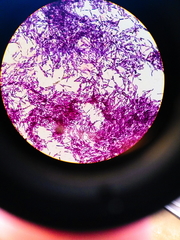 Bacillus thuringiensise5symbiont
- Outcome
- supportede5
Verbatim
e0“Greenhouse trials using okra (Abelmoschus esculentus) evaluated plant growth”
e5“rice bran supported P. fluorescens and B. thuringiensis (a)”
Title
Olubukola Monisola Oyawoye; Kehinde Joseph Ayantola; Oyindamola Felicia Osho; et al. International Journal of Plant & Soil Science 2026. doi:10.9734/ijpss/2026/v38i56079
Other claims from this paper (7)
- Observation All five rhizobacterial isolates exhibited multiple growth-promoting traits.
- Observation Lysinibacillus sphaericus uniquely showed protease activity among the isolates.
- Observation The formulations maintained high microbial viability of 1.29 × 10⁷–8.91 × 10⁷ CFU/g.
- Observation Sawdust supported L. sphaericus and B. thuringiensis (b) in the carrier formulation.
- Intervention effect L. sphaericus with sawdust significantly enhanced okra plant height and biomass compared with NPK and control.
- Intervention effect P. fluorescens with sawdust significantly enhanced okra plant height and biomass compared with NPK and control.
- Recommendation Agro-waste PGPR biofertilizers are proposed as a cost-effective, sustainable alternative to chemical fertilizers.
 Rhizoctonia solani
 Brassica rapa subsp. pekinensis
 Zea mays