
Claim · model-written summary
Acacia nilotica and Punica granatum hosts were associated with higher sandalwood chlorophyll content, relative water content, and proline levels.
- Taxon
- Santalum album L.
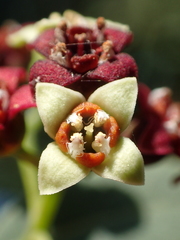 Santalum albume1
- Interactor
- Acacia nilotica
 Vachellia niloticae0host
- Second interactor
- Punica granatum
 Punica granatume0host
- Outcome
- physiological resiliencee0
- Direction
- enhancede0
Verbatim
e0“Acacia nilotica and Punica granatum enhanced physiological resilience, with higher chlorophyll content (5.57 µg mg − 1 FW), relative water content (62.8%), and proline levels (18.38 µg g − 1 FW)”
e1“Sandalwood ( Santalum album L.)”
Title
Dinesh Kumar Yadav; S. B. Chavan; Lalji Singh; et al. Scientific Reports 2026. doi:10.1038/s41598-026-56713-0
Other claims from this paper (8)
- Association Free amino acid profiles varied significantly with host species in sandalwood roots.
- Association Association with Pongamia pinnata gave the highest aspartic acid accumulation at 7.28 µg g − 1 FW.
- Association Association with Pongamia pinnata gave the highest glutamic acid accumulation at 13.87 µg g − 1 FW.
- Association Association with Pongamia pinnata gave the highest lysine accumulation at 67.11 µg g − 1 FW.
- Association Sesbania grandiflora was associated with minimal arginine at 0.55 µg g − 1 FW.
- Method / resource PCA explained 69.7% variance and identified arginine, lysine, and histidine as key contributors to metabolic shifts under stress.
- Observation Hierarchical clustering confirmed host-specific FAA patterns, with Pongamia pinnata and nitrogen-fixing hosts promoting stress-responsive amino acids.
- Association Pongamia pinnata, Dalbergia sissoo, and Punica granatum enhance nitrogen metabolism, amino acid accumulation, and physiological traits under stress in sandalwood.
 Citrullus lanatus