Claim · model-written summary
Sequential dicamba at 720 g a.e. ha-1, or dicamba at 360 or 720 g a.e. ha-1 tank-mixed with glyphosate, effectively controlled Euphorbia heterophylla.
 Euphorbia heterophylla
Verbatim
e0“selective dicamba use in dicamba‐resistant soybean (DRS)”
e2“alongside weedy and weed‐free checks”
e3“Effective control of A. hybridus , E. heterophylla , and Ipomoea spp. required sequential dicamba at 720 g a.e. ha −1 or dicamba (360 or 720 g a.e. ha −1 ) tank‐mixed with glyphosate”
Title
Leila Lucia Camintia; Ricardo Pazinato; Clarice Elizabete Antunes; et al. New Zealand Journal of Crop and Horticultural Science 2026. doi:10.1002/nzc2.70141
Other claims from this paper (7)
- Intervention effect Single dicamba applications at 360 g a.e. ha-1 were insufficient to control Amaranthus viridis in dicamba-resistant soybean.
- Intervention effect Sequential dicamba at 720 g a.e. ha-1, or dicamba at 360 or 720 g a.e. ha-1 tank-mixed with glyphosate, effectively controlled Amaranthus hybridus.
- Intervention effect Sequential dicamba at 720 g a.e. ha-1, or dicamba at 360 or 720 g a.e. ha-1 tank-mixed with glyphosate, effectively controlled Ipomoea spp.
- Intervention effect Only sequential dicamba plus glyphosate treatments were effective against Raphanus raphanistrum.
- Intervention effect Conyza spp. was controlled only by sequential applications of dicamba at 720 g a.e. ha-1 plus glyphosate.
- Intervention effect Sequential dicamba plus glyphosate applications provided superior weed control.
- Intervention effect Sequential dicamba plus glyphosate applications did not negatively affect dicamba-resistant soybean yield.
 Chrysanthemum seticuspe
 Triadica sebifera
 Handroanthus impetiginosus
 Ricinus communis
 Poa crymophila
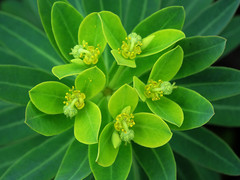 Euphorbia jolkinii
 Zea mays
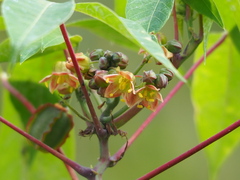 Manihot esculenta