Hormaphididae 11 claims

family · order Hemiptera · 4 taxa · NCBI Taxonomy ↗

4 entries

Observationobservedoriginal resultmeasured

Claim · model-written summary

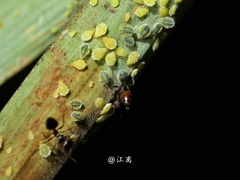
Adult females of the aphid were apterous, broadly pear shaped, small, and yellowish green or pale green.

Taxon
Astegopteryx bambusaeAstegopteryx bambusaet1
Outcome
Adult female was apterous, broadly pear shaped, small in size and yellowish green or pale green in coloure3

Verbatim

e3

“Adult female was apterous, broadly pear shaped, small in size and yellowish green or pale green in colour”

✓ located verbatim in the source · abstract, characters 384–489
t1

“Astegopteryx bambusae (Buckton)”

✓ located verbatim in the source · title, characters 23–54

Title

First Report of Aphid, Astegopteryx bambusae (Buckton) (Hemiptera: Aphididae) on Bamboo, Dendrocalamus strictus (Poaceae) from Gujarat, India

Parmar, N. L; Barad, C. S; Deb Sushma; et al. Journal of Scientific Research and Reports 2024. doi:10.9734/jsrr/2024/v30i72201

Other claims from this paper (3)
Associationobservedoriginal resultmeasured

Claim · model-written summary

Derived genetic variants in the aphid gene dgc are associated with strong downregulation of dgc transcription in aphid salivary glands.

Taxon
Hormaphis cornuHormaphis cornue0
Organ / stage
salivary glandse2
Gene
dgce2
Outcome
dgc transcription in aphid salivary glandse2
Direction
downregulatione2

Verbatim

e0

“the aphid Hormaphis cornu”

✓ located verbatim in the source · abstract, characters 404–429
e2

“derived genetic variants in the aphid gene determinant of gall color (dgc) are associated with strong downregulation of dgc transcription in aphid salivary glands”

✓ located verbatim in the source · abstract, characters 529–691

Title

A novel family of secreted insect proteins linked to plant gall development

Aishwarya Korgaonkar; Clair Han; Andrew L. Lemire; et al. Current Biology 2021. doi:10.1016/j.cub.2021.01.104

Other claims from this paper (7)
Observationobservedoriginal resultmeasured

Claim · model-written summary

The aphid gene dgc is a member of a large, diverse family of novel predicted secreted proteins with a pair of widely spaced cysteine-tyrosine-cysteine residues, named BICYCLE proteins.

Taxon
Hormaphis cornuHormaphis cornue0
Gene
BICYCLE proteinse2
Outcome
member of a large, diverse family of novel predicted secreted proteinse2

Not reportedDirection

Verbatim

e0

“the aphid Hormaphis cornu”

✓ located verbatim in the source · abstract, characters 404–429
e2

“dgc is a member of a large, diverse family of novel predicted secreted proteins characterized by a pair of widely spaced cysteine-tyrosine-cysteine (CYC) residues, which we named BICYCLE proteins”

✓ located verbatim in the source · abstract, characters 954–1149

Title

A novel family of secreted insect proteins linked to plant gall development

Aishwarya Korgaonkar; Clair Han; Andrew L. Lemire; et al. Current Biology 2021. doi:10.1016/j.cub.2021.01.104

Other claims from this paper (7)
Observationobservedoriginal resultmeasured

Claim · model-written summary

bicycle genes have experienced unusually frequent diversifying selection.

Taxon
Hormaphis cornuHormaphis cornue0
Gene
bicycle genese2
Outcome
unusually frequent diversifying selectione2

Not reportedDirection

Verbatim

e0

“the aphid Hormaphis cornu”

✓ located verbatim in the source · abstract, characters 404–429
e2

“bicycle genes have experienced unusually frequent diversifying selection”

✓ located verbatim in the source · abstract, characters 1327–1399

Title

A novel family of secreted insect proteins linked to plant gall development

Aishwarya Korgaonkar; Clair Han; Andrew L. Lemire; et al. Current Biology 2021. doi:10.1016/j.cub.2021.01.104

Other claims from this paper (7)
Intervention effectobservedoriginal resultpositivemeasured

Claim · model-written summary

At 2 mg/ml, ageraphorone caused 73.33% aphid mortality within 6 h in laboratory bioassays, corrected to 70%.

Taxon
P. bambucicolaPseudoregma bambucicolae0
Treatment
ageraphorone compound at a concentration of 2 mg/mle0
Outcome
mortalitye0
Direction
causede0
Value
73.33%e0
Qualifier
corrected mortality [Subtracted the mortality of the negative control]: 70%e0
Comparator
negative controle0
Setting
laboratorye0

Verbatim

e0

“This ageraphorone compound at a concentration of 2 mg/ml caused 73.33% mortality (corrected mortality [Subtracted the mortality of the negative control]: 70%) of P. bambucicola by laboratory bioassay within 6 h”

✓ located verbatim in the source · abstract, characters 560–770

Title

Aphicidal Activity of an Ageraphorone Extract FromEupatorium adenophorumAgainstPseudoregma bambucicola(Homoptera: Aphididae, Takahashi)

Xiang Nong; Feng-Zheng Chen; Yao-Jun Yang; et al. Journal of Insect Science 2015. doi:10.1093/jisesa/iev060

Other claims from this paper (6)
Intervention effectobservedoriginal resultpositivemeasured

Claim · model-written summary

Lower ageraphorone concentrations caused greater 33% aphid mortality, corrected to 30%.

Taxon
P. bambucicolaPseudoregma bambucicolae1
Treatment
lower concentrationse0
Outcome
mortalitye0
Direction
causede0
Value
33%e0
Qualifier
corrected mortality: 30%e0

Not reportedComparator

Verbatim

e0

“Even at lower concentrations, this compound caused greater 33% mortality (corrected mortality: 30%) of aphids”

✓ located verbatim in the source · abstract, characters 772–881
e1

“This ageraphorone compound at a concentration of 2 mg/ml caused 73.33% mortality (corrected mortality [Subtracted the mortality of the negative control]: 70%) of P. bambucicola by laboratory bioassay within 6 h”

✓ located verbatim in the source · abstract, characters 560–770

Title

Aphicidal Activity of an Ageraphorone Extract FromEupatorium adenophorumAgainstPseudoregma bambucicola(Homoptera: Aphididae, Takahashi)

Xiang Nong; Feng-Zheng Chen; Yao-Jun Yang; et al. Journal of Insect Science 2015. doi:10.1093/jisesa/iev060

Other claims from this paper (6)
Intervention effectobservedoriginal resultmeasured

Claim · model-written summary

Brushing off aphids onto bamboo was more effective than pin attachment.

Taxon
C. japonicaCeratovacuna japonicae0
Treatment
brushing-off methode0
Interactor
Pseudosasa japonicaPseudosasa japonicae0host
Outcome
releasinge0
Direction
more effectivee0
Comparator
pining-attached methode0

Verbatim

e0

“The releasing methods of C. japonica on Pseudosasa japonica was more effective at the brushing-off method than the pining-attached method.”

✓ located verbatim in the source · abstract, characters 801–939

Title

A ecological survey of Ceratovacuna japonica (Takahashi) (Hemiptera, Aphididae) in Korea

YoungBo Lee; Hyung-Joo Yoon; Kyeong-Yong Lee; et al. Journal of Sericultural and Entomological Science 2014. doi:10.7852/jses.2014.52.2.123

Other claims from this paper (4)
Intervention effectobservedoriginal resultmeasured

Claim · model-written summary

Green house conditions gave the highest releasing success rate.

Taxon
C. japonicaCeratovacuna japonicae1
Treatment
green housee0
Interactor
Pseudosasa japonicaPseudosasa japonicae1host
Outcome
successful rate of releasinge0
Direction
higheste0
Comparator
outdoor, vinyl green house and in a insects net conditionse0

Verbatim

e0

“The successful rate of releasing was the highest at green house than others such as at outdoor, vinyl green house and in a insects net conditions.”

✓ located verbatim in the source · abstract, characters 940–1086
e1

“The releasing methods of C. japonica on Pseudosasa japonica”

✓ located verbatim in the source · abstract, characters 801–860

Title

A ecological survey of Ceratovacuna japonica (Takahashi) (Hemiptera, Aphididae) in Korea

YoungBo Lee; Hyung-Joo Yoon; Kyeong-Yong Lee; et al. Journal of Sericultural and Entomological Science 2014. doi:10.7852/jses.2014.52.2.123

Other claims from this paper (4)
Associationobservedoriginal resultmeasured

Claim · model-written summary

Aphid winter survival was closely associated with the bamboo vegetative temperature limit.

Taxon
C. japonicaCeratovacuna japonicae0
Interactor
P. japonicaPseudosasa japonicae0host
Outcome
survival limite0
Value
$-10^{\circ}C$e0
Qualifier
below $-15^{\circ}C$ two times in Januarye0
Setting
Ilsan lake park and Guri ecological parke0

Not reportedDirection

Verbatim

e0

“The survival limit of C. japonica was closely associated with the lowest temperature ($-10^{\circ}C$) of vegetative limit of P. japonica for over wintering because of two fields of Ilsan lake park and Guri ecological park showed falling down below $-15^{\circ}C$ two times in January.”

✓ located verbatim in the source · abstract, characters 1087–1371

Title

A ecological survey of Ceratovacuna japonica (Takahashi) (Hemiptera, Aphididae) in Korea

YoungBo Lee; Hyung-Joo Yoon; Kyeong-Yong Lee; et al. Journal of Sericultural and Entomological Science 2014. doi:10.7852/jses.2014.52.2.123

Other claims from this paper (4)
Observationauthor interpretationoriginal resultmeasured

Claim · model-written summary

The inferred aphid distribution is restricted south of the Han River.

Taxon
C. japonicaCeratovacuna japonicae0
Outcome
restricted to south of Han Rivere0
Setting
south of Han Rivere0

Verbatim

e0

“It provides for a reasonable distribution information of C. japonica that is restricted to south of Han River.”

✓ located verbatim in the source · abstract, characters 1372–1482

Title

A ecological survey of Ceratovacuna japonica (Takahashi) (Hemiptera, Aphididae) in Korea

YoungBo Lee; Hyung-Joo Yoon; Kyeong-Yong Lee; et al. Journal of Sericultural and Entomological Science 2014. doi:10.7852/jses.2014.52.2.123

Other claims from this paper (4)