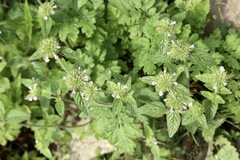
Pilosella officinarum 317 claims

species · family Asteraceae · green plant · NCBI Taxonomy ↗

Common name: mouse-ear hawkweed — Also written in claims: Hieracium pilosella · H. pilosella · Hieracium pilosella L · H pilosella · Mouse-ear hawkweed · P.officinarum — NCBI synonyms: Hieracium pilosella

23 spellings

Pilosella officinarum
Pilosella officinarumAnne Burgess · CC BY-SA 2.0 · Wikimedia Commons ↗
Intervention effectobservedoriginal resultpositivemeasured

Claim · model-written summary

Lowest pressure increased stomatal conductance in H. pilosella after four weeks.

Taxon
H. pilosellaPilosella officinarume0
Treatment
lowest pressuree0
Outcome
stomatal conductancee0
Direction
increasee0
Comparator
control scenarioe0

Verbatim

e0

“In T. pratense and H. pilosella, we observed an increase in stomatal conductance but a reduction in aboveground biomass at the lowest pressure compared to the control scenario after four weeks of incubation.”

✓ located verbatim in the source · abstract, characters 1290–1497

Title

Short-term impact of low air pressure on plants’ functional traits

Silvia Lembo; Georg Niedrist; Bouchra El Omari; et al. PLoS ONE 2025. doi:10.1371/journal.pone.0317590

Other claims from this paper (5)
Intervention effectobservedoriginal resultnegativemeasured

Claim · model-written summary

Lowest pressure reduced aboveground biomass in H. pilosella after four weeks.

Taxon
H. pilosellaPilosella officinarume0
Treatment
lowest pressuree0
Outcome
aboveground biomasse0
Direction
reductione0
Comparator
control scenarioe0

Verbatim

e0

“In T. pratense and H. pilosella, we observed an increase in stomatal conductance but a reduction in aboveground biomass at the lowest pressure compared to the control scenario after four weeks of incubation.”

✓ located verbatim in the source · abstract, characters 1290–1497

Title

Short-term impact of low air pressure on plants’ functional traits

Silvia Lembo; Georg Niedrist; Bouchra El Omari; et al. PLoS ONE 2025. doi:10.1371/journal.pone.0317590

Other claims from this paper (5)
Intervention effectobservedoriginal resultnegativemeasured

Claim · model-written summary

Reduced air pressure decreased growth in Hieracium pilosella L.

Taxon
Hieracium pilosella L.Pilosella officinarume0
Treatment
Reduced air pressuree1
Outcome
growthe1
Direction
decreasede1

Not reportedComparator

Verbatim

e0

“Hieracium pilosella L. and Trifolium pratensis L.”

✓ located verbatim in the source · abstract, characters 573–622
e1

“Reduced air pressure decreased growth, carbon isotopic discrimination and chlorophyll content”

✓ located verbatim in the source · abstract, characters 981–1074

Title

Eco-physiological responses of Hieracium pilosella and Trifolium pratense to reduced air pressure

Bouchra El Omari; Silvia Lembo; Matteo Dainese; et al. PLANT PHYSIOLOGY 2025. doi:10.1093/plphys/kiaf631

Other claims from this paper (9)
Intervention effectobservedoriginal resultmeasured

Claim · model-written summary

Reduced air pressure decreased carbon isotopic discrimination in Hieracium pilosella L.

Taxon
Hieracium pilosella L.Pilosella officinarume0
Treatment
Reduced air pressuree1
Outcome
carbon isotopic discriminatione1
Direction
decreasede1

Not reportedComparator

Verbatim

e0

“Hieracium pilosella L. and Trifolium pratensis L.”

✓ located verbatim in the source · abstract, characters 573–622
e1

“Reduced air pressure decreased growth, carbon isotopic discrimination and chlorophyll content”

✓ located verbatim in the source · abstract, characters 981–1074

Title

Eco-physiological responses of Hieracium pilosella and Trifolium pratense to reduced air pressure

Bouchra El Omari; Silvia Lembo; Matteo Dainese; et al. PLANT PHYSIOLOGY 2025. doi:10.1093/plphys/kiaf631

Other claims from this paper (9)
Intervention effectobservedoriginal resultnegativemeasured

Claim · model-written summary

Reduced air pressure decreased chlorophyll content in Hieracium pilosella L.

Taxon
Hieracium pilosella L.Pilosella officinarume0
Treatment
Reduced air pressuree1
Outcome
chlorophyll contente1
Direction
decreasede1

Not reportedComparator

Verbatim

e0

“Hieracium pilosella L. and Trifolium pratensis L.”

✓ located verbatim in the source · abstract, characters 573–622
e1

“Reduced air pressure decreased growth, carbon isotopic discrimination and chlorophyll content”

✓ located verbatim in the source · abstract, characters 981–1074

Title

Eco-physiological responses of Hieracium pilosella and Trifolium pratense to reduced air pressure

Bouchra El Omari; Silvia Lembo; Matteo Dainese; et al. PLANT PHYSIOLOGY 2025. doi:10.1093/plphys/kiaf631

Other claims from this paper (9)
Intervention effectobservedoriginal resultmeasured

Claim · model-written summary

Reduced air pressure increased CO2 fixation efficiency in Hieracium pilosella L.

Taxon
Hieracium pilosella L.Pilosella officinarume0
Treatment
Reduced air pressuree1
Outcome
CO2 fixation efficiencye1
Direction
increasede1

Not reportedComparator

Verbatim

e0

“Hieracium pilosella L. and Trifolium pratensis L.”

✓ located verbatim in the source · abstract, characters 573–622
e1

“Reduced air pressure decreased growth, carbon isotopic discrimination and chlorophyll content, but increased CO2 fixation efficiency and carbohydrate accumulation in the leaves.”

✓ located verbatim in the source · abstract, characters 981–1158

Title

Eco-physiological responses of Hieracium pilosella and Trifolium pratense to reduced air pressure

Bouchra El Omari; Silvia Lembo; Matteo Dainese; et al. PLANT PHYSIOLOGY 2025. doi:10.1093/plphys/kiaf631

Other claims from this paper (9)
Intervention effectobservedoriginal resultmeasured

Claim · model-written summary

Reduced air pressure increased carbohydrate accumulation in the leaves of Hieracium pilosella L.

Taxon
Hieracium pilosella L.Pilosella officinarume0
Organ / stage
leavese1
Outcome
carbohydrate accumulatione1
Direction
increasede1

Not reportedTreatmentComparator

Verbatim

e0

“Hieracium pilosella L. and Trifolium pratensis L.”

✓ located verbatim in the source · abstract, characters 573–622
e1

“increased CO2 fixation efficiency and carbohydrate accumulation in the leaves”

✓ located verbatim in the source · abstract, characters 1080–1157

Title

Eco-physiological responses of Hieracium pilosella and Trifolium pratense to reduced air pressure

Bouchra El Omari; Silvia Lembo; Matteo Dainese; et al. PLANT PHYSIOLOGY 2025. doi:10.1093/plphys/kiaf631

Other claims from this paper (9)
Intervention effectobservedoriginal resultnegativemeasured

Claim · model-written summary

Pilosella grown alone or in mixture exploited soil nutrients less efficiently

Taxon
Pilosella officinarumPilosella officinarume3
Treatment
Pilosella had grown alonee2
Outcome
soil nutrientse2
Direction
exploited less efficientlye2

Not reportedComparator

Verbatim

e2

“The invasive weed negated these benefits, and soil nutrients were exploited less efficiently when Pilosella had grown alone or in a mixture with the other species”

✓ located verbatim in the source · abstract, characters 1046–1208
e3

“Combinations of Pilosella officinarum (mouse-eared hawk-weed, an invasive weed), Trifolium repens (white clover, a nitrogen fixer) and Dactylis glomerata (cocksfoot, a pasture grass) were planted into a soil with low-to-deficient concentrations of key nutrients”

✓ located verbatim in the source · abstract, characters 551–812

Title

Invasive weed disrupts facilitation of nutrient uptake in grass-clover assemblage

Wei Zhang; Rick Muir; Nicholas Dickinson Soil Ecology Letters 2024. doi:10.1007/s42832-023-0187-1

Other claims from this paper (6)
Observationobservedoriginal resultmeasured

Claim · model-written summary

Nine species were first found in the surveyed areas.

Taxon
Gagea turkestanica, Bunias orienta-lis, Viola dissecta, Clinopodium integerrimum, Melissa officinalis, Sambucus nigra, Hieracium pilosella, Lapsana intermedia and Xanthium spinosumSambucus nigraMelissa officinalisPilosella officinarumViola dissectaBunias orientalisGagea turkestanicaXanthium spinosumLapsana communis subsp. intermediaClinopodium integerrimume0
Outcome
first found on surveyed arease0

Verbatim

e0

“Nine species (Gagea turkestanica, Bunias orienta-lis, Viola dissecta, Clinopodium integerrimum, Melissa officinalis, Sambucus nigra, Hieracium pilosella, Lapsana intermedia and Xanthium spinosum) were first found on surveyed areas”

✓ located verbatim in the source · abstract, characters 418–648

Title

Some rare and new plants in the National Parks of Northern Tien-Shan (Kazakhstan)

A. A. Ivashchenko; R. E. Kaparbai; D. M. Almabek; et al. Проблемы ботаники Южной Сибири и Монголии 2022. doi:10.14258/pbssm.2022053

Other claims from this paper (3)
Observationobservedoriginal resultmeasured

Claim · model-written summary

Six newly recorded species are alien to the area.

Taxon
Bunias orientalis, Melissa officinalis, Sambucus nigra, Hieracium pilosella, Lapsana intermedia and Xanthium spinosumSambucus nigraMelissa officinalisPilosella officinarumBunias orientalisXanthium spinosumLapsana communis subsp. intermediae0
Outcome
alien speciese0

Verbatim

e0

“Six others (Bunias orientalis, Melissa officinalis, Sambucus nigra, Hieracium pilosella, Lapsana intermedia and Xanthium spinosum) are alien species”

✓ located verbatim in the source · abstract, characters 975–1123

Title

Some rare and new plants in the National Parks of Northern Tien-Shan (Kazakhstan)

A. A. Ivashchenko; R. E. Kaparbai; D. M. Almabek; et al. Проблемы ботаники Южной Сибири и Монголии 2022. doi:10.14258/pbssm.2022053

Other claims from this paper (3)