Begonia 964 claims

genus · family Begoniaceae · green plant · NCBI Taxonomy ↗

20 spellings

Begonia
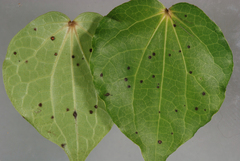
Begonia · picture of the genus (one of its species)Juni from Kyoto, Japan · CC BY 2.0 · Wikimedia Commons ↗
Intervention effectobservedoriginal resultpositivemeasured

Claim · model-written summary

QYN6 controlled Begonia anthracnose in pots with 48.91% efficacy.

Taxon
BegoniaBegoniae0
Treatment
QYN6e0
Interactor
Colletotrichum aotearoa SWBG5Colletotrichum aotearoae1pathogen
Second interactor
QYN6e0biocontrol_agent
Outcome
Begonia anthracnosee0
Direction
biocontrole0
Value
48.91%e0
Setting
greenhouse pot trialse0

Not reportedComparator

Verbatim

e0

“In greenhouse pot trials, QYN6 achieved a biocontrol efficacy of 48.91% against Begonia anthracnose.”

✓ located verbatim in the source · abstract, characters 766–866
e1

“Colletotrichum aotearoa SWBG5”

✓ located verbatim in the source · abstract, characters 206–235

Title

Biological Control and Growth-Promoting Potential of the Endophytic Fungus Nigrospora sphaerica Against Anthracnose in Begonia benariensis

Shuwen Liu; Mian Liu; Jian Liu; et al. Journal of Fungi 2026. doi:10.3390/jof12060412

Other claims from this paper (9)
Associationauthor interpretationoriginal resultmeasured

Claim · model-written summary

Begonia lipid shifts under light correlated with energy storage adjustments and stress resilience.

Taxon
BegoniaBegoniae0
Treatment
lighte0
Outcome
adjustments in energy storage, and stress resiliencee0

Not reportedDirection

Verbatim

e0

“Begonia shifts its lipid metabolism in response to light, correlating with adjustments in energy storage, and stress resilience”

✓ located verbatim in the source · abstract, characters 1249–1376
e1

“Begonia ‘Black Velvet’”

✓ located verbatim in the source · abstract, characters 316–338

Title

Photoregulation of lipid metabolism in Begonia: synergistic effects of spectral composition and intensity on stress adaptation

Zhongke Wang; Hongbo Fu; Hongzheng Tao; et al. Frontiers in Plant Science 2026. doi:10.3389/fpls.2025.1746063

Other claims from this paper (11)
Observationobservedoriginal resultbasis n/a

Claim · model-written summary

Two new tuberous Begonia species, B. angustibracteata and B. baishishanensis, from Guangxi, China are described.

Taxon
BegoniaBegoniae0
Outcome
Two new tuberous speciese0
Setting
Guangxi of Chinae0

Verbatim

e0

“Two new tuberous species of Begonia (Begoniaceae), Begonia angustibracteata D.K.Tian & R.C.Hu and B. baishishanensis R.C.Hu & D.K.Tian from Guangxi of China are described”

✓ located verbatim in the source · abstract, characters 0–170

Title

Two new tuberous species of Begonia (Begoniaceae) from Guangxi, China

Renchuan Hu; Jinye Zhou; Ziyi Zhao; et al. PhytoKeys 2025. doi:10.3897/phytokeys.256.145725

Other claims from this paper (2)
Observationobservedoriginal resultmeasured

Claim · model-written summary

The genera Begonia, Impatiens and Sida had the highest species diversity.

Taxon
Begonia , Impatiens , and SidaBegoniaImpatiensSidae3
Outcome
species diversitye3
Direction
higheste3

Verbatim

e3

“the genera Begonia , Impatiens , and Sida exhibited the highest species diversity”

✓ located verbatim in the source · abstract, characters 1290–1371

Title

Floristic and medicinal plant diversity of South Sikkim: An assessment of therapeutic potential, conservation status, and economic potential

Yugandhar Pulicherla; Srinivasulu Cheemanapalli; Shiddamallayya Nagayya; et al. Journal of Drug Research in Ayurvedic Sciences 2025. doi:10.4103/jdras.jdras_384_24

Other claims from this paper (10)
Method / resourceobservedoriginal resultpositivemeasured

Claim · model-written summary

NDVI-based ENM approach achieved high predictive accuracy (AUC 0.82–0.97) for Begonia species

Taxon
BegoniaBegoniae0
Outcome
predictive accuracye1
Value
0.82–0.97e1

Verbatim

e0

“We used an NDVI-based ecological niche modeling (ENM) approach for Begonia species for this purpose”

✓ located verbatim in the source · abstract, characters 172–271
e1

“where we achieved high predictive accuracy (AUC: 0.82–0.97)”

✓ located verbatim in the source · abstract, characters 273–332

Title

Niche characterization and distribution of Sikkim Himalayan <Begonia> (Begoniaceae), India: a niche modeling approach

Aditya Pradhan; Dibyendu Adhikari; Arun Chettri Journal of Threatened Taxa 2025. doi:10.11609/jott.9538.17.9.27433-27443

Other claims from this paper (18)
Associationobservedoriginal resultsignificant (as stated)measured

Claim · model-written summary

Broader niche breadth is positively correlated with larger predicted distribution areas in Begonia

Taxon
BegoniaBegoniae0
Treatment
broader niche breadthe2
Outcome
predicted distribution arease2
Direction
positive correlatione2
Value
r = 0.747, p = 0.003e2

Verbatim

e0

“We used an NDVI-based ecological niche modeling (ENM) approach for Begonia species for this purpose”

✓ located verbatim in the source · abstract, characters 172–271
e2

“Niche breadth analysis revealed a positive correlation (r = 0.747, p = 0.003) between broader niche breadth and larger predicted distribution areas”

✓ located verbatim in the source · abstract, characters 334–481

Title

Niche characterization and distribution of Sikkim Himalayan <Begonia> (Begoniaceae), India: a niche modeling approach

Aditya Pradhan; Dibyendu Adhikari; Arun Chettri Journal of Threatened Taxa 2025. doi:10.11609/jott.9538.17.9.27433-27443

Other claims from this paper (18)
Intervention effectobservedoriginal resultpositivemeasured

Claim · model-written summary

Deep fertilizer placement improved begonia growth.

Taxon
begoniaBegoniae0
Treatment
CRF subdressing and dibbling applied at 7.6 cme0
Interactor
liverworte0weed
Outcome
growth of both begonia and dracaenae0
Direction
improvinge0

Not reportedComparator

Verbatim

e0

“CRF subdressing and dibbling applied at 7.6 cm were the most effective in reducing liverwort coverage and biomass while improving the growth of both begonia and dracaena.”

✓ located verbatim in the source · abstract, characters 1569–1739

Title

Strategic fertilizer placement in containers influences liverwort (Marchantia polymorpha) growth, reproduction, and competitiveness with ornamentals

Manjot Kaur Sidhu; Sushila Chaudhari; Roberto Lopez; et al. Weed Technology 2025. doi:10.1017/wet.2025.10022

Other claims from this paper (6)
Observationobservedoriginal resultmeasured

Claim · model-written summary

Twenty-one Begonia species were collected and their trichomes characterized.

Taxon
BegoniaBegoniae0
Outcome
21 Begonia speciese0
Value
21 Begonia speciese0

Verbatim

e0

“The 21 Begonia species were collected, and their trichome was characterized.”

✓ located verbatim in the source · abstract, characters 871–947

Title

Trichomes Characterization of Ornamental Plants Begonia spp (Begoniaceae)

Adriana Hakapaa; Hermalina Sinay; Ritha Lusian Karuwal; et al. Biosaintifika Journal of Biology & Biology Education 2025. doi:10.15294/biosaintifika.v17i2.21854

Other claims from this paper (3)
Observationobservedoriginal resultmeasured

Claim · model-written summary

Begonia trichomes showed base, body and tip structures, variable rows, shapes and glandularity.

Taxon
BegoniaBegoniae0
Outcome
base, median or body and tip, uniseriate and multiseriate types, needle or cone shape, and glandular or non glandulare0

Verbatim

e0

“the Begonia’s trichome consists of structure like base, median or body and tip, uniseriate and multiseriate types, needle or cone shape, and glandular or non glandular”

✓ located verbatim in the source · abstract, characters 960–1127

Title

Trichomes Characterization of Ornamental Plants Begonia spp (Begoniaceae)

Adriana Hakapaa; Hermalina Sinay; Ritha Lusian Karuwal; et al. Biosaintifika Journal of Biology & Biology Education 2025. doi:10.15294/biosaintifika.v17i2.21854

Other claims from this paper (3)
Observationobservedoriginal resultmeasured

Claim · model-written summary

Average Begonia trichome length ranged from 29.80 to 233.47 µm.

Taxon
BegoniaBegoniat0
Outcome
average length of trichomese0
Direction
rangee0
Value
29.80-233.47 µme0

Verbatim

e0

“The average length of trichomes range from 29.80-233.47 µm.”

✓ located verbatim in the source · abstract, characters 1129–1188
t0

“Ornamental Plants Begonia spp”

✓ located verbatim in the source · title, characters 30–59

Title

Trichomes Characterization of Ornamental Plants Begonia spp (Begoniaceae)

Adriana Hakapaa; Hermalina Sinay; Ritha Lusian Karuwal; et al. Biosaintifika Journal of Biology & Biology Education 2025. doi:10.15294/biosaintifika.v17i2.21854

Other claims from this paper (3)