Pinus halepensis 1,908 claims

species · family Pinaceae · green plant · NCBI Taxonomy ↗

Common name: Aleppo pine — Also written in claims: Aleppo pine · Aleppo pines · Aleppo pine forests · Aleppo pine trees · Pinus hale-pensis · Aurasian Aleppo pine

68 spellings

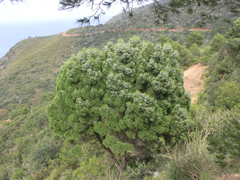
Pinus halepensis
Pinus halepensisspacebirdy (also known as geimfyglið (:> )=| made with Sternenlaus -spirit) · CC BY-SA 3.0 · Wikimedia Commons ↗
Intervention effectobservedoriginal resultpositivemeasured

Claim · model-written summary

Extract at 1000 µg/mL inhibited Fusarium circinatum growth with a FIP of 71.85%.

Taxon
Pinus halepensisPinus halepensise1
Treatment
GBEe6
Interactor
F. circinatumFusarium circinatume6pathogen
Outcome
fungal inhibition percentage (FIP)e6
Direction
inhibitinge6
Value
71.85%e6
Qualifier
1000 µg/mLe6

Not reportedComparator

Verbatim

e1

“were used as biofungicide agents applied to Pinus halepensis Mill. wood samples”

✓ located verbatim in the source · abstract, characters 508–587
e6

“Both GBE and kinos showed potential antifungal activity at 1000 µg/mL, inhibiting F. circinatum growth with fungal inhibition percentage (FIP) values of 71.85% and 71.11%, respectively”

✓ located verbatim in the source · abstract, characters 1554–1738

Title

Phytochemical analysis of green-branch bark extract and the brown gum exudates “kinos” from Eucalyptus camaldulensis by HPLC and GC–MS with their antifungal activity

Mohamed Z. M. Salem; Mohammed A. A. Elshaer; Abeer A. Mohamed; et al. Scientific Reports 2026. doi:10.1038/s41598-026-38109-2

Other claims from this paper (17)
Intervention effectobservedoriginal resultpositivemeasured

Claim · model-written summary

Kinos at 1000 µg/mL inhibited Fusarium circinatum growth with a FIP of 71.11%.

Taxon
Pinus halepensisPinus halepensise1
Treatment
kinose6
Interactor
F. circinatumFusarium circinatume6pathogen
Outcome
fungal inhibition percentage (FIP)e6
Direction
inhibitinge6
Value
71.11%e6
Qualifier
1000 µg/mLe6

Not reportedComparator

Verbatim

e1

“were used as biofungicide agents applied to Pinus halepensis Mill. wood samples”

✓ located verbatim in the source · abstract, characters 508–587
e6

“Both GBE and kinos showed potential antifungal activity at 1000 µg/mL, inhibiting F. circinatum growth with fungal inhibition percentage (FIP) values of 71.85% and 71.11%, respectively”

✓ located verbatim in the source · abstract, characters 1554–1738

Title

Phytochemical analysis of green-branch bark extract and the brown gum exudates “kinos” from Eucalyptus camaldulensis by HPLC and GC–MS with their antifungal activity

Mohamed Z. M. Salem; Mohammed A. A. Elshaer; Abeer A. Mohamed; et al. Scientific Reports 2026. doi:10.1038/s41598-026-38109-2

Other claims from this paper (17)
Intervention effectobservedoriginal resultpositivemeasured

Claim · model-written summary

GBE at 1000 µg/mL had the highest antifungal effect against Pythium tardicrescens, with a FIP of 39.62%.

Taxon
Pinus halepensisPinus halepensise1
Treatment
GBEe7
Interactor
P. tardicrescensPythium tardicrescense7pathogen
Outcome
FIP valuese7
Direction
higheste7
Value
39.62%e7
Qualifier
1000 and 500 µg/mLe7

Not reportedComparator

Verbatim

e1

“were used as biofungicide agents applied to Pinus halepensis Mill. wood samples”

✓ located verbatim in the source · abstract, characters 508–587
e7

“The GBE at 1000 and 500 µg/mL exhibited the highest antifungal effects against P. tardicrescens, with FIP values of 39.62% and 35.55%, respectively”

✓ located verbatim in the source · abstract, characters 1740–1887

Title

Phytochemical analysis of green-branch bark extract and the brown gum exudates “kinos” from Eucalyptus camaldulensis by HPLC and GC–MS with their antifungal activity

Mohamed Z. M. Salem; Mohammed A. A. Elshaer; Abeer A. Mohamed; et al. Scientific Reports 2026. doi:10.1038/s41598-026-38109-2

Other claims from this paper (17)
Intervention effectobservedoriginal resultpositivemeasured

Claim · model-written summary

GBE at 500 µg/mL had a strong antifungal effect against Pythium tardicrescens, with a FIP of 35.55%.
Taxon
Pinus halepensisPinus halepensise1
Treatment
GBEe7
Interactor
P. tardicrescensPythium tardicrescense7pathogen
Outcome
FIP valuese7
Direction
higheste7
Value
35.55%e7
Qualifier
500 µg/mLe7

Not reportedComparator

Verbatim

e1

“were used as biofungicide agents applied to Pinus halepensis Mill. wood samples”

✓ located verbatim in the source · abstract, characters 508–587
e7

“The GBE at 1000 and 500 µg/mL exhibited the highest antifungal effects against P. tardicrescens, with FIP values of 39.62% and 35.55%, respectively”

✓ located verbatim in the source · abstract, characters 1740–1887

Title

Phytochemical analysis of green-branch bark extract and the brown gum exudates “kinos” from Eucalyptus camaldulensis by HPLC and GC–MS with their antifungal activity

Mohamed Z. M. Salem; Mohammed A. A. Elshaer; Abeer A. Mohamed; et al. Scientific Reports 2026. doi:10.1038/s41598-026-38109-2

Other claims from this paper (17)
Observationobservedoriginal resultmeasured

Claim · model-written summary

Large-tree, low-density fuel types had lowest fire severity.

Taxon
Pinus halepensisPinus halepensise1
Outcome
fire severitye0
Direction
loweste0
Qualifier
large trees and low densitiese0

Verbatim

e0

“Fuel types characterized by large trees and low densities had the lowest fire severity in both forest types”

✓ located verbatim in the source · abstract, characters 909–1016
e1

“pine ( Pinus halepensis ) and oak ( Quercus suber ) forests”

✓ located verbatim in the source · abstract, characters 461–520

Title

Effects of fuel types and fire severity on atmospheric pollutant emissions in an extreme wind-driven wildfire

Albert Alvarez; Judit Lecina-Diaz; Miquel De Cáceres; et al. Journal of Forestry Research 2026. doi:10.1007/s11676-026-01988-2

Other claims from this paper (8)
Associationobservedoriginal resultmeasured

Claim · model-written summary

Greater fuel continuity accompanied higher severity and consumption.

Taxon
Pinus halepensisPinus halepensise1
Outcome
fire severity and fuel consumptione0
Direction
highere0
Qualifier
more vertical and horizontal continuitye0
Setting
forestse1

Verbatim

e0

“Fuel types with more vertical and horizontal continuity experienced higher fire severity and fuel consumption (72–85% of high severity)”

✓ located verbatim in the source · abstract, characters 1298–1433
e1

“pine ( Pinus halepensis ) and oak ( Quercus suber ) forests”

✓ located verbatim in the source · abstract, characters 461–520

Title

Effects of fuel types and fire severity on atmospheric pollutant emissions in an extreme wind-driven wildfire

Albert Alvarez; Judit Lecina-Diaz; Miquel De Cáceres; et al. Journal of Forestry Research 2026. doi:10.1007/s11676-026-01988-2

Other claims from this paper (8)
Associationobservedoriginal resultmeasured

Claim · model-written summary

Fire severity was the primary determinant of pollutant emissions.

Taxon
Pinus halepensisPinus halepensise1
Outcome
pollutant emissionse0
Qualifier
Fire severitye0
Setting
forestse1

Not reportedDirection

Verbatim

e0

“Fire severity rather than species or fuel type was the primary factor influencing pollutant emissions”

✓ located verbatim in the source · abstract, characters 1435–1536
e1

“pine ( Pinus halepensis ) and oak ( Quercus suber ) forests”

✓ located verbatim in the source · abstract, characters 461–520

Title

Effects of fuel types and fire severity on atmospheric pollutant emissions in an extreme wind-driven wildfire

Albert Alvarez; Judit Lecina-Diaz; Miquel De Cáceres; et al. Journal of Forestry Research 2026. doi:10.1007/s11676-026-01988-2

Other claims from this paper (8)
Intervention effectobservedoriginal resultpositivesignificant (as stated)measured

Claim · model-written summary

Mixed stands had higher soil porosity than pure stands.

Taxon
Pinus halepensis and Tetraclinis articulataTetraclinis articulataPinus halepensise1
Treatment
Mixed standse0
Outcome
porositye0
Direction
highere0
Value
78.3 vs. 79.5e0
Comparator
pure standse2

Verbatim

e0

“Mixed stands significantly enhanced soil physicochemical properties, as reflected by higher porosity (78.3 vs. 79.5)”

✓ located verbatim in the source · abstract, characters 760–876
e1

“Pinus halepensis and Tetraclinis articulata”

✓ located verbatim in the source · abstract, characters 182–225
e2

“compared to pure stands”

✓ located verbatim in the source · abstract, characters 947–970

Title

Forest admixture as a strategy for enhancing soil-plant properties under semi-arid mediterranean climate in Western Algeria

Catherine Rébufa; Amine Habib Borsali; Khalida Malek Belhamza; et al. Forest Ecology and Management 2026. doi:10.1016/j.foreco.2026.123832

Other claims from this paper (8)
Intervention effectobservedoriginal resultpositivesignificant (as stated)measured

Claim · model-written summary

Mixed stands had higher soil permeability than pure stands.

Taxon
Pinus halepensis and Tetraclinis articulataTetraclinis articulataPinus halepensise1
Treatment
Mixed standse2
Outcome
permeabilitye0
Direction
highere2
Value
50.0 vs. 51.3e0
Comparator
pure standse2

Verbatim

e0

“permeability (50.0 vs. 51.3)”

✓ located verbatim in the source · abstract, characters 878–906
e1

“Pinus halepensis and Tetraclinis articulata”

✓ located verbatim in the source · abstract, characters 182–225
e2

“Mixed stands significantly enhanced soil physicochemical properties, as reflected by higher porosity (78.3 vs. 79.5), permeability (50.0 vs. 51.3), and C org /N tot ratio (13.5 vs. 20.1) compared to pure stands”

✓ located verbatim in the source · abstract, characters 760–970

Title

Forest admixture as a strategy for enhancing soil-plant properties under semi-arid mediterranean climate in Western Algeria

Catherine Rébufa; Amine Habib Borsali; Khalida Malek Belhamza; et al. Forest Ecology and Management 2026. doi:10.1016/j.foreco.2026.123832

Other claims from this paper (8)
Intervention effectobservedoriginal resultpositivesignificant (as stated)measured

Claim · model-written summary

Mixed stands had a higher soil carbon to nitrogen ratio than pure stands.

Taxon
Pinus halepensis and Tetraclinis articulataTetraclinis articulataPinus halepensise1
Treatment
Mixed standse2
Outcome
C org /N tot ratioe0
Direction
highere2
Value
13.5 vs. 20.1e0
Comparator
pure standse2

Verbatim

e0

“C org /N tot ratio (13.5 vs. 20.1)”

✓ located verbatim in the source · abstract, characters 912–946
e1

“Pinus halepensis and Tetraclinis articulata”

✓ located verbatim in the source · abstract, characters 182–225
e2

“Mixed stands significantly enhanced soil physicochemical properties, as reflected by higher porosity (78.3 vs. 79.5), permeability (50.0 vs. 51.3), and C org /N tot ratio (13.5 vs. 20.1) compared to pure stands”

✓ located verbatim in the source · abstract, characters 760–970

Title

Forest admixture as a strategy for enhancing soil-plant properties under semi-arid mediterranean climate in Western Algeria

Catherine Rébufa; Amine Habib Borsali; Khalida Malek Belhamza; et al. Forest Ecology and Management 2026. doi:10.1016/j.foreco.2026.123832

Other claims from this paper (8)