Abstract
Glufosinate ammonium diminished developments of rice (Oryza sativa) blast and brown leaf spot in 35S:bar-transgenic rice. Pre- and postinoculation treatments of this herbicide reduced disease development. Glufosinate ammonium specifically impeded appressorium formation of the pathogens Magnaporthe grisea and Cochliobolus miyabeanus on hydrophobic surface and on transgenic rice. In contrast, conidial germination remained unaffected. Glufosinate ammonium diminished mycelial growth of two pathogens; however, this inhibitory effect was attenuated in malnutrition conditions. Glufosinate ammonium caused slight chlorosis and diminished chlorophyll content; however, these alterations were almost completely restored in transgenic rice within 7 d. Glufosinate ammonium triggered transcriptions of PATHOGENESIS-RELATED (PR) genes and hydrogen peroxide accumulation in transgenic rice and PR1 transcription in Arabidopsis (Arabidopsis thaliana) wild-type ecotype Columbia harboring 35S:bar construct. All transgenic Arabidopsis showed robust hydrogen peroxide accumulation by glufosinate ammonium. This herbicide also induced PR1 transcription in etr1 and jar1 expressing bar; however, no expression was observed in NahG and npr1. Fungal infection did not alter transcriptions of PR genes and hydrogen peroxide accumulation induced by glufosinate ammonium. Infiltration of glufosinate ammonium did not affect appressorium formation of M. grisea in vivo but inhibited blast disease development. Hydrogen peroxide scavengers nullified blast protection and transcriptions of PR genes by glufosinate ammonium; however, they did not affect brown leaf spot progression. In sum, both direct inhibition of pathogen infection and activation of defense systems were responsible for disease protection in bar-transgenic rice.
Abstract from the paper’s OpenAlex record, shown for indexing and research. Copyright remains with the authors or the publisher. Read at the source ↗
The text the model read, with the source record’s inline markup (italics, sub- and superscripts) rendered and its character entities decoded; quote offsets refer to the raw text.
Claims 19
Claim · model-written summary
Glufosinate diminished blast and brown leaf spot in transgenic rice.
- Taxon
- rice (Oryza sativa)
 Oryza sativae0
- Material
- 35S:bar-transgenic ricee0
- Treatment
- Glufosinate ammoniume0
- Outcome
- blast and brown leaf spote0
- Direction
- diminishede0
Not reportedComparator
Organisms pictured · Representative pictures of the matched species, not figures from the paper.

Verbatim
e0“Glufosinate ammonium diminished developments of rice (Oryza sativa) blast and brown leaf spot in 35S:bar-transgenic rice.”
Claim · model-written summary
Pre- and postinoculation herbicide treatments reduced disease development.
- Taxon
- RiceOryza sativat0
- Treatment
- Pre- and postinoculation treatments of this herbicidee0
- Outcome
- disease developmente0
- Direction
- reducede0
Not reportedComparator
Organisms pictured · Representative pictures of the matched species, not figures from the paper.
Verbatim
e0“Pre- and postinoculation treatments of this herbicide reduced disease development.”
t0“bar-Transgenic Rice”
Claim · model-written summary
Glufosinate impeded pathogen appressorium formation on hydrophobic surfaces and rice.
- Taxon
- RiceOryza sativat0
- Treatment
- Glufosinate ammoniume0
- Interactor
- Magnaporthe grisea
 Pyricularia griseae0pathogen
- Second interactor
- Cochliobolus miyabeanus
 Bipolaris oryzaee0pathogen
- Outcome
- appressorium formation of the pathogens Magnaporthe grisea and Cochliobolus miyabeanuse0
- Direction
- impedede0
Not reportedComparator
Organisms pictured · Representative pictures of the matched species, not figures from the paper.

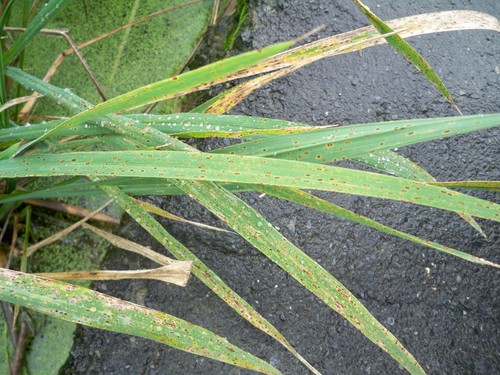
Verbatim
e0“Glufosinate ammonium specifically impeded appressorium formation of the pathogens Magnaporthe grisea and Cochliobolus miyabeanus on hydrophobic surface and on transgenic rice.”
t0“bar-Transgenic Rice”
Claim · model-written summary
Conidial germination was unaffected.
- Taxon
- RiceOryza sativat0
- Treatment
- Glufosinate Ammoniumt0
- Outcome
- conidial germinatione0
- Direction
- unaffectede0
Not reportedComparator
Organisms pictured · Representative pictures of the matched species, not figures from the paper.
Verbatim
e0“In contrast, conidial germination remained unaffected.”
t0“Glufosinate Ammonium-Induced Pathogen Inhibition and Defense Responses Culminate in Disease Protection in bar-Transgenic Rice”
Claim · model-written summary
Glufosinate diminished pathogen mycelial growth, with attenuation under malnutrition.
- Taxon
- RiceOryza sativat0
- Treatment
- Glufosinate ammoniume0
- Outcome
- mycelial growth of two pathogense0
- Direction
- diminishede0
- Qualifier
- attenuated in malnutrition conditionse0
Not reportedComparator
Organisms pictured · Representative pictures of the matched species, not figures from the paper.
Verbatim
e0“Glufosinate ammonium diminished mycelial growth of two pathogens; however, this inhibitory effect was attenuated in malnutrition conditions.”
t0“bar-Transgenic Rice”
Claim · model-written summary
Glufosinate caused slight chlorosis in rice, almost completely restored within 7 days.
- Taxon
- RiceOryza sativat0
- Treatment
- Glufosinate ammoniume0
- Outcome
- slight chlorosise0
- Qualifier
- almost completely restored in transgenic rice within 7 de0
Not reportedComparatorDirection
Organisms pictured · Representative pictures of the matched species, not figures from the paper.
Verbatim
e0“Glufosinate ammonium caused slight chlorosis and diminished chlorophyll content; however, these alterations were almost completely restored in transgenic rice within 7 d.”
t0“bar-Transgenic Rice”
Claim · model-written summary
Glufosinate diminished chlorophyll content, almost completely restored within 7 days.
- Taxon
- RiceOryza sativat0
- Treatment
- Glufosinate ammoniume0
- Outcome
- chlorophyll contente0
- Direction
- diminishede0
- Qualifier
- almost completely restored in transgenic rice within 7 de0
Not reportedComparator
Organisms pictured · Representative pictures of the matched species, not figures from the paper.
Verbatim
e0“Glufosinate ammonium caused slight chlorosis and diminished chlorophyll content; however, these alterations were almost completely restored in transgenic rice within 7 d.”
t0“bar-Transgenic Rice”
Claim · model-written summary
Glufosinate triggered PR gene transcription and hydrogen peroxide accumulation in rice.
- Taxon
- RiceOryza sativat0
- Treatment
- Glufosinate ammoniume0
- Gene
- PATHOGENESIS-RELATED (PR) genese0
- Outcome
- transcriptions of PATHOGENESIS-RELATED (PR) genes and hydrogen peroxide accumulatione0
- Direction
- triggerede0
Not reportedComparator
Organisms pictured · Representative pictures of the matched species, not figures from the paper.
Verbatim
e0“Glufosinate ammonium triggered transcriptions of PATHOGENESIS-RELATED (PR) genes and hydrogen peroxide accumulation in transgenic rice”
t0“bar-Transgenic Rice”
Claim · model-written summary
Glufosinate triggered PR1 transcription in transformed Arabidopsis Columbia.
- Taxon
- Arabidopsis (Arabidopsis thaliana)
 Arabidopsis thalianae0
- Material
- wild-type ecotype Columbiae0
- Treatment
- Glufosinate Ammoniumt0
- Gene
- PR1e0
- Outcome
- PR1 transcriptione0
Not reportedComparatorDirection
Organisms pictured · Representative pictures of the matched species, not figures from the paper.

Verbatim
e0“PR1 transcription in Arabidopsis (Arabidopsis thaliana) wild-type ecotype Columbia harboring 35S:bar construct”
t0“Glufosinate Ammonium-Induced”
Claim · model-written summary
All transgenic Arabidopsis showed robust hydrogen peroxide accumulation after glufosinate.
- Taxon
- ArabidopsisArabidopsise0
- Material
- transgenic Arabidopsise0
- Treatment
- glufosinate ammoniume0
- Outcome
- hydrogen peroxide accumulatione0
- Direction
- accumulatione0
Not reportedComparator
Organisms pictured · Representative pictures of the matched species, not figures from the paper.
Verbatim
e0“All transgenic Arabidopsis showed robust hydrogen peroxide accumulation by glufosinate ammonium.”
Claim · model-written summary
Glufosinate induced PR1 transcription in etr1 and jar1 expressing bar.
- Taxon
- ArabidopsisArabidopsise1
- Material
- etr1 and jar1 expressing bare0
- Treatment
- This herbicidee0
- Gene
- PR1e0
- Outcome
- PR1 transcriptione0
- Direction
- inducede0
Not reportedComparator
Organisms pictured · Representative pictures of the matched species, not figures from the paper.
Verbatim
e0“This herbicide also induced PR1 transcription in etr1 and jar1 expressing bar”
e1“All transgenic Arabidopsis showed robust hydrogen peroxide accumulation by glufosinate ammonium.”
Claim · model-written summary
PR1 expression was absent in NahG and npr1 after herbicide treatment.
- Taxon
- ArabidopsisArabidopsise1
- Material
- NahG and npr1e0
- Treatment
- glufosinate ammoniume1
- Outcome
- expressione0
- Direction
- no expressione0
Not reportedComparator
Organisms pictured · Representative pictures of the matched species, not figures from the paper.
Verbatim
e0“no expression was observed in NahG and npr1”
e1“All transgenic Arabidopsis showed robust hydrogen peroxide accumulation by glufosinate ammonium.”
Claim · model-written summary
Fungal infection did not alter glufosinate-induced PR transcription and peroxide accumulation.
- Taxon
- RiceOryza sativat0
- Treatment
- Fungal infectione0
- Outcome
- transcriptions of PR genes and hydrogen peroxide accumulatione0
- Direction
- did not altere0
Not reportedComparator
Organisms pictured · Representative pictures of the matched species, not figures from the paper.
Verbatim
e0“Fungal infection did not alter transcriptions of PR genes and hydrogen peroxide accumulation induced by glufosinate ammonium.”
t0“bar-Transgenic Rice”
Claim · model-written summary
Glufosinate infiltration did not affect M. grisea appressorium formation in vivo.
- Taxon
- RiceOryza sativat0
- Treatment
- Infiltration of glufosinate ammoniume0
- Interactor
- M. griseaPyricularia griseae0pathogen
- Outcome
- appressorium formation of M. griseae0
- Direction
- did not affecte0
Not reportedComparator
Organisms pictured · Representative pictures of the matched species, not figures from the paper.
Verbatim
e0“Infiltration of glufosinate ammonium did not affect appressorium formation of M. grisea in vivo but inhibited blast disease development.”
t0“bar-Transgenic Rice”
Claim · model-written summary
Glufosinate infiltration inhibited rice blast development.
- Taxon
- RiceOryza sativat0
- Treatment
- Infiltration of glufosinate ammoniume0
- Outcome
- blast disease developmente0
- Direction
- inhibitede0
Not reportedComparator
Organisms pictured · Representative pictures of the matched species, not figures from the paper.
Verbatim
e0“Infiltration of glufosinate ammonium did not affect appressorium formation of M. grisea in vivo but inhibited blast disease development.”
t0“bar-Transgenic Rice”
Claim · model-written summary
Hydrogen peroxide scavengers nullified blast protection by glufosinate.
- Taxon
- RiceOryza sativat0
- Treatment
- Hydrogen peroxide scavengerse0
- Outcome
- blast protectione0
- Direction
- nullifiede0
Not reportedComparator
Organisms pictured · Representative pictures of the matched species, not figures from the paper.
Verbatim
e0“Hydrogen peroxide scavengers nullified blast protection and transcriptions of PR genes by glufosinate ammonium; however, they did not affect brown leaf spot progression.”
t0“bar-Transgenic Rice”
Claim · model-written summary
Hydrogen peroxide scavengers nullified glufosinate-induced PR gene transcription.
- Taxon
- RiceOryza sativat0
- Treatment
- Hydrogen peroxide scavengerse0
- Gene
- PR genese0
- Outcome
- transcriptions of PR genese0
- Direction
- nullifiede0
Not reportedComparator
Organisms pictured · Representative pictures of the matched species, not figures from the paper.
Verbatim
e0“Hydrogen peroxide scavengers nullified blast protection and transcriptions of PR genes by glufosinate ammonium; however, they did not affect brown leaf spot progression.”
t0“bar-Transgenic Rice”
Claim · model-written summary
Hydrogen peroxide scavengers did not affect brown leaf spot progression.
- Taxon
- RiceOryza sativat0
- Treatment
- Hydrogen peroxide scavengerse0
- Outcome
- brown leaf spot progressione0
- Direction
- did not affecte0
Not reportedComparator
Organisms pictured · Representative pictures of the matched species, not figures from the paper.
Verbatim
e0“Hydrogen peroxide scavengers nullified blast protection and transcriptions of PR genes by glufosinate ammonium; however, they did not affect brown leaf spot progression.”
t0“bar-Transgenic Rice”
Claim · model-written summary
Direct pathogen inhibition and defense activation were responsible for disease protection in transgenic rice.
- Taxon
- riceOryza sativae0
- Outcome
- disease protectione0
- Qualifier
- direct inhibition of pathogen infection and activation of defense systemse0
Organisms pictured · Representative pictures of the matched species, not figures from the paper.
Verbatim
e0“both direct inhibition of pathogen infection and activation of defense systems were responsible for disease protection in bar-transgenic rice.”
The same questions in other papers
hydrogen peroxide · disease · Oryza sativa (rice)Positive and negative results
2 papers in the same direction as this paper · 5 in the opposite direction
- positive
- positive
- positive
4 papers more in this group
See all 8 papers →hydrogen peroxide · molecular: expression · Oryza sativa (rice)Positive and negative results
1 paper in the same direction as this paper · 9 in the opposite direction
- positive
- positive
- positive
7 papers more in this group
See all 11 papers →glufosinate · disease · Oryza sativa (rice)Results agree
2 papers in the same direction as this paper
- positive
- positive
nitrogen · physiology: pigments · Oryza sativa (rice)Results differ
11 papers in the same direction as this paper · 73 in the opposite direction
- positive
- positive
- positive
81 papers more in this group
See all 85 papers →nitrogen · Pyricularia grisea · Oryza sativa (rice)Positive and negative results
1 in the opposite direction
- negative
nitrogen · molecular: expression · Arabidopsis thaliana (thale cress)Positive and negative results
5 papers in the same direction as this paper · 8 in the opposite direction
- no effect
- negative
- no effect
10 papers more in this group
See all 14 papers →nitrogen · molecular: expression · ArabidopsisPositive and negative results
11 papers in the same direction as this paper · 6 in the opposite direction
- positive
- positive
- positive
14 papers more in this group
See all 18 papers →herbicide · disease · Oryza sativa (rice)Positive and negative results
16 papers in the same direction as this paper · 7 in the opposite direction
- negative
- no effect
- negative
20 papers more in this group
See all 24 papers →8 of 12 groups shown: named compounds and organisms first, then groups whose results differ (checked claim by claim), then those with positive and negative results, then the smaller groups.
Claims are grouped by organism, treatment and what was measured or targeted. A paper counts as positive when any of its claims in the group is positive.