Abstract
The leaf surface area of l-year-old, potted `Montmorency' sour cherry (Prunus cerasus L.) trees was reduced by punching disks from some or all leaves to determine the threshold level of leaf area removal (LAR) necessary to reduce net CO 2 assimilation (A) and whole-plant growth. Removal of 30% of the leaf area of individual leaves reduced A on a whole-leaf basis between 1 and 3 weeks following LAR. Less than 30% LAR was compensated for by higher estimated carboxylation efficiency and ribulose-l,5-bisphosphate (RuBP) regeneration capacity. The threshold level of LAR based on gas exchange of individual leaves was 20%. Although whole-plant dry weight accumulation was reduced at all levels of LAR, a disproportionately large decrease in dry weight occurred as LAR increased from 20% to 30%. This result indicates that 30% LAR exceeded the threshold LAR level that was noted for A (20% LAR). Wound ethylene production induced by leaf-punching ceased after 24 hours, which indicated that wounds had healed and that ethylene, therefore, did not influence A significantly. The observed threshoId of 20% LAR represents a significant compensation ability for sour cherry, but this threshold may change with crop load, environment, or both.
Abstract from the paper’s OpenAlex record, shown for indexing and research. Copyright remains with the authors or the publisher. Read at the source ↗
The text the model read, with the source record’s inline markup (italics, sub- and superscripts) rendered and its character entities decoded; quote offsets refer to the raw text.
Claims 9
Claim · model-written summary
Removing 30% of individual leaf area reduced whole leaf assimilation after one to three weeks.
- Taxon
- sour cherry
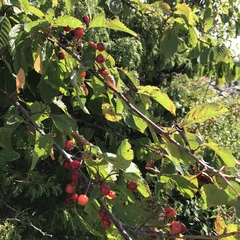 Prunus cerasuse1
- Treatment
- Removal of 30% of the leaf areae0
- Outcome
- A on a whole-leaf basise0
- Direction
- reducede0
- Value
- 30%e0
- Qualifier
- between 1 and 3 weeks following LARe0
Not reportedComparator
Organisms pictured · Representative pictures of the matched species, not figures from the paper.

Verbatim
e0“Removal of 30% of the leaf area of individual leaves reduced A on a whole-leaf basis between 1 and 3 weeks following LAR.”
e1“sour cherry (Prunus cerasus L.)”
Claim · model-written summary
Less than 30% leaf area removal was compensated by higher carboxylation efficiency and RuBP regeneration capacity.
- Taxon
- sour cherryPrunus cerasuse1
- Treatment
- Less than 30% LARe0
- Outcome
- estimated carboxylation efficiency and ribulose-l,5-bisphosphate (RuBP) regeneration capacitye0
- Direction
- highere0
Organisms pictured · Representative pictures of the matched species, not figures from the paper.
Verbatim
e0“Less than 30% LAR was compensated for by higher estimated carboxylation efficiency and ribulose-l,5-bisphosphate (RuBP) regeneration capacity.”
e1“sour cherry (Prunus cerasus L.)”
Claim · model-written summary
The individual leaf gas exchange threshold for leaf area removal was 20%.
- Taxon
- sour cherryPrunus cerasuse1
- Outcome
- threshold level of LAR based on gas exchange of individual leavese0
- Value
- 20%e0
Organisms pictured · Representative pictures of the matched species, not figures from the paper.
Verbatim
e0“The threshold level of LAR based on gas exchange of individual leaves was 20%.”
e1“sour cherry (Prunus cerasus L.)”
Claim · model-written summary
Whole plant dry weight accumulation was reduced at every leaf area removal level.
- Taxon
- sour cherryPrunus cerasuse1
- Treatment
- LARe0
- Outcome
- whole-plant dry weight accumulatione0
- Direction
- reducede0
Not reportedComparator
Organisms pictured · Representative pictures of the matched species, not figures from the paper.
Verbatim
e0“whole-plant dry weight accumulation was reduced at all levels of LAR”
e1“sour cherry (Prunus cerasus L.)”
Claim · model-written summary
Dry weight fell disproportionately as removal rose from 20% to 30%.
- Taxon
- sour cherryPrunus cerasuse1
- Treatment
- LARe0
- Outcome
- dry weighte0
- Direction
- decreasee0
- Value
- 30%e0
- Comparator
- 20%e0
Organisms pictured · Representative pictures of the matched species, not figures from the paper.
Verbatim
e0“a disproportionately large decrease in dry weight occurred as LAR increased from 20% to 30%”
e1“sour cherry (Prunus cerasus L.)”
Claim · model-written summary
Leaf punching induced wound ethylene production that ceased after 24 hours.
- Taxon
- sour cherryPrunus cerasuse1
- Treatment
- leaf-punchinge0
- Outcome
- Wound ethylene productione0
- Direction
- ceasede0
- Value
- 24 hourse0
Not reportedComparator
Organisms pictured · Representative pictures of the matched species, not figures from the paper.
Verbatim
e0“Wound ethylene production induced by leaf-punching ceased after 24 hours”
e1“sour cherry (Prunus cerasus L.)”
Claim · model-written summary
The authors infer that wound ethylene did not significantly influence assimilation.
- Taxon
- sour cherryPrunus cerasuse1
- Compound
- ethylenee0
- Outcome
- Ae0
Not reportedDirection
Organisms pictured · Representative pictures of the matched species, not figures from the paper.
Verbatim
e0“ethylene, therefore, did not influence A significantly”
e1“sour cherry (Prunus cerasus L.)”
Claim · model-written summary
The authors interpret 30% leaf area removal as exceeding the assimilation threshold of 20%.
- Taxon
- sour cherryPrunus cerasuse1
- Outcome
- threshold LAR level that was noted for Ae0
- Direction
- exceedede0
- Value
- 20%e0
Organisms pictured · Representative pictures of the matched species, not figures from the paper.
Verbatim
e0“30% LAR exceeded the threshold LAR level that was noted for A (20% LAR)”
e1“sour cherry (Prunus cerasus L.)”
Claim · model-written summary
The authors conclude that sour cherry can compensate for a 20% leaf area reduction, subject to crop load and environment.
- Taxon
- sour cherryPrunus cerasuse0
- Outcome
- compensation abilitye0
- Value
- 20%e0
- Qualifier
- may change with crop load, environment, or bothe0
Organisms pictured · Representative pictures of the matched species, not figures from the paper.
Verbatim
e0“The observed threshoId of 20% LAR represents a significant compensation ability for sour cherry, but this threshold may change with crop load, environment, or both.”