Abstract
Effects of drought on water relations, whole-shoot gas-exchange characteristics, and pigment and zeatin concentrations were investigated in the Mediterranean shrubs rosemary (Rosmarinus officinalis L.) and lavender (Lavandula stoechas L.). Two-year-old, greenhouse-grown plants were placed in a whole-shoot gas-exchange measurement system and subjected to 10 days of drought, resulting in severe water stress, and then re-watered for 5 days in order to study their recovery. Water stress resulted in a significant decline in maximum whole-shoot net CO2 assimilation rates (An) for both species that was associated with reductions in leaf area and stomatal conductance. Because shoot dark respiration rate (Rd) was less sensitive to water stress than An, shoot Rd/An ratio increased from about 15 to 95% during water stress. No major changes in chlorophyll and carotenoid concentrations of rosemary leaves were observed during the experiments, but chlorophyll and carotenoid concentrations fell significantly in water-stressed lavender leaves. Zeatin concentrations were higher in rosemary leaves than in lavender leaves during water stress. After re-watering, whole-shoot An and Rd rapidly recovered to their pre-drought rates.
Abstract from the paper’s OpenAlex record, shown for indexing and research. Copyright remains with the authors or the publisher. Read at the source ↗
The text the model read, with the source record’s inline markup (italics, sub- and superscripts) rendered and its character entities decoded; quote offsets refer to the raw text.
Claims 10
Claim · model-written summary
Water stress significantly reduced maximum shoot net CO2 assimilation in rosemary.
- Taxon
- rosemary
 Salvia rosmarinust0
- Treatment
- Water stresse0
- Outcome
- maximum whole-shoot net CO2 assimilation ratese0
- Direction
- declinee0
Not reportedComparator
Organisms pictured · Representative pictures of the matched species, not figures from the paper.

Verbatim
e0“Water stress resulted in a significant decline in maximum whole-shoot net CO2 assimilation rates (An) for both species”
t0“rosemary (Rosmarinus officinalis L.) and lavender (Lavandula stoechas L.)”
Claim · model-written summary
Water stress significantly reduced maximum shoot net CO2 assimilation in lavender.
- Taxon
- lavender
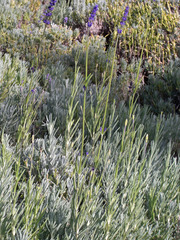 Lavandula angustifoliat0
- Treatment
- Water stresse0
- Outcome
- maximum whole-shoot net CO2 assimilation ratese0
- Direction
- declinee0
Not reportedComparator
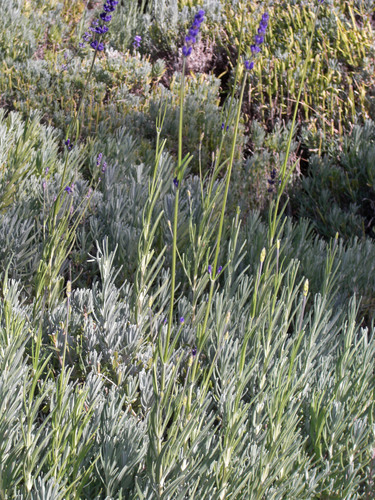
Organisms pictured · Representative pictures of the matched species, not figures from the paper.
Verbatim
e0“Water stress resulted in a significant decline in maximum whole-shoot net CO2 assimilation rates (An) for both species”
t0“rosemary (Rosmarinus officinalis L.) and lavender (Lavandula stoechas L.)”
Claim · model-written summary
Reduced assimilation under water stress was associated with reduced leaf area and stomatal conductance in both shrubs.
- Taxon
- rosemarySalvia rosmarinust0
- Treatment
- Water stresse0
- Outcome
- leaf area and stomatal conductancee0
- Direction
- reductionse0
Organisms pictured · Representative pictures of the matched species, not figures from the paper.
Verbatim
e0“Water stress resulted in a significant decline in maximum whole-shoot net CO2 assimilation rates (An) for both species that was associated with reductions in leaf area and stomatal conductance”
t0“rosemary (Rosmarinus officinalis L.) and lavender (Lavandula stoechas L.)”
Claim · model-written summary
Shoot dark respiration was less sensitive to water stress than net assimilation in the shrubs.
- Taxon
- rosemarySalvia rosmarinust0
- Outcome
- shoot dark respiration ratee0
- Direction
- less sensitivee0
Organisms pictured · Representative pictures of the matched species, not figures from the paper.
Verbatim
e0“shoot dark respiration rate (Rd) was less sensitive to water stress than An”
t0“rosemary (Rosmarinus officinalis L.) and lavender (Lavandula stoechas L.)”
Claim · model-written summary
Shoot dark respiration to assimilation ratio rose from about 15 to 95% during water stress.
- Taxon
- rosemarySalvia rosmarinust0
- Treatment
- water stresse0
- Outcome
- shoot Rd/An ratioe0
- Direction
- increasede0
- Value
- about 15 to 95%e0
Organisms pictured · Representative pictures of the matched species, not figures from the paper.
Verbatim
e0“shoot Rd/An ratio increased from about 15 to 95% during water stress”
t0“rosemary (Rosmarinus officinalis L.) and lavender (Lavandula stoechas L.)”
Claim · model-written summary
Rosemary leaf chlorophyll and carotenoid concentrations showed no major changes during the experiments.
- Taxon
- rosemarySalvia rosmarinuse0
- Organ / stage
- leavese0
- Outcome
- chlorophyll and carotenoid concentrationse0
- Direction
- No major changese0
Organisms pictured · Representative pictures of the matched species, not figures from the paper.
Verbatim
e0“No major changes in chlorophyll and carotenoid concentrations of rosemary leaves were observed during the experiments”
Claim · model-written summary
Water stress significantly lowered lavender leaf chlorophyll and carotenoid concentrations.
- Taxon
- lavenderLavandula angustifoliae0
- Organ / stage
- leavese0
- Treatment
- water-stressede0
- Outcome
- chlorophyll and carotenoid concentrationse0
- Direction
- felle0
Not reportedComparator
Organisms pictured · Representative pictures of the matched species, not figures from the paper.
Verbatim
e0“chlorophyll and carotenoid concentrations fell significantly in water-stressed lavender leaves”
Claim · model-written summary
Rosemary leaf zeatin concentration was higher than lavender leaf zeatin concentration during water stress.
- Taxon
- rosemarySalvia rosmarinuse0
- Organ / stage
- leavese0
- Treatment
- water stresse0
- Outcome
- Zeatin concentrationse0
- Direction
- highere0
- Comparator
- lavendere0
Organisms pictured · Representative pictures of the matched species, not figures from the paper.
Verbatim
e0“Zeatin concentrations were higher in rosemary leaves than in lavender leaves during water stress”
Claim · model-written summary
Whole-shoot assimilation rapidly recovered to pre-drought rates after re-watering.
- Taxon
- rosemarySalvia rosmarinust0
- Treatment
- re-wateringe0
- Outcome
- whole-shoot Ane0
- Direction
- recoverede0
- Comparator
- pre-drought ratese0
Organisms pictured · Representative pictures of the matched species, not figures from the paper.
Verbatim
e0“After re-watering, whole-shoot An and Rd rapidly recovered to their pre-drought rates”
t0“rosemary (Rosmarinus officinalis L.) and lavender (Lavandula stoechas L.)”
Claim · model-written summary
Shoot dark respiration rapidly recovered to pre-drought rates after re-watering.
- Taxon
- lavenderLavandula angustifoliat0
- Treatment
- re-wateringe0
- Outcome
- Rde0
- Direction
- recoverede0
- Comparator
- pre-drought ratese0
Organisms pictured · Representative pictures of the matched species, not figures from the paper.
Verbatim
e0“After re-watering, whole-shoot An and Rd rapidly recovered to their pre-drought rates”
t0“rosemary (Rosmarinus officinalis L.) and lavender (Lavandula stoechas L.)”
The same questions in other papers
drought · physiology: pigments · Lavandula angustifolia (lavender)Positive and negative results
1 in the opposite direction
- positive
drought · physiology: photosynthesis · Lavandula angustifolia (lavender)Results agree
1 paper in the same direction as this paper
- negative
drought · physiology: photosynthesis · Salvia rosmarinus (rosemary)Results agree
2 papers in the same direction as this paper
- negative
- negative
Claims are grouped by organism, treatment and what was measured or targeted. A paper counts as positive when any of its claims in the group is positive.