Abstract
Nitrogen and phosphorus were identified as nutrients limiting the growth of plants in an herbaceous community on serpentine soil. Potassium, sulfur and calcium additions had little or no effect. Nutrients were added, alone and in combination, to plots in the field and to greenhouse pots of serpentine soil containing the annual grasses, Bromus mollis and Vulpia microstachys. The absence of any effect due to added calcium indicates that calcium deficiency is not a universal explanation of the low primary production on serpentine soils. INTRODUCTION Wherever they are found, serpentine soils support a vegetation that differs from that on surrounding nonserpentine soils in productivity, floristic composition and often physiognomy. It is now clear that a considerable degree of variability in physical and chemical properties is found among soils classified as serpentine. Thus the phenomenon cannot be ascribed to a single cause but rather a family of causes that vary in importance from site to site. Most notable among these are low levels of the major nutrients, nitrogen, phosphorus and potassium, low levels of calcium combined with high magnesium, and high concentrations of the potentially toxic elements, nickel, chromium and cobalt (Proctor and Woodell, 1975). Serpentine outcrops are common in the California Coastal Mountains as part of the Franciscan formation (Page, 1966). Among these is an outcrop supporting an herbaceous plant community contained within the Jasper Ridge Biological Preserve. The low productivity and floristic uniqueness of this grassland has been well-documented by McNaughton (1968). The consequences of its low productivity for foliage canopy development and potential light competition were studied by Turitzin (1978). No one, however, has reported on the causes of its low productivity. The present study was undertaken to analyze nutrient limitations to plant growth on this serpentine soil. MATERIALS AND METHODS The Jasper Ridge Biological Preserve occupies half of a low-lying ridge on the eastern side of the Santa Cruz Mountains in San Mateo Co., Calif. The crest of the ridge, which reaches an elevation of 189 m, supports an extensive area of annual grassland. A serpentine outcrop, obliquely bisecting the ridge, is occupied by a mixture of annuals and herbaceous perennials. The climate is of the Mediterranean type with warm, dry summers and cool, wet winters. Plants are active from October until May. Nutrient limitations to productivity in the field were studied on experimental plots arranged in a randomized complete blocks design (Sokal and Rohlf, 1969). Treatments were applied to nine 0.25m2 square plots arranged in 1 x 2.5 m blocks that included an untreated control plot. Blocks were replicated six times. Nutrient supplements were applied on 12 January and 12 March 1975. On each occasion nitrogen, phosphorus or potassium, or various combinations were added as solutions of reagent grade NH4NO3 (28.6g m2),. NaH2PO4 * H20 (19.4g m-2) and K2S04 (18.5g m2). Calcium applied as powdered agricultural grade gypsum (calcium sulfate, 1OOg m-2) was added in January only. Aboveground biomass contained within a 0.09 m2 quadrat was harvested from the center of each plot during late April. 'Present address: University Honors Program and School of Life and Health Sciences, University of Delaware, Newark 1971 1.
Abstract from the paper’s OpenAlex record, shown for indexing and research. Copyright remains with the authors or the publisher. Read at the source ↗
The text the model read, with the source record’s inline markup (italics, sub- and superscripts) rendered and its character entities decoded; quote offsets refer to the raw text.
Claims 6
Claim · model-written summary
Nitrogen was identified as limiting plant growth in the serpentine herbaceous community.
- Taxon
- Bromus mollis
 Bromus mollise1
- Treatment
- Nitrogene0
- Outcome
- growth of plantse0
- Setting
- serpentine soile0
Not reportedComparatorDirection
Organisms pictured · Representative pictures of the matched species, not figures from the paper.

Verbatim
e0“Nitrogen and phosphorus were identified as nutrients limiting the growth of plants in an herbaceous community on serpentine soil.”
e1“Nutrients were added, alone and in combination, to plots in the field and to greenhouse pots of serpentine soil containing the annual grasses, Bromus mollis and Vulpia microstachys.”
Claim · model-written summary
Phosphorus was identified as limiting plant growth in the serpentine herbaceous community.
- Taxon
- Vulpia microstachys
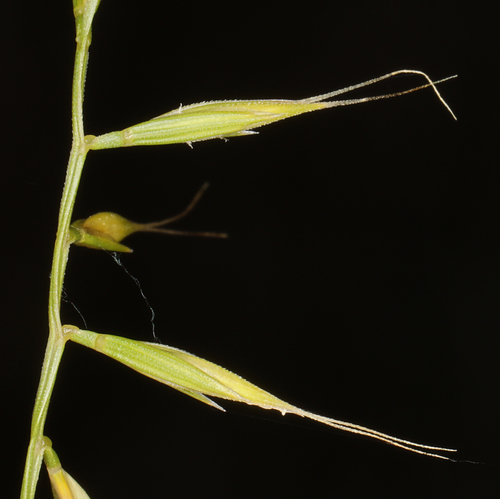
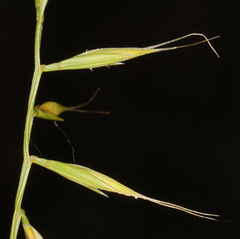 Festuca microstachyse1
- Treatment
- phosphoruse0
- Outcome
- growth of plantse0
- Setting
- serpentine soile0
Not reportedComparatorDirection
Organisms pictured · Representative pictures of the matched species, not figures from the paper.
Verbatim
e0“Nitrogen and phosphorus were identified as nutrients limiting the growth of plants in an herbaceous community on serpentine soil.”
e1“Nutrients were added, alone and in combination, to plots in the field and to greenhouse pots of serpentine soil containing the annual grasses, Bromus mollis and Vulpia microstachys.”
Claim · model-written summary
Potassium additions had little or no effect on plant growth.
- Taxon
- plantsViridiplantaee1
- Treatment
- Potassiume0
- Outcome
- growth of plantse1
- Direction
- little or no effecte0
Not reportedComparator
Verbatim
e0“Potassium, sulfur and calcium additions had little or no effect.”
e1“Nitrogen and phosphorus were identified as nutrients limiting the growth of plants in an herbaceous community on serpentine soil.”
Claim · model-written summary
Sulfur additions had little or no effect on plant growth.
- Taxon
- plantsViridiplantaee1
- Treatment
- sulfure0
- Outcome
- growth of plantse1
- Direction
- little or no effecte0
Not reportedComparator
Verbatim
e0“Potassium, sulfur and calcium additions had little or no effect.”
e1“Nitrogen and phosphorus were identified as nutrients limiting the growth of plants in an herbaceous community on serpentine soil.”
Claim · model-written summary
Calcium additions had little or no effect on plant growth.
- Taxon
- plantsViridiplantaee1
- Treatment
- calciume0
- Outcome
- growth of plantse1
- Direction
- little or no effecte0
Not reportedComparator
Verbatim
e0“Potassium, sulfur and calcium additions had little or no effect.”
e1“Nitrogen and phosphorus were identified as nutrients limiting the growth of plants in an herbaceous community on serpentine soil.”
Claim · model-written summary
The lack of a calcium addition effect indicates calcium deficiency does not universally explain low production on serpentine soils.
- Taxon
- plantsViridiplantaee1
- Treatment
- added calciume0
- Outcome
- low primary productione0
- Qualifier
- not a universal explanatione0
Verbatim
e0“The absence of any effect due to added calcium indicates that calcium deficiency is not a universal explanation of the low primary production on serpentine soils.”
e1“growth of plants in an herbaceous community”
The same questions in other papers
calcium atom · growth · Viridiplantae (plants)Results differ
3 papers in the same direction as this paper · 4 in the opposite direction
- positive
- positive
- positive
4 papers more in this group
See all 8 papers →sulfur atom · growth · Viridiplantae (plants)Positive and negative results
1 paper in the same direction as this paper · 2 in the opposite direction
- positive
- positive
- negative
potassium · growth · Viridiplantae (plants)Positive and negative results
1 paper in the same direction as this paper · 4 in the opposite direction
- no effect
- positive
- positive
2 papers more in this group
See all 6 papers →Claims are grouped by organism, treatment and what was measured or targeted. A paper counts as positive when any of its claims in the group is positive.