Abstract
Water availability is one of the main factors affecting crop production and the occurrence of drought periods is expected to increase in the context of ongoing climate change. We investigated the impact of water stress on two pseudocereal species, common buckwheat (Fagopyrum esculentum) and Tartary buckwheat (Fagopyrum tataricum). Plants were grown under greenhouse conditions under two water regimes: control (40-50% soil humidity) and water stress (<20% soil humidity). Although closely related, both species differed by their resistance to water stress. The vegetative growth was affected in F. esculentum but not in F. tataricum as water stress decreased leaf production, leaf fresh, and dry weight, stomatal conductance, transpiration rate, and photosynthesis rate in the former but not in the latter. However, chlorophyll fluorescence parameters were not affected by water stress, whatever the species, and the chlorophyll content increased in water-stressed plants in both species. Oxidative stress was observed in both species in response to water stress, and antioxidant content was increased in F. tataricum. The reproductive phase was affected by water stress in both species: the number of inflorescences and pollen production decreased, mainly in F. esculentum. Seed set was maintained in F. tataricum while this parameter was not investigated in F. esculentum due to its self-incompatibility. Our results suggested that F. tataricum was more resistant to water stress than F. esculentum and that F. esculentum had characteristics of drought avoidance, while F. tataricum exhibited traits of drought tolerance.
Abstract from the paper’s OpenAlex record; open copy licensed other-oa. Read at the source ↗
The text the model read, with the source record’s inline markup (italics, sub- and superscripts) rendered and its character entities decoded; quote offsets refer to the raw text.
Claims 17
Claim · model-written summary
Water stress reduced leaf production in F. esculentum.
- Taxon
- F. esculentum
 Fagopyrum esculentume1
- Treatment
- water stresse0
- Outcome
- leaf productione0
- Direction
- decreasede0
- Comparator
- control (40-50% soil humidity)e2
Organisms pictured · Representative pictures of the matched species, not figures from the paper.

Verbatim
e0“water stress decreased leaf production, leaf fresh, and dry weight, stomatal conductance, transpiration rate, and photosynthesis rate in the former but not in the latter”
e1“F. esculentum but not in F. tataricum”
e2“control (40-50% soil humidity)”
Claim · model-written summary
Water stress reduced leaf fresh weight in F. esculentum.
- Taxon
- F. esculentumFagopyrum esculentume1
- Treatment
- water stresse0
- Outcome
- leaf freshe0
- Direction
- decreasede0
- Comparator
- control (40-50% soil humidity)e2
Organisms pictured · Representative pictures of the matched species, not figures from the paper.
Verbatim
e0“water stress decreased leaf production, leaf fresh, and dry weight, stomatal conductance, transpiration rate, and photosynthesis rate in the former but not in the latter”
e1“F. esculentum but not in F. tataricum”
e2“control (40-50% soil humidity)”
Claim · model-written summary
Water stress reduced leaf dry weight in F. esculentum.
- Taxon
- F. esculentumFagopyrum esculentume1
- Treatment
- water stresse0
- Outcome
- dry weighte0
- Direction
- decreasede0
- Comparator
- control (40-50% soil humidity)e2
Organisms pictured · Representative pictures of the matched species, not figures from the paper.
Verbatim
e0“water stress decreased leaf production, leaf fresh, and dry weight, stomatal conductance, transpiration rate, and photosynthesis rate in the former but not in the latter”
e1“F. esculentum but not in F. tataricum”
e2“control (40-50% soil humidity)”
Claim · model-written summary
Water stress reduced stomatal conductance in F. esculentum.
- Taxon
- F. esculentumFagopyrum esculentume1
- Treatment
- water stresse0
- Outcome
- stomatal conductancee0
- Direction
- decreasede0
- Comparator
- control (40-50% soil humidity)e2
Organisms pictured · Representative pictures of the matched species, not figures from the paper.
Verbatim
e0“water stress decreased leaf production, leaf fresh, and dry weight, stomatal conductance, transpiration rate, and photosynthesis rate in the former but not in the latter”
e1“F. esculentum but not in F. tataricum”
e2“control (40-50% soil humidity)”
Claim · model-written summary
Water stress reduced transpiration rate in F. esculentum.
- Taxon
- F. esculentumFagopyrum esculentume1
- Treatment
- water stresse0
- Outcome
- transpiration ratee0
- Direction
- decreasede0
- Comparator
- control (40-50% soil humidity)e2
Organisms pictured · Representative pictures of the matched species, not figures from the paper.
Verbatim
e0“water stress decreased leaf production, leaf fresh, and dry weight, stomatal conductance, transpiration rate, and photosynthesis rate in the former but not in the latter”
e1“F. esculentum but not in F. tataricum”
e2“control (40-50% soil humidity)”
Claim · model-written summary
Water stress reduced photosynthesis rate in F. esculentum.
- Taxon
- F. esculentumFagopyrum esculentume1
- Treatment
- water stresse0
- Outcome
- photosynthesis ratee0
- Direction
- decreasede0
- Comparator
- control (40-50% soil humidity)e2
Organisms pictured · Representative pictures of the matched species, not figures from the paper.
Verbatim
e0“water stress decreased leaf production, leaf fresh, and dry weight, stomatal conductance, transpiration rate, and photosynthesis rate in the former but not in the latter”
e1“F. esculentum but not in F. tataricum”
e2“control (40-50% soil humidity)”
Claim · model-written summary
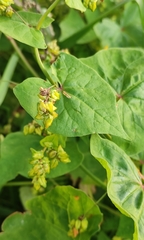
Water stress did not affect these vegetative and physiological traits in F. tataricum.
- Taxon
- F. tataricum
 Fagopyrum tataricume1
- Treatment
- water stresse0
- Outcome
- leaf production, leaf fresh, and dry weighte0
- Direction
- note0
- Comparator
- control (40-50% soil humidity)e2
Organisms pictured · Representative pictures of the matched species, not figures from the paper.

Verbatim
e0“water stress decreased leaf production, leaf fresh, and dry weight, stomatal conductance, transpiration rate, and photosynthesis rate in the former but not in the latter”
e1“F. esculentum but not in F. tataricum”
e2“control (40-50% soil humidity)”
Claim · model-written summary
Water stress did not affect chlorophyll fluorescence parameters in either species.
- Taxon
- common buckwheat (Fagopyrum esculentum) and Tartary buckwheat (Fagopyrum tataricum)Fagopyrum esculentumFagopyrum tataricume1
- Treatment
- water stresse0
- Outcome
- chlorophyll fluorescence parameterse0
- Direction
- not affectede0
- Comparator
- control (40-50% soil humidity)e2
Organisms pictured · Representative pictures of the matched species, not figures from the paper.
Verbatim
e0“chlorophyll fluorescence parameters were not affected by water stress, whatever the species”
e1“common buckwheat (Fagopyrum esculentum) and Tartary buckwheat (Fagopyrum tataricum)”
e2“control (40-50% soil humidity)”
Claim · model-written summary
Chlorophyll content increased with water stress in both species.
- Taxon
- common buckwheat (Fagopyrum esculentum) and Tartary buckwheat (Fagopyrum tataricum)Fagopyrum esculentumFagopyrum tataricume1
- Treatment
- water-stressede0
- Outcome
- chlorophyll contente0
- Direction
- increasede0
- Comparator
- control (40-50% soil humidity)e2
Organisms pictured · Representative pictures of the matched species, not figures from the paper.
Verbatim
e0“chlorophyll content increased in water-stressed plants in both species”
e1“common buckwheat (Fagopyrum esculentum) and Tartary buckwheat (Fagopyrum tataricum)”
e2“control (40-50% soil humidity)”
Claim · model-written summary
Water stress caused oxidative stress in both species.
- Taxon
- common buckwheat (Fagopyrum esculentum) and Tartary buckwheat (Fagopyrum tataricum)Fagopyrum esculentumFagopyrum tataricume1
- Treatment
- water stresse0
- Outcome
- Oxidative stresse0
Not reportedComparatorDirection
Organisms pictured · Representative pictures of the matched species, not figures from the paper.
Verbatim
e0“Oxidative stress was observed in both species in response to water stress”
e1“common buckwheat (Fagopyrum esculentum) and Tartary buckwheat (Fagopyrum tataricum)”
Claim · model-written summary
Antioxidant content increased in F. tataricum under water stress.
- Taxon
- F. tataricumFagopyrum tataricume0
- Treatment
- water stresse1
- Outcome
- antioxidant contente0
- Direction
- increasede0
Not reportedComparator
Organisms pictured · Representative pictures of the matched species, not figures from the paper.
Verbatim
e0“antioxidant content was increased in F. tataricum”
e1“Oxidative stress was observed in both species in response to water stress”
Claim · model-written summary
Water stress decreased inflorescence number in both species, mainly F. esculentum.
- Taxon
- common buckwheat (Fagopyrum esculentum) and Tartary buckwheat (Fagopyrum tataricum)Fagopyrum esculentumFagopyrum tataricume1
- Treatment
- water stresse2
- Outcome
- number of inflorescencese0
- Direction
- decreasede0
- Qualifier
- mainly in F. esculentume0
Not reportedComparator
Organisms pictured · Representative pictures of the matched species, not figures from the paper.
Verbatim
e0“the number of inflorescences and pollen production decreased, mainly in F. esculentum”
e1“common buckwheat (Fagopyrum esculentum) and Tartary buckwheat (Fagopyrum tataricum)”
e2“The reproductive phase was affected by water stress in both species”
Claim · model-written summary
Water stress decreased pollen production in both species, mainly F. esculentum.
- Taxon
- common buckwheat (Fagopyrum esculentum) and Tartary buckwheat (Fagopyrum tataricum)Fagopyrum esculentumFagopyrum tataricume1
- Treatment
- water stresse2
- Outcome
- pollen productione0
- Direction
- decreasede0
- Qualifier
- mainly in F. esculentume0
Not reportedComparator
Organisms pictured · Representative pictures of the matched species, not figures from the paper.
Verbatim
e0“the number of inflorescences and pollen production decreased, mainly in F. esculentum”
e1“common buckwheat (Fagopyrum esculentum) and Tartary buckwheat (Fagopyrum tataricum)”
e2“The reproductive phase was affected by water stress in both species”
Claim · model-written summary
Seed set was maintained under water stress in F. tataricum.
- Taxon
- F. tataricumFagopyrum tataricume0
- Treatment
- water stresse1
- Outcome
- Seed sete0
- Direction
- maintainede0
Not reportedComparator
Organisms pictured · Representative pictures of the matched species, not figures from the paper.
Verbatim
e0“Seed set was maintained in F. tataricum”
e1“The reproductive phase was affected by water stress in both species”
Claim · model-written summary
The authors infer that F. tataricum is more resistant to water stress than F. esculentum.
- Taxon
- F. tataricumFagopyrum tataricume0
- Outcome
- resistant to water stresse0
- Direction
- moree0
- Comparator
- F. esculentume0
Organisms pictured · Representative pictures of the matched species, not figures from the paper.
Verbatim
e0“F. tataricum was more resistant to water stress than F. esculentum”
Claim · model-written summary
The authors interpret F. esculentum traits as drought avoidance.
- Taxon
- F. esculentumFagopyrum esculentume0
- Outcome
- characteristics of drought avoidancee0
Organisms pictured · Representative pictures of the matched species, not figures from the paper.
Verbatim
e0“F. esculentum had characteristics of drought avoidance”
Claim · model-written summary
The authors interpret F. tataricum traits as drought tolerance.
- Taxon
- F. tataricumFagopyrum tataricume0
- Outcome
- traits of drought tolerancee0
Organisms pictured · Representative pictures of the matched species, not figures from the paper.
Verbatim
e0“F. tataricum exhibited traits of drought tolerance”
The same questions in other papers
drought · yield · Fagopyrum esculentum (common buckwheat)Results differ
6 papers in the same direction as this paper · 1 in the opposite direction
- negative
- negative
- negative
4 papers more in this group
See all 8 papers →drought · physiology: pigments · Fagopyrum esculentum (common buckwheat)Positive and negative results
1 in the opposite direction
- negative
drought · physiology: gas exchange · Fagopyrum esculentum (common buckwheat)Positive and negative results
2 papers in the same direction as this paper · 1 in the opposite direction
- positive
- negative
- negative
drought · physiology: photosynthesis · Fagopyrum esculentum (common buckwheat)Positive and negative results
5 papers in the same direction as this paper · 2 in the opposite direction
- positive
- positive
- negative
4 papers more in this group
See all 8 papers →drought · growth · Fagopyrum esculentum (common buckwheat)Positive and negative results
10 papers in the same direction as this paper · 1 in the opposite direction
- negative
- negative
- negative
8 papers more in this group
See all 12 papers →drought · physiology: oxidative · Fagopyrum esculentum (common buckwheat)Results agree
3 papers in the same direction as this paper
- negative
- negative
- negative
Claims are grouped by organism, treatment and what was measured or targeted. A paper counts as positive when any of its claims in the group is positive.